June – week 3

What is it that draws the human soul to the water’s edge, to the place where the powers of the sea attack and retreat, constantly reshaping the land underfoot?  Whether you come for contemplation, to allow the ocean’s roar to drown out the noise of a stressful life, to commune with the strange creatures of the tide pools, or do recreational surfing, there is something about the coastline that beckons to us and always satisfies.  Ask any photographer – it’s the creative possibilities along the coast that draw us there!

Watch for the incoming waves and then use them to your advantage.  Sea Weeds perched on protruding rocks will become partially submerged when the foam and edge of a wave rolls over them giving you opportunities for stunning images.  By using a polarizer or neutral density filter you can achieve a slow shutter spend in bright sunlight (1/20 – ¼ of a second).  As the water washes over and around them you will record its movement as beautiful streaks of white flowing water.

San Mateo Coastline is graced with a wonderful phenomenon called tafoni.  Italian for cavern or hollow, tafoni are the honeycombs, labyrinths and patterns of holes, ridges and hollows that are etched into sandstone.  Although they are found in a number of locations around the world, including in deserts, it is the coastal areas that make tafoni a natural artistic expression. A unique combination of coastal fog, cold ocean currents, tectonic upthrust and sandstone cliffs provide the right ingredients for this astonishing display.

Bean Hollow and Pebble beach have a large concentration of tafoni, and, in addition, small pebbles are washed up on these beaches and strewn by the tides into the various hollows of the rocks.  These multi-colored pebbles lie in the rocks as if they were honeybees resting in the comb.

Wet pebbles remain stuck on small wet sandstone ledges as the tide recedes from the coast.  If you divide your viewfinder like a tic-tac-toe board, the intersecting lines will guide you to the most interesting places to position your subject. A diffuser can be used to keep the harsh sun from making the highlights too bright, then add a gold reflector to bounce light back onto your scene.

REMEMBER to scroll down to read my recent Morocco entries if you haven’t already done so.

Posted in Weekly 2 | Leave a comment

June – weeks 1 and 2

After getting back from Morocco (see postings below) the first of June I needed to do a little catch up at work so I am offering you just two images for weeks one and two of June.

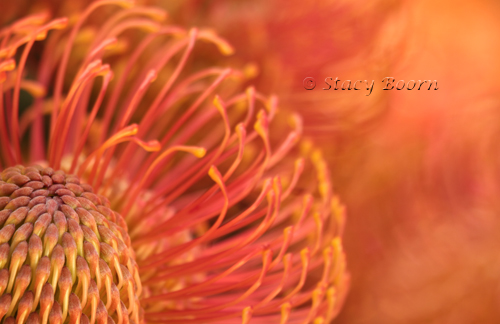
The Santa Cruz Arboretum had a huge collection of South African Proteas that are usually in full bloom beginning in mid Winter and still showing through June.  Although the grasses around them at this time of year are burning off the bushes themselves are lush.  In addition the proteas there are many other options including humming birds, rabbits and cacti.   The California native garden is very accessible.  See http://arboretum.ucsc.edu/

This image is the leucadendrons, also members of the Proteaceae (a name inspired by the Greek god Proteus, master of disguise). Indeed the leucadendrons are well-known for their dazzling variety in foliage form and color and are choice favorites of cut-flower growers. The whole blossom resembles a pincushion, which turns out to be the plant’s common name.

I wanted to capture the feel of the color of this particular orange and red round protea.  I choose to use a 100-400 mm lens at 400 with a shallow depth of field (f/5.6) so that the proteas behind the bud would quickly go out of focus.  I needed to ad  a 12mm extension tube in order to get this close.

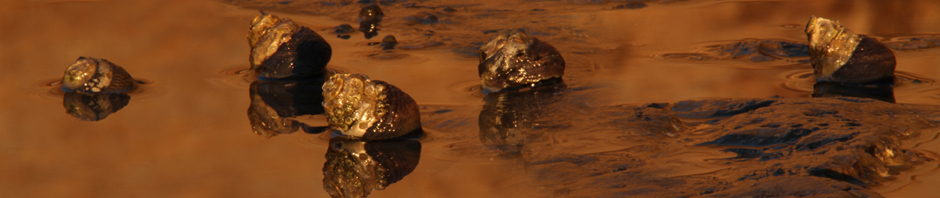
My second image is simple – sea snails at low tide.  Using a macro lens I was able to get in close to the subject.  I felt the fourth snail in the upper right hand of the image added to the composition although you often look for groups of three and five to make a dynamic presentation.

These small snails are actually slowly moving at times so I needed to keep them still while taking a 1/15 of a second exposure.  I shot at f/16 for the depth of field.  Using a diffuser to keep the light even I needed the slower shutter speed.  If you tap the snail on the top of her shell she will stay still long enough to make the exposure.

Sometimes the snail shells are inhabited by hermit crabs and they run away before you have taken your shot.  No kidding!  They may not be huge game animals, but they still move!  Occasionally, like on this particular day, I set out at low tide and challenge myself to not photograph the sea stars and anemones.  I am drawn to them so often that I over look all the other gems!

Posted in Uncategorized | Comments Off on June – weeks 1 and 2

May Week 5 – Morocco


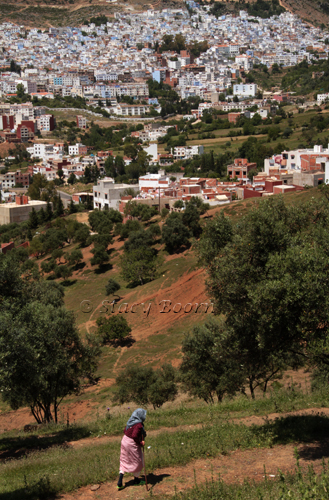
From Fes our group traveled through the Rif Mountains north to Chefchaouen.  This town nestled into a hillside is made up of blue and white washed buildings, narrow streets, elaborately decorated doorways and a Mediterranean flavor.  Although not on the Mediterranean, it is as close as we got.   Founded in 1471 by descendants of the prophet Mohammad a larger wave of Muslims and Jews expelled from Spain arrived in 1492.

Although this town is known for it’s friendliness it was still  a difficult place to include people in your photographs.  Some decades ago people flocked here to get their supply of hashish grown locally since the 15th century.  It is fondly referred to as “Kif” which is the Arabic word for pleasure.  Although many members of our group were asked if they wanted to purchase some or go out to the “farms,” I happily was not solicited.

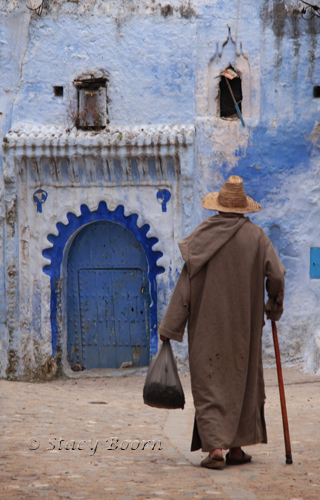
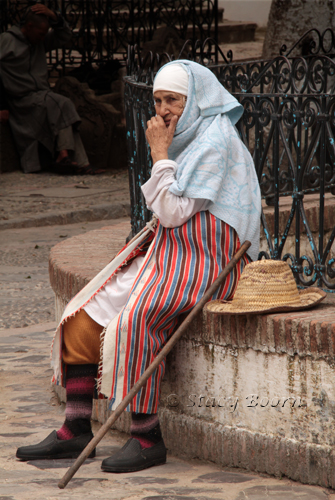
As we entered the medina, walking from our hotel the Dar Chefchaouen, we crossed the Wadi (river) Laou where women carried carpets for washing along with piles of laundry. Obviously very hard work! It was warm but not hot here and made walking up and down the hillside streets very pleasant.  We didn’t need a wool jellaba, which are made here.  We also saw women with the traditional red and white striped frabics tied around their waist over their other clothes.  These are worn by the Jebala tribe.

At the town square across from a Kasbah and Museum members of our group sat at out door café  tables watching the people.  Men in jellabas sat care-free out side the Kasbah and Grand Mosque for hours talking, laughing and reading the newspaper.  Occasionally we would take their pictures without them waving us off.  The square is an intersection of many streets and peoples in the center of town.

The Coca-Cola delivery was made via donkey while children played in the beautiful arch ways and near the age old blue painted and tiled fountains where a community cup was supplied for drinking.

After two long days in Chefchaouen we returned to Casablanca via the capitol Rabat.  We enjoyed a farewell dinner and the next day beginning at 3:00 AM the members of our tour began their trips home or on to other destinations.

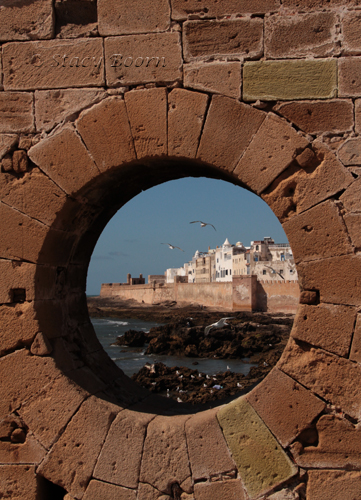
Sqala de la Ville from Port

But Chris and Maureen and I continued on with Ishmael (our guide) in a van with driver Jamal.  Our plan was to photograph for five more days between Casablanca and the Atlantic coast town of Essaouira.  We were hoping to photograph people riding donkeys, women shepherding flocks of sheep, fields being harvest and small town activities.

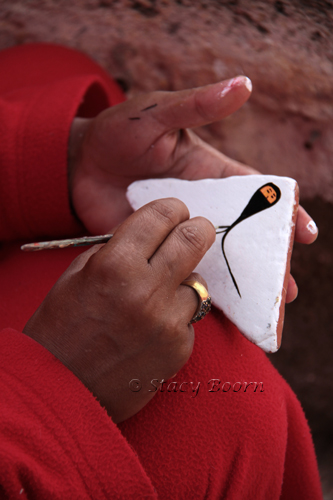
In hind site we didn’t really need a guide and for some reason didn’t have access to the driver and van for the entire time as was scheduled.  Although Essaouira came highly recommended by Strabo Tours it is primarily a destination for tourists who want to lounge on the beach and shop for silver and art.  Lovely as it was we could have captured its quaint fishing boats and markets in a day and a half.  Ishmael did introduced us to an artist who set up shop to demonstrate for us her craft, especially painting pieces of clay roof tiles into women in the haik.

Artist paints woman in haik

This town is a bit more conservative than others and you will see many women covered from head to toe except for their eyes.  They are wearing the traditionally haik.  Outside of the medina on the ocean side you find many modern homes and businesses.  It is obvious that Essaouira is a weekend destination for Moroccans.  Families were enjoying the camel rides available on the beach.  The Moroccan woman are fully clothed at the beach while men and children wear bathing suits.

Our three nights were spent in the ornate Riad Al Medina.  Chris and I only had to climb 50 stairs to our rooms while Maureen had 66 steps.  A riad is a traditional residence organized around a courtyard which usually has planted trees or flowers and fountains.  From its name Al-Medina you can tell it is in the old city (medina) which was only a short walk to the harbor.

A better plan would have been to go straight to Essaouira for a couple of days and then spend three or more days back in Marrakech where we had hardly scratched the surface of all the photographic opportunities (city walls, gates, tombs, markets, gardens, palm groves).  I guess I did not get my fill of the snake charmers and had hoped to walk through La Palmeraie, the famous palm groves while seeing the distant High Atlas Mountains in the background.  But we spent three days  beneath the seagulls and among the spice souks.

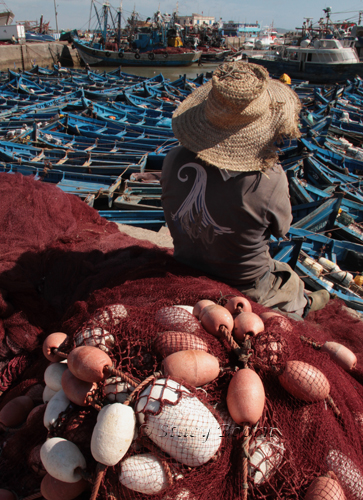
Although most of the boats in Essaouira off loaded a ton or so of fish you also see women selling a few sardines they had caught in the harbor with their buckets. All of the family owned boats were painted blue and tied together when not in the open waters. Although our meals were all paid for at the riad, Chris and I ate a meal at the harbor where you pick out the fish you want and it is immediately grilled for you.  I loved that lobster, king scrimp and calamari!

Essaouira became known as the port of Timbuctu in the 18th century when 40 percent of the Atlantic traffic passed through.  I have shared more of my encounter with the culture, people and land than my photographic techniques.  But hopefully you see them in the images here and those yet to come in my Moroccan portfolios. Wakha?  (Arabic for “okay.”)

Posted in Weekly 2 | Leave a comment

May week 4 – Morocco

Traveling south of Erfoud we left our comfortable bus and wonderful driver Tommy behind.  Carrying only a small overnight bag and camera equipment we boarded land rovers to get to our next destination: the edge of the Sahara.  I would have loved to drive this terrain – no roads and the challenge of sand and rocks and lots of bumps.  As we headed out to the edge of the dunes of the desert it begins to feel like  setting foot into a centuries old route.

This part of the desert was in central western Morocco.  The southern part of Morocco is all desert but there are some border disputes with Algeria for that land.  In fact as we neared this finger of the desert written with stones on a hillside are the Arab words “The Sahara is Ours.”  Our two days here were supposed to be spent in Berber tents.  These are made of wool pieces of cloth.  But bad weather – rain and high winds – made it impossible to stay at the encampment.  So the next door Kasbah put us up. (hurray!)

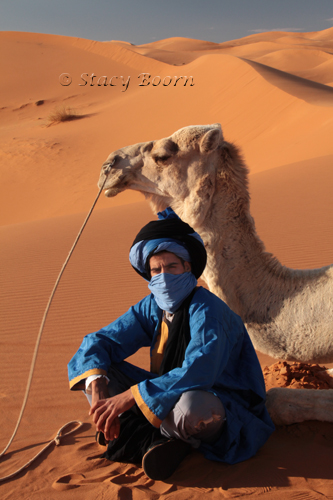
When you walked out the door of the Kasbah you were in the dunes.  Part of our journey there included a camel ride in the evening for the beautiful light on the dunes.  I was not looking forward to this, remembering my camel ride with a 12 year old boy in Pushkar, India.  He made that camel gallop as I pleaded for him to slow down.  Deborah Hall laughed and the boy assured me “It will be alright Mama…”  Don’t mama me!

This dromedary in the Sahara was very gentle.  Although mine was mountain sized, because the skinny people get to ride the little ones who are lower to the ground.  Our camel drivers were all enjoying themselves as models for us in the dunes.

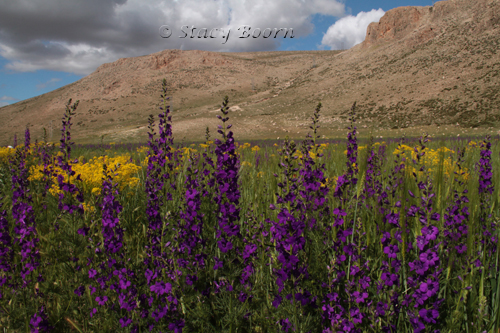
Then on the way to Fes, which is considered the “most completely Islamic medieval city in the world” we traveled through the high Atlas Mountains.  It is like the Grand Canyon and on the high plateaus we stopped to photograph the wild flowers. When I post the Morocco portfolio I will include our lodging in Fes.  The tile work was exquisite and it was located in the Medina (old city).  This city is the symbolic heart of Morocco with its 15,000 streets in the medina on which many of the goods can only be transported by donkey or hand kart.

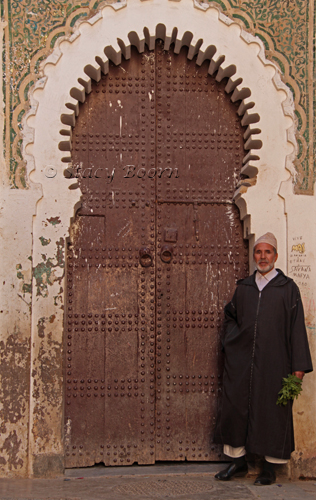
Almost every little alley or walk way you look down has marvelous doors and tall stone walls.  Often the doors you are walking by are the entrance ways to the mosques.  Here you encounter men sitting and chatting, talking and laughing, and sometimes singing and praying. At times we needed to squeeze past the shoppers to continue our walk from one brilliant color to another, one covered market to the next.

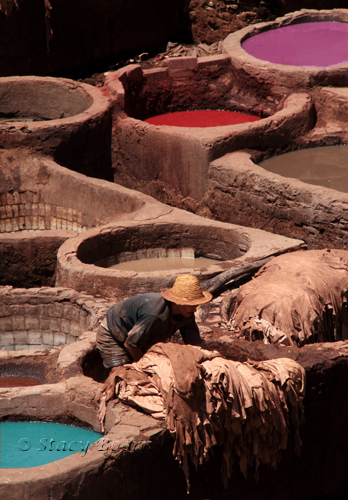
We walked to the famous tannery where we climbed three stories to over look the block long, hundreds of connected round vats where camel and other animal skins were dyed. Some of these vats have been used for centuries.  Before the dying process area are the vats that use a solution to turn the skins into leather.

All the dyes are made from natural pigments.  Red comes from the poppies, green from the mint…etc… The tanners worked with their feet and whole bodies in the vats making sure the dyes covered the materials.  Usually the smell of the tanning solution and dyes is so strong a visitor is recommended to stuff some mint leaves in her or his nostrils. But not too bad the day we visited.  In the show rooms you find the famous Fes slippers and leather bags and garments.

I don’t think we would have found our way to the Royal Palace, the souks and the tannery without our guide Ishmeal.  Along the way he stopped to explain things like the numbered 3 feet by 5 feet rectangles on the walls in the alleys.  They are assigned to political candidates. The name of the party and an image (like a running facet or a eye or scale) are symbols for the candidates running for various offices.  A symbol is used especially for those who can’t read.

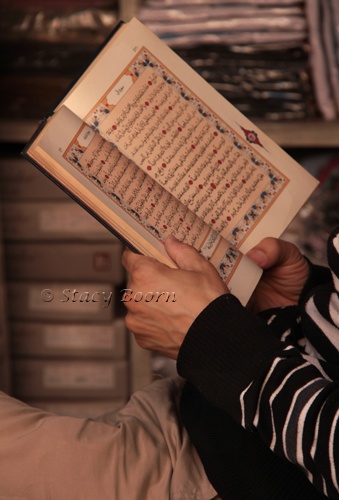
Often peering into a vendor’s stall you will see the merchant reading the Koran with its stylized calligraphy.  Carpets are often spread out on terraces.  And heaping portions of spices, olives and fruits are displayed in colorful triangular mounds.  Everyone wears his or her jellaba when walking the narrow streets.  Here you find them made out of wool.

One evening we went to the hillside 16th century Merinid Tombs, which are surrounded by blue agave plants, to over look the city.  As many streets as there are in the medina of Fes it is likely that they are out numbered by satellite dishes on the top of the houses and riads and shops.

Man in wool jellaba - Fes

From a distance we saw the green roofed  Karaouiyine Mosque established in 859 situated in the middle of the medina.  As you walk by the  mosques in the medina you don’t realize it because of the narrow winding nature of the streets.  This mosque is not open to non-Muslims.  Friday prayer takes place in both small and large mosques which stand as a religious and cultural symbol from which comes five times a day the call to worship.

Fes is also known for its pottery (especially painted and blue  and multicolor on a white base.)  Next is Chefchaouen – a city with blue washed houses.

Posted in Weekly 2 | Leave a comment

May week 3 – Morocco

Sometimes when you are traveling you forget to focus on the details because the grander scenes are so breath taking.  As we drove into and through the Atlas mountains the oases along the river valleys that gorged the mountains were stunning.  Although most of the time the bus could not pull over to allow time for panorama photographing. This route also led us past the “movie sets” where all of a sudden Egyptian pharaohs and scenes from the Queen of the Nile rose in the distance.

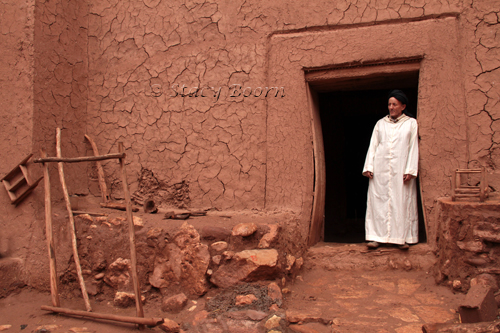
We stopped at Ait Benhaddou which is one of the best preserved Kasbahs in the Atlas region and was the set of Lawrence of Arabia and Jesus of Nazareth.  Once occupied by a hundred families less than ten remain.  One of the residents enjoyed modeling his jellaba in his door way.  So afterwards we passed the hat and everyone contributed a 10 dirham coin (worth about $1.50).

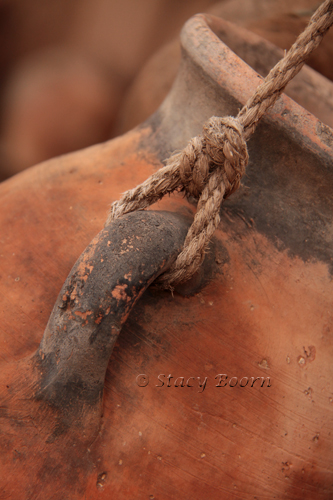
After photographing here we headed to our own renovated Kasbah (fortified house with one or four crenellated towers) for lodging. This was a great spot to include the details of the culture.  I was especially attracted to a pile of clay and wooded bowls, pots and water pitchers which I think were meant to be sold to patrons.

Usually you want to avoid something coming directly out of one of the corners of your image – but once in a while it works best this way.  I think that is the case for the rope that is holding this jug to a wooded post.  The early morning overcast helped vitalize the earth tones. Purposely I used a relatively shallow depth of field so the shapes of the other jugs in the upper left hand corner are barely detectable (in focus they would have been distracting, but without them the white sky would have been to distracting and bright)

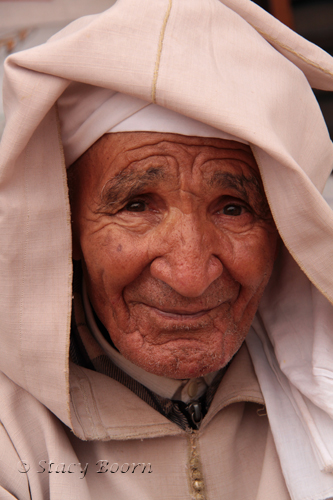
There are just too many days and images to share with you in this blog entry, so watch for my portfolios and slideshow.  At Tinerhir we walked around the markets.  I photographed a couple of men in their hooded jellabas.  One of them was happy to have me make his portrait.  And he only asked for 10 dirham.

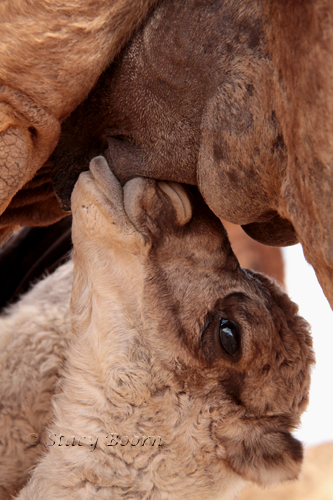
Along the way the bus pulled over to present us our first group of camel “models” and the added treat was a baby camel, even better when she took a drink from her mother.  The sky was so white and bright I choose to get in as close as possible to illuminate as much of it as possible. These camels were tended to by Berbers (early inhabitants if Morocco – with mixed origins/three distinct groups.  Often they are nomadic and know for their trading activities, rugs/carpets, and tribal ties).

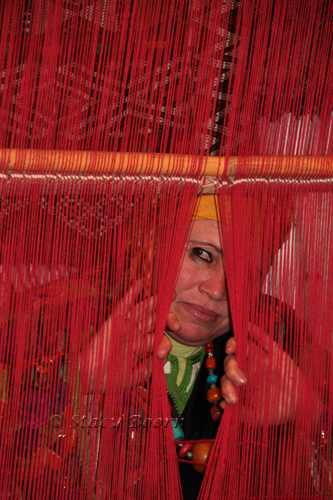
The methods used by the Berbers to make camel hair and other styles of rugs/carpets were demonstrated.  The woman at the loom occasionally peaked out from between her strings.  I especially like this shot with only one of her eyes and it is playfully looking off in wonder.  Of course I was convinced to buy a rug – the embroidered style.   All of the colors are from dyes made with natural and organic ingredients, such as poppies for red and mint for greens.  When I got it home it needed a good airing out.

Here is where being on a tour probably helps – letting the company know we are coming. The weavers and sellers all dressed in their cultural clothing and didn’t turn away when we photographed them.  Sometimes they were a little corny but that was all part of the “dance.”  Of course mint tea, more than half sugar, was served.  We photographed at least three staged Tea pouring ceremony.  The server must be able to pour the tea from the silver pot to a glass cup.  Not just pour the tea – but from over one’s head allowing it to cascade but not spill.

Like everywhere you bargain, for your price – oh, I don’t like this.  I settle all too early.  I had to choose a carpet with purple/blue in it – the most costly color!

My next glimpse of Morocco will include the trek into the Sahara Desert.

Posted in Weekly 2 | Comments Off on May week 3 – Morocco

May – Week 2 – Morocco

King Hassan II Mosque Window

On May 12th with friends Chris Kibre (AWE Gallery artist) and Maureen McGettigan, I flew from San Francisco to JFK to Casablanca, Morocco.  There we joined nine other photographers and leader Brenda Tharp for a two week photo tour produced by Strabo Tours. Brenda’s partner Jed Manwaring, also a photographer, was part of the journey along with Ishmael the local guide.

This was the first time I traveled with a group of photographers overseas.  That alone made it a challenge.  “Am I in someone’s viewfinder?.”  “Is that guy’s elbow in my picture again!”

The focus was on “creative travel photography.”  I found it difficult to  put the amount of time into each shoot needed to capture the dynamic image I could see in each location.  This was also due to the fact that many people, after asking them, did not want their pictures taken.  I don’t think this was only because it is a Muslim culture.
I will let you know when I have posted the portfolios from this trip. I took some 5,000 captures.  Did I really need those 200 images of a single tea ceremony?  I, unfortunately still act like a film shooter – thinking that pushing an ISO higher than 400 degrades your images.  With moving subjects going to ISO equivalents of 800 – 1,200 should be done.  Can’t say I did it though.

I am expanding my weekly two to be a weekly four or five.  My travel equipment was a Canon 7D, a 10-20mm, 18-200 and 100 – 400 mm lens.  I took a tripod because we were able to leave things safely on the bus or in our Kasbahs, Riads and hotels.  I could have gotten by with the 18 – 200 mm lens only.

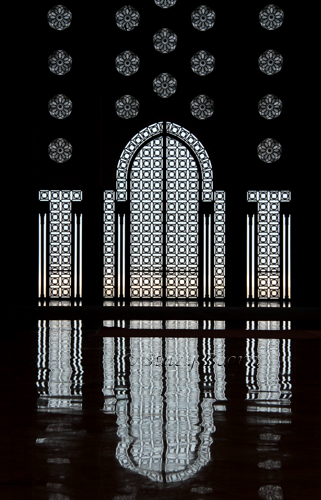
Our first stop was at the King Hassan II Mosque in Casablanca (image 1).  This huge edifice is the largest mosque after the one in Mecca and its construction was funded by all citizen donations.  You can only tour the facility with one of the appointed guides.  There are only two mosques open to non-Muslims in Morocco.
Marrakech Night Market

I was surprised that our photo destinations did not include any of the other thousands of mosques that are prominent throughout the whole country side and cities.  This Mosque was completed in 1993 and truly is a show piece.  It reminded me that we dare not question the validity of any religion – could something so beautifully created by its devotees be intended for any thing other than honoring the Holy One and calling humanity to prayer and peace?

No tripods were permitted inside.  So I used my camera bag to rest my camera on while taking a beautiful latticed window and its reflection on the floor.  You don’t have to worry about the high contrast with this kind of image because that is what makes it pop!

Marrakech a three hour or so drive on a wonderfully maintained highway was our next stop.  The square and the markets (souks) were crowded with locals and tourists winding through the smells and activities.  The souks are stalls that offer just one item:  shoes, spices, nuts & dried fruit, meats, olives, silk, breads, jellabas…etc.  The jellaba is the wide sleeved hooded garment worn by both men and women

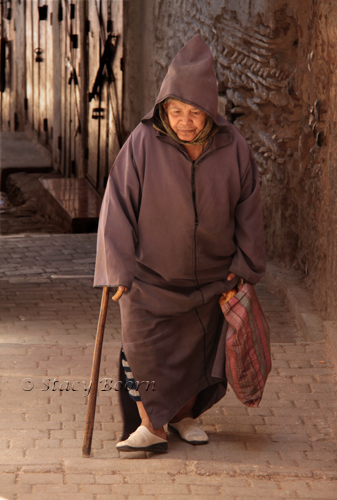
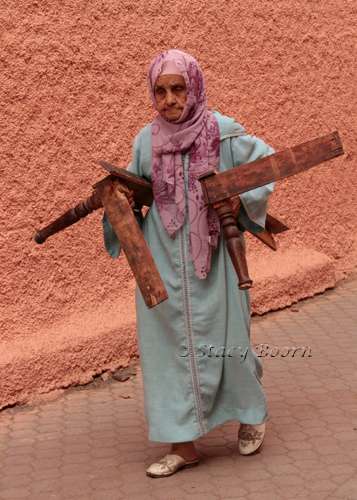
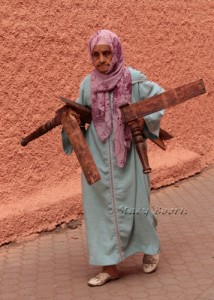
The jellaba, in various colors and designs, is what makes the people pictures so focused and colorful.  In several locations I found a great background and waited around for someone in a jellaba to be the complimenting subject.  I was happy with the image included here of the woman carrying her bed frame (image 2 above).  It also reminds me of how much physical work the women do every day!
Entering High Atlas Mountains

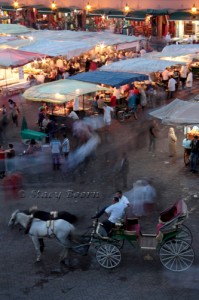
The Marrakech square is bustling with shoppers, carriages, motorcycles around the edges while tarps connect the” cook houses” and refreshment sellers. (image 3 above)  A mystical feel comes upon this area at dusk and evening when the smoke ascends above the strung lights.  Thanks to Brenda for bringing us to a rooftop café to capture the aura of the square.  Here the use of a tripod made the world of difference allowing me to use a slow shutter speed to capture a blurred swirling mass.

It is like traveling back in time in Marrakech with the snake charmers, fortune tellers, acrobats, dancers, and children selling tissues while an adult waits to collect their earnings.

In retrospect I would have gone back to Marrakech for a couple of days in our 5 day extension.  We did not have time to even scratch the surface of the photographic wonders there (the gardens, the palm grove, the royal palace, the gates, the city walls…etc.).  The Medina (old city) had snaking streets lined with wares beyond your imagination, musicians and the smell of candy and sizzling meats!

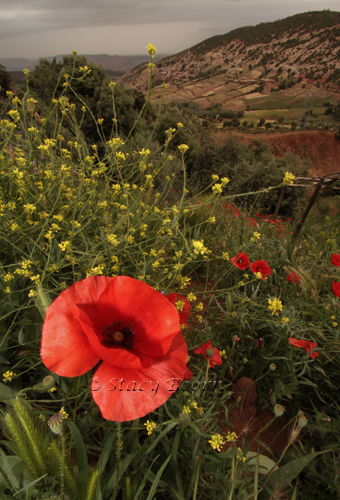
Leaving Marrakech we headed into the High Atlas Mountains on the road to Ait Benhaddou.  Here I used my 10-20 mm lens to get a sense of the expansive hillsides and its vegetation (poppies, mustards, olive trees).

I will add the next Morocco segments shortly.
Posted in Uncategorized, Weekly 2 | Comments Off on May – Week 2 – Morocco

May week 1

It is always a hard choice which location to choose when it isn’t breezy and it is also low tide.  I headed for the poppies but took a detour to the mussels on the rocks along Tomales Bay (Point Reyes).  At a negative tide you can find lots of mussels clinging to the coastal rocks.  At Shell Beach they are often a beautiful blue with small barnacles on them.

With tripod, a 100 mm macro lens and a diffusion disc I set up shop.  Kneeling in the sand makes a comfortable shooting position.  Since my meter was on the black and deep blue colors of the mussels I used my exposure compensation and dialed in -1.5.

You can get lost in time while checking out every little grouping of mussels and sea weeds.  Therefore on my return I had to go ankle deep in the bay around the last corner of the beach. Usually I like to arrive at a location one hour before the tide is at its lowest. Fortunately the bay side is a calmer incoming tide.  So take a buddy!

Whenever I see old farm houses I wish I wrote poetry because it seems like endless inspiration is oozing out from the old boards and moss covered corners.  My poetry is to find an angle to create a photograph.

You would think I was talking about a sepia image or some monochrome eerie capture.  Nope, I still want vibrant colors to contrast the present state of the farm house history and the natural world around it.

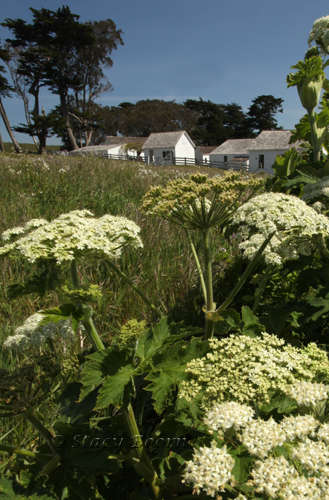
So using a wide angle lens from behind a gorgeous clump of blooming cow parsnip I set out to capture the “Old Farm  House.”  This one is at the end of Pierce Point Road in Pt. Reyes, National Seashore.  It reminds me of part of a poem I recently read, referenced below.

The Old Farm House by Wolf O’neill Mitchum

The old farm house stood
by the side of a nameless road,
it’s occupants gone to a better home
a better place, a new abode,

it’s windows were borken
and it’s roof was caved in,
and i stood there and listened
to the whispering wind………

…….leaving this old farm house
to it’s loneliness and decay,
to be rediscovered by a stranger
passing by on his lonely way,

all this and more
moved through my restless mind,
as i gazed at that old far house
standing alone in eloquent silence, sublime…


Posted in Weekly 2 | Comments Off on May week 1

April Week 4

When the April winds are gusty along the California coast it is very difficult to capture all those beautiful wild flowers.  So one must consider very solid or stable nature subjects like rocks.  Fortunately the rocks I choose surfaced at low tide teaming with a variety of life clinging to them.

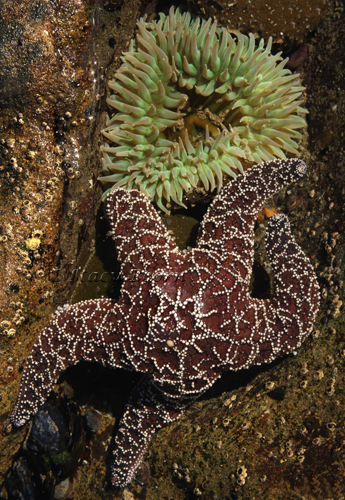
The Ochre Star is a wonderful subject at low tide and you will often see them near mussel beds since it is one of their sources of food.  I prefer mine steamed, thank you!  They can be orange or purple or brown. When the tide goes out, their skin and arms become stiff and hard, for protection from predators. Occasionally they will get stranded on the sand and then they can be easily moved into your “frame.” without hurting them.

Usually for low tide photography, as mentioned a couple of weeks ago, I like to carry as little equipment as possible so I don’t’ accidentally knock it into the water.  Often you need some sort of diffusion for tide pools to eliminate some of the reflections and glare on the water.

But if you arrive in the morning when the sun is still relatively low you might be able to get a good angle on a shallow tide pool. (As you see here).  Use your polarizing filter to reduce as much reflection as possible.  Look for shallow tide, perhaps where the sea star is not fully immersed.  The sun also gives the giant anemones their neon green look.  You get this angle best at being pretty low to the ground/water, so a gardening kneeler is helpful for your knees or tushie.

The giant green anemone is one of the most spectacular animals you can find in the tide pools along the Pacific coast. Giant green anemones live on the rocks of tide pools and in deep channels on exposed rocky shores. They can also be found on concrete pilings in open bays and harbors. From Alaska to Panama, these anemones flourish in the intertidal and sub tidal zones. These large anemones like to eat detached mussels, crabs, sea urchins and small fishes. Their predators include sea snails and sea spiders.

I also returned to a patch of Calla Lilies in Golden Gate Park.  Arriving at 6:45 AM it was still pretty calm, but by 7:30 they were really dancing in the breeze.  I wanted to keep my shot a Monochrome image so I just chose that setting on my camera.  Sometimes I de-saturate a colored image to get a black and white.  But this method is quick and you immediately see if it is working as a black and white.

With this image I wanted the edges to look as crisp as possible so in post possessing I applied the artistic filter “accentuate the edges.”

With all my images I ask, “Would I make this a print?”  I am not sure about this monochrome calla lily detail, so I will have to give it a try.


Posted in Weekly 2 | Comments Off on April Week 4

April Week 3

The flowers, scents and music filled the sanctuary this morning at herchurch in San Francisco.  And as adults and children chaotically gathered around a cross made from the trunks of old Christmas trees they transformed it from a symbol of death to a symbol of life.  Tulips, Calla Lilies, Iris, Hyacinth, gladiolus, roses, orchids. jasmine, daffodils and other flowers were placed in the hundred or so two inch stables.

Yes, out of chaos came beauty, as from the tomb came life. Organ music, a brass quintet and a women’s drumming circle added sacred sounds to the holy proclamation – that the Christ-Sophia is risen.  Mother earth again shakes and trembles and surprises us by bursting forth with life after times that seemed lifeless.

Again close to the earth and ocean this week I felt the life of the great mother bursting forth in multiple colors.  The first images that transported me into great joy were among the poppies blooming abundantly at Abbotts Lagoon in Pt. Reyes National Seashore.  Indeed, they blossom forth in golden beauty and dance and play in the wind. These are Coastal Poppies.

If you start fairly early in the morning you can see the poppies move from their closed state to opening fully as the sun coaxes them to unfurl.  Usually the fog of the night before is still providing water drops.

I was particularly drawn to a poppy that had just one petal left after obviously be chewed up by some sort of bug.  But it was not to be passed by because the shape was beautiful and the center gorgeous.  I chose a shallow depth of field, using a wide open aperture (f/2.8) to render most of the image soft or out of focus.  The extra yellow glow is the result of my 100 mm lens catching pieces of poppy petals close to it.

“Flowering within us this Eastertide: that, opening to new life, we leave death behind forever.  Tender of the Gardens of our Souls, Ephemeral One, You are the Perennial who brings us into life eternal.”  -Rev. Kathleen Speegle Schmitt, from a portion of an Easter prayer in “Seasons of the Feminine Divine.”

The second image is at low tide in Pescadero, CA.  The emerald sea grasses stretched out like waves on the beach make for some wonderful lead in lines to the ocean and the distant horizon.

Fortunately a rock crab was enjoying her day on the beach.  Using a wide angle lens I was able to get this grand vista.  With a 3 stop graduated neutral density filter I kept  the details in the bright clouds from blowing out.  I used a 10mm lens on my 7D which renders the lens a 16.5 mm equivalent.

A small aperture (f/22) provides for a great deal of depth of field (that which is in focus from the closest to the farthest points in the image).  You can view some of my other coastline favorites in my portfolio called “At the Water’s Edge.”

Thanks to Leila France (1917)  we can sing the California Poppy Song:

  • Poppies, golden Poppies, gleaming in the sun.
  • Closing up at evening, when the day is done.
  • Pride of California, flower of our state.
  • Growing from the mountains, to the Golden Gate!
Posted in Weekly 2 | Leave a comment

April week 2

Up until this point I have had no Calla Lilies in my portfolios.  Maybe it is because once you have seen the Robert Mapplethorpe collection you begin to wonder if you can produce anything as original and as beautiful as his images.

Yet every year I see the islands of calla lilies throughout Golden Gate Park, along the costal roads, near the farm lands and in my neighbors’ backyards.  “This is the year,” I say.

I love my subjects outside so I am not going to do studio set ups at this point in life.  But that would provide a better lighting system to capture the pure white of these dazzling monoliths.  Each edge is like a new dance that moves one erotically into the subject.  No wonder Mapplethorpe photographed both the human figure nude and the calla lily – they share a common soul.

Thursday morning, past, was very calm from 7 AM – 9:30 so it was possible to work among the Callas. (Golden Gate Park).  The overcast day made for a nice muted light. I chose natural lighting and to allow the slight reflection of green from the large leaves to be a part of the image.

Using a 400mm lens with extension tubes (allowing for a closer focus) I was able to isolate parts of the flower and the background.  Without a breeze I could shoot with my aperture at f/32 for as much depth of field as possible at 400mm.  Another time I will check out the “Photoshop technique for “multiple focus stacking.”  But capture and convey the image in camera if you can!

This is Holy Week in the Christian Calendar which provides an apposite time to think about the Calla Lilies and their role as a symbol of the coming Easter/resurrection/rebirth or the Lily of/as the Goddess and her incarnation, in say – Mary Magdalene!

Along the Sonoma Coast the invasive non-native ice plant is very prolific and coming into full bloom.  Despite the fact they conquer the lands and dunes of natives and choke them out – they are so beautiful.

Go WIDE!  You can get the flowers in the foreground and the whole coastline in the background.  Late in the afternoon or early evening provides great light.  But I was there more towards high noon and it still worked.  At this time of day you don’t have to worry too much about getting your own shadow in the image.  If you don’t know what hyper-focal-distance is – it is time to learn.  Sign up for my next class.  See:  AWEgallery EVENTS.

Posted in Weekly 2 | Comments Off on April week 2