July week 4 – Fiery Ball of Light: Magical and Mystical

The Sun is the star found at the center of our Solar System. The Sun’s surface temperature is around 5500 degrees Celsius (9941 degrees Fahrenheit) and  the core is around 13600000 degrees Celsius. Light from the Sun reaches Earth in around 8 minutes. But no mater how many facts we know about the Sun it remains for us magical and mystical as it “sets” and “rises” before us!

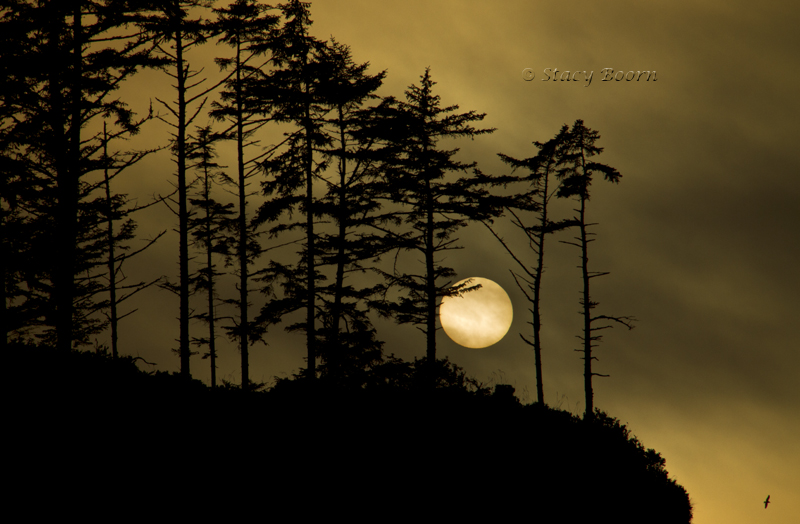
July 4 - Sunset Couple WEBFog gently ripples like curtains covering the setting sun and providing a glimpse at its “shape.” Because of the Sun’s huge influence on Earth, many early cultures honored the Sun as a deity. For example, Ancient Egyptians worshiped Ra while in Aztec mythology the Sun Deity is named Tonatiuh.

July 4 - Fog Sun WEBThe “Canticle of the Sun”, also known as the “Laudes Creaturarum” (“Praise of the Creatures”) by Saint Francis of Assisi, calls the sun our brother and the moon our sister. But I prefer to see the sun as another beautiful mother!

July 4 - Sunset Beach WEBFiery Ball of Light
You release and offer the energy
needed to nourish our spirit and universe
 
You awe us with wonder and comfort
as the splendor of your creative powers
blanket us warmly in dreams of tomorrow
 
Let us not underestimate your presence
regenerating the life forces
within and around us
 
Movable
Immovable
Wisdom of the Ages
Mother Sun
Shine on!
Poetry © Stacy Boorn, July 2014

Posted in Weekly 2 | Tagged , , | Comments Off on July week 4 – Fiery Ball of Light: Magical and Mystical

July 3 – translating minimal stuff into something monumental

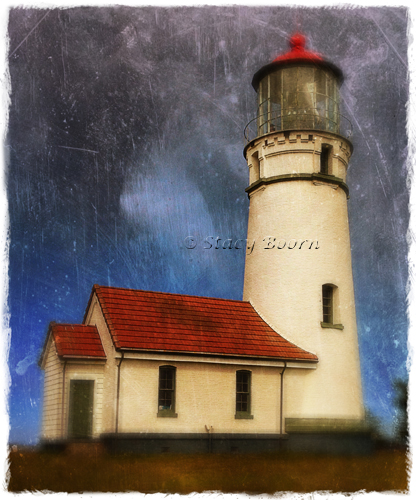
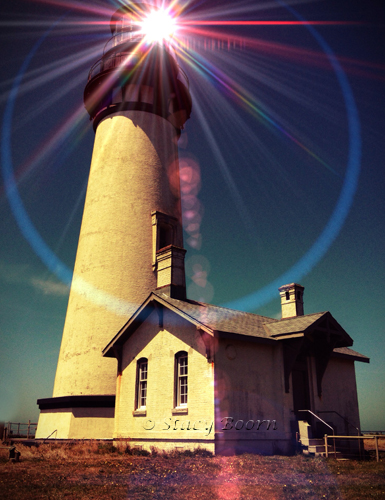
July 3 - WEB Cape BlancoAs a child I loved to visit the lighthouse in Cape May, New Jersey. It seemed to tower into the sky, practically touching the moon. In fact, on July 20, 1969, after walking in the shadow of that lighthouse looking for Cape May diamonds (ocean-tumbled quartz), my three grandparents, parents, two brothers and I crowded together in a small cabin and, in amazement, watched the broadcast of the Apollo 12 moon-landing on a little black and white television.

The room was lit only by the TV and the beacon of the lighthouse as Neil Armstrong took those small but giant steps on behalf of us all. Perhaps this is why I continue to think of lighthouses as projectors of awesome possibilities.

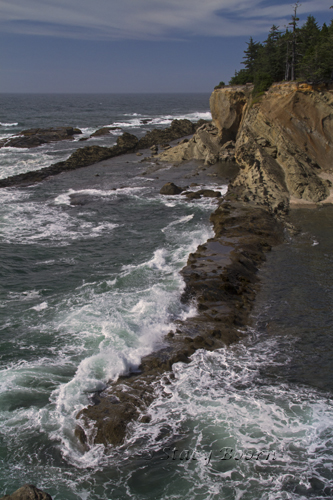
July 3 - WEB ShoreAcresEach light house is a depository of significant stories and tales of service, though perhaps not as historically ground-breaking as the moon walk. Yet, as you climb their spiral staircases to the tower watch or lantern rooms, it only takes a little imagination to get a feel for what it was like for the early light-tenders. That was my experience this past week on the Oregon coast. Built between 1870 and 1896, these lighthouses are located on prominent headlands near bays and ports that supported commercial fishing and shipping, including the gold rush and lumber routes.

Most of these structures were made from local bricks, and each took a unique form. There are nine surviving lighthouses on the Oregon Coast whose oil-fueled lights were all converted to automated beacons in the 1960-80’s. Lighthouses like the one at Cape Blanco near Point Orford was originally only approachable via the sea. So the light-tending family would often not have relief or fresh supplies for six months at a time. What stamina! After camping for just 6 days, with flush toilets, I was ready to call it quits and head home.

July 3 - WEB Yaquina HeadLighthouses and the rugged coastlines are, both literally and metaphorically, bastions of strength. They have taken the beatings of waves and wild weather and still provided a life line to those in danger. This is a symbol that is universally meaningful. When death tolls mount in Gaza, commercial planes are downed by terrorists in the Ukraine, protests grow over tens of thousands of children seeking asylum at our southern boarders, we want – and need – beacons of light providing signals of guidance and hope.

Maybe the lighthouses are also reminders that people, much like us, are responsible for keeping rays of light shining so that those in peril might finally make their way to safer conditions and a welcomed shore!

My images this week are meant to bring you a glimpse of the beauty of the Oregon lighthouses and their surrounding shorelines as well as challenge you to think of the ways you will be a shining light of hope and healing. Our small steps and acts just might be translated into something monumental.

(Images – Cape Blanco Lighthouse, Shore Acres Coastline, Yaquina Head -Newport).

Posted in Weekly 2 | Tagged , , , , , , | Comments Off on July 3 – translating minimal stuff into something monumental

July Week 1 – Red, White and Rose, all Americana!

Almost every city and town has one. It can be very elaborate and cared for by a team of professional gardeners, or it may be the product of a community group or a single individual. Of course I am talking about the “rose garden.”

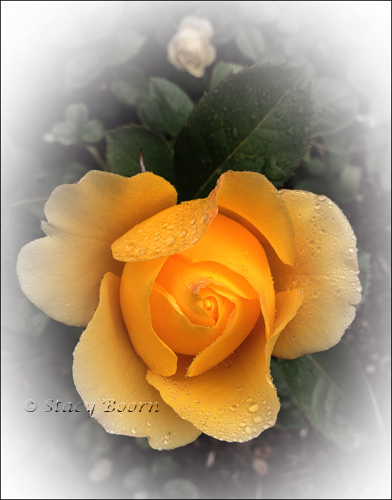
Rose - Walking on Sunshine

Rose – Walking on Sunshine

In my estimation, the rose garden in my hometown is one of the largest and most beautiful. Schenectady, New York, has less than 66,000 residents right now, and it is a typical old East Coast city in decline. But its rose garden is very elaborate with a flowing stream, pine trees around its edges, and a stone bridge that is adorned every weekend on the hour by bridal parties. Schenectady is a Mohawk word which is loosely translated as “near the pines.” It is in eastern New York, near the confluence of the Hudson and Mohawk Rivers.

I know this particular rose garden well because it was a backdrop for my father’s wedding and portrait photography business. Not only did he creatively photograph hundreds of brides and grooms there, every year my brothers and I would have to lean against a rustic fence or trellis in the midst of the thorns and roses for our family portrait.

Confirmation Day -way back when!

Confirmation Day -way back when!

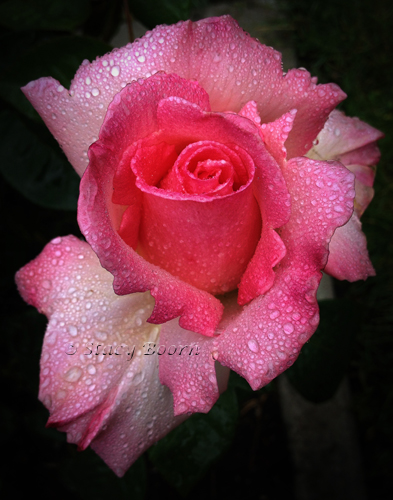
When I visited my parents in their retirement years, we always made a pilgrimage to Schenectady’s Central Park to take pictures of the roses. I never ceased to enjoy it. But the one great feature that San Francisco’s rose garden has over Schenectady’s and almost every rose garden in the world is the summer fog. It provides the best light for viewing and photographing roses, and quite often the fog produces a heavy mist or drizzle that creates on each petal effervescent beads of water strung like priceless pearls.

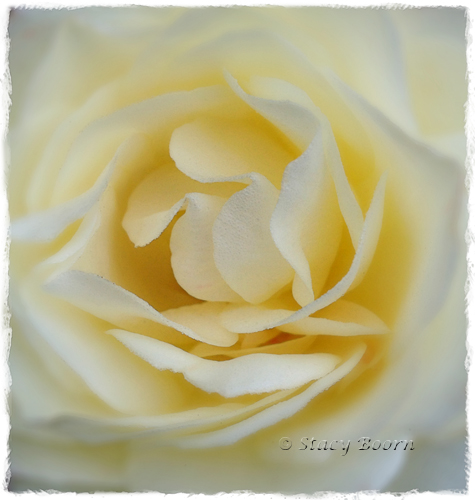
Think about the places where roses grew in your childhood. Don’t they bring back memories that are peaceful and filled with the beauty of Americana? While I thought about providing firework pictures for you in this first week of July, I chose instead this other American summer icon. This particular rose may be a new variety, or simply new to me; it is called “rainbow sorbet.”

Pink Promise - Golden Gate Park, SF

Pink Promise – Golden Gate Park, SF

The San Francisco Rose Garden in Golden Gate Park really complements the 4th of July celebrations as each bloom produces an explosion of natural “fireworks” in a variety of colors. To date, there are more than 60 rose beds planted in the garden, each of which comes from the creativity of commercial growers. A collection of dedicated locals, however, tend the roses, pruning them and picking the weeds. The tall Eglantine rosebushes are presently bursting with a fiery combination of red and orange.

So, here’s to the red, white and blue (well, maybe velvet violet instead of blue), the colors of this coming weekend’s celebration.
PEACE - One petal at a time!

PEACE – One petal at a time!

Some of the other creative names for roses in the garden are Broadway, Walking on Sunshine, Honey Perfume, Pink Promise, Kaleidoscope, Strike it Rich, Lavender Lassie, Sally Holmes, Dream Come True, and Sweet Briar.

Give thanks for the fog and the drizzle, and don’t forget to use some of these mornings to walk among the roses either in your garden, around your neighborhood or in our parks.It’s a cliché, I know – but a good one: “Stop, and smell the roses” — the Hope, the Peace, the American Beauty!
Posted in Weekly 2 | Tagged , , , , | Comments Off on July Week 1 – Red, White and Rose, all Americana!

June Week 4 – Nature’s Altars, 3000 BCE and Yesterday

June wk 4 PB 1 WEBEarth items gathered, arranged, or erected can often be seen along paths, in the fields, on the beach and under groves of trees. Eucalyptus leaves, duck feathers, and redwood cones were perhaps placed together by a small swirling wind or the inquisitive fingers of a toddler. Grown-up humans sometimes make earth altars as a way of offering their thanksgivings or as shrines or memorials. Constructing them could also be a means to honor nature and/or the great Mother of us all.

Many of my images involve the “rearrangement” of nature’s altars. Wind and water, ice and fire, have often set the sacred table. Then I come along and make a tweak here and there.

When I was in sixth grade we did a little bit of world history. I remember seeing for the first time pictures of the huge stones jutting skyward at Stonehenge in the lush green of Wiltshire, England. I also remember very distinctly the teacher saying, as did the grammar school history book, that no one knew why or how these stones were arranged in this circle circa 3000-1,600 BCE.

I also clearly remember thinking something like “are you kidding, you don’t know how and why this circle came into being?” Even a small child could figure out that its makers were filled with scientific and spiritual information, knowledge and wisdom. It certainly was by design since every year on the summer solstice the sun would appear between two of the huge stones that formed an archway like the entrance of a great cathedral.

June wk 4 PB3 WEBStonehenge was definitely intentional. Less phenomenal but still filled with purpose are the many mounds and collections of earth items making altars. For some, the word “altar” carries a lot of baggage since patriarchal religions usually equate them with sacrificial rites that are necessary for atonement with the “High God,” but most people have altars in their homes. They may not identify them as such – but they are collections of special items, family pictures, flowers and mementos.

An altar is often a sacred place we have created for reflection and meditation on deep issues or specific feelings. Community altars can also be created with a group of friends or family members. Often these altars are constructed with a certain theme in mind.

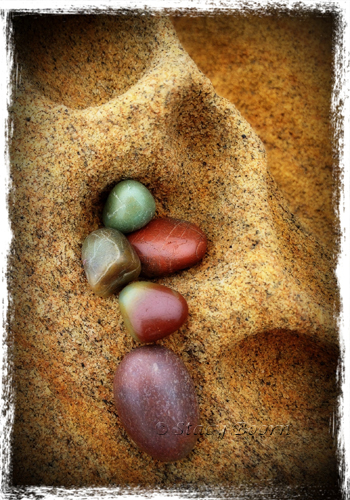
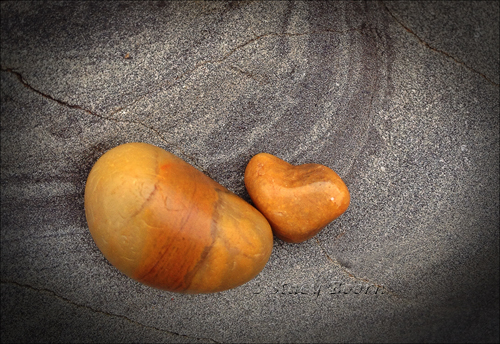
June wk 4 PB2 WEBFor me, rock altars adorned by pebbles capture both my sense of being connected to something much grander than myself as well as using the pebbles’ simple colors and numeric arrangements to mark blessings that are a part of my personal life. Sometimes I like to place the pebbles in the various shapes that have been found at Newgrange, Ireland (circa 3100 BCE) as well as multiple other such sites: circles, spirals, arcs, serpentiniforms, dot-in-circles, and the rectilinear shapes.

If you would like to make and photograph beach-pebble altars, plan on joining me on Saturday, August 16. We will meet at the herchurch parking lot at 8:00 a.m. and head to one of my favorite beaches near Pescadero. Afterwards we will enjoy local artichoke bread and goat cheese for lunch. We will return around 3:00 p.m.

Posted in Weekly 2 | Tagged , , , | Comments Off on June Week 4 – Nature’s Altars, 3000 BCE and Yesterday

June Week 3 – Designs in Arrested Decay

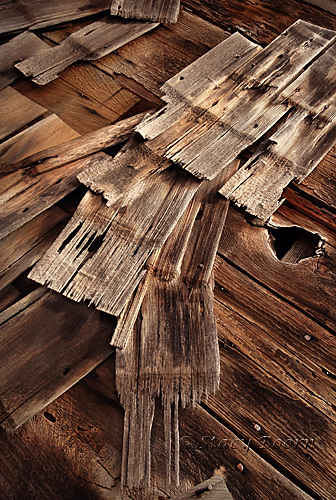
Jun wk 3 - BarnBoards WEBWhen there are dilapidated homes next-door to us, we regard them as eyesores. We are often quick to point out that they violate housing codes and city ordinances. But it’s amazing how decaying homesteads and barns, as we see them along the coastal roads or in the countryside, become treasures.

They are converted into beautiful subjects through our art and our memories. We paint them, we photograph them, and we write poetry and creative narratives about them. Each broken board, weathered shingle and rusting nail seems to be worth its weight in gold when it comes to storytelling and visual expression.

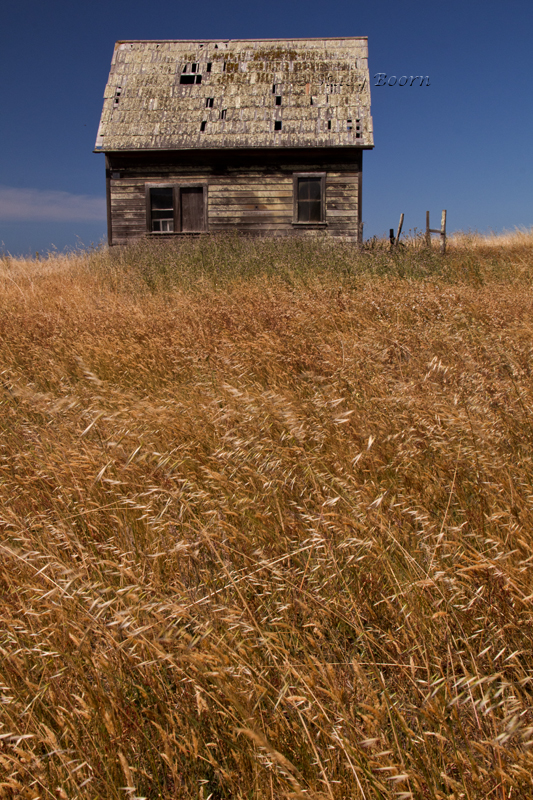
Just south of the town of Mendocino on Highway One I discovered such a treasure. The only visible sign read “Property of the State Park.” There was no information about the history of this farm and homestead – what it was used for or when it was deserted. Beautiful to my eyes, the patches of lime-green mosses on the roofs, the barn sideboards that have worn away to become paper thin, and the tilting walls were all provocatively surrounded by three-foot-high golden grasses dancing in the sea breeze.

Jun wk 3 - Homestead WEBHaving spent my childhood in upstate New York I am familiar with barns in all their stages, from those pristinely painted in reds and blues to the skinny skeletons scarcely standing. For years, on family outings, we simply drove by the barns, barely noticing their existence in our peripheral vision. Now I can hardly keep myself from stopping to examine every crumbling structure, hoping to mine hidden memories both from the actual site and my childhood connections to these structures.

It is incongruent with my lifestyle as a “city girl” to be attracted to the pastoral farm scenes. But that is probably true of many things, theosophical and concrete, that we admire. For instance, I find that I am attracted to old fishing equipment. Where does this come from? Perhaps I can thank my grandmothers, fishers both, for this fascination. I enjoy the beauty of these crumbling items that morph with lines and colors to become attractive venues.

Jun wk 3 - Buoys 2 WEBGrandmother Ethel, oldest of her siblings, left the Jonesville, NY, farm when she turned 18. No looking back, she walked nearly 10 miles to the city of Amsterdam to begin a new and independent life. Grandmother Augusta, one of nine children, grew up in a poor fishing family in Cape May, NJ, at a time when lobster was a throw-away catch!

Along Highway One in the one-block town of Point Arena you find a house on the east side that is draped in old buoys and other washed-ashore boat accoutrements. Like the weathered shingles on the side of the barn, these decaying and discarded materials are arranged chaotically into creative patterns, especially if you look for them.

Perhaps our creative eyes/voices/hearts are directed, subconsciously, to things hidden deep in our inherited memories, things that are often resuscitated from their own arrested decay. Cobwebs aside, they are quite worth exploring, don’t you think?

Posted in Weekly 2 | Tagged , , , , , | Comments Off on June Week 3 – Designs in Arrested Decay

June week 2 – Among the Redwoods, Tree of Life

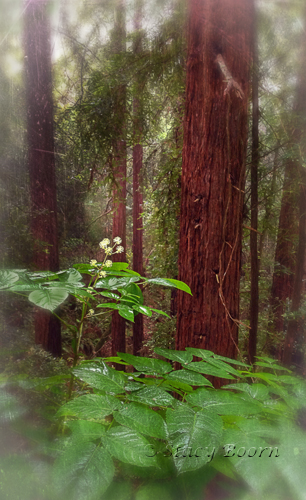
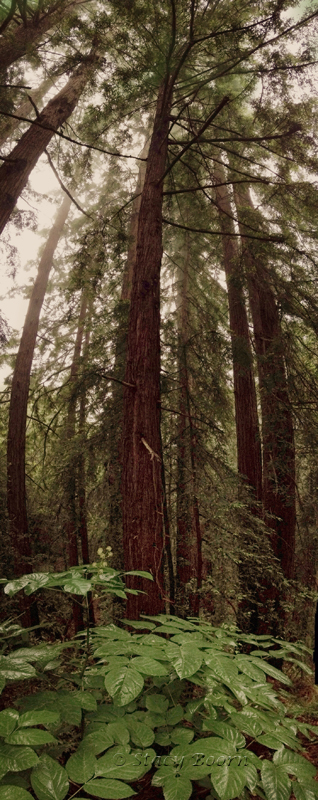
June wk 2 -WEB  trees 2Photographing the redwoods as individual trees, or as segments of a small or large forest, is a difficult task. The trees themselves are so vast. A vertical orientation or vertical panorama is basically what is necessary to even begin to capture the immensity and heritage of one single tree.

Fog in the forest helps create a more even light. If the sun is out you will have very dark shadows in some areas and hot highlights in others making the trees virtually impossible to photograph. The fog not only creates beautiful light, but also covers the branches and forest floor in moisture. The thick, course surfaces of the reddish bark begin to soften and feel like hair on a lion’s mane. (At least that is my guess.) For this reason alone, tree hugging is beautiful. But for political and environmental purposes it is also a powerful practice.

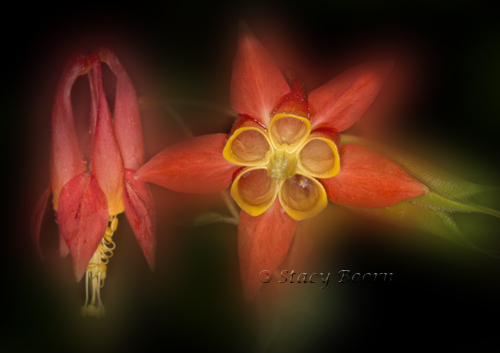
Columbine grows below the Redwoods - Marin County, CA

Columbine grows below the Redwoods – Marin County, CA

Etz Chaim, Hebrew for “tree of life,” is a common term used in Judaism, Christianity and Islam. The expression, found in the Book of Proverbs, is figuratively applied to the Torah itself describing each of the wooden poles to which the parchment of a Sefer Torah is attached.

But also in Proverbs, the tree of life is Sophia, aka “wisdom.” “Wisdom is a tree of life to them that lay hold upon her, and happy is everyone she embraces.”

The tree of life motif is present in many traditions. In Native American, especially among the Ojibway tribal cosmology, the tree is sometimes described as Grandmother Cedar who watches over us all. Disney’s Animal King/Queendom theme park features an artificial tree dubbed “The Tree of Life,” which includes 325 carvings of different species of animals.

Since the redwoods often grow in rings, in family circles around the area of the “Mother Tree,” they feel so “divine.” Standing among them is like being in an open cathedral!

June wk 2 -WEB  trees 1Tree of life,
your roots grounded
into the essence of your existence
planted alongside
the stream’s rapid flow.
Your branches leaf
into the cosmos.
Embracing us
with grace and peace,
You give of yourself
to satisfy the yearning in our souls.
To all who hunger for you
you blossom and fruit
through season and eternity.
Draw us into the fibers of your heart,
that we may become lovers
of the world that you enchant.
Your steadfastness even into old age
soothes and heals this planet.
Music rustles from your tendrils’ tips
entering our very being with promise.
Praise to you, treasured tree of life!
Your canopy is our life torah
scrolling songs from the winds of justice.
Blessed Be, Etz Chaim.
 

Poem and images © Stacy Boorn


These images were captured on the Fairfax-Bolinas Road.


Posted in Weekly 2 | Tagged , , , , , , , | Comments Off on June week 2 – Among the Redwoods, Tree of Life

May week 4 – acknowledge the creature-teachers and PURPLE

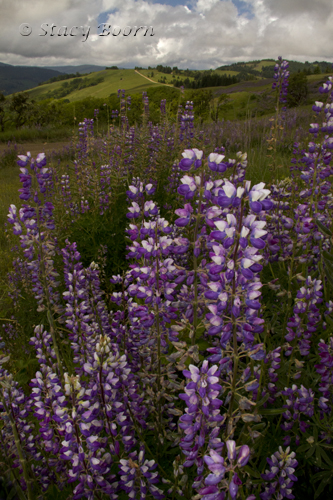
May 4 - WEB  Lupine Hill 4Part of the joy of landscape photography is being out in nature. I love wandering around to get a sense of the place, especially when it is a first time visit. That was my experience at Bald Hill Road near Prairie Creek State Park in Humboldt County. Thanks to my friend and AWE Gallery photographer, Janet Stock, for showing me this location not too far from her Arcata home.

Bald Hills Scenic Drive offers many opportunities for elk viewing in an area that features redwoods, lupine fields, magnificent oak woodlands, wildflowers, and prairies. This scenic drive gives you access to the Lady Bird Johnson Rhododendron/Redwood and Tall Trees Grove, home of the some of the tallest Redwoods in the world.

Once out of the car I moved around like an “American idol” contestant on the dance floor. Well, at least in my mind anyway. I have taken to heart this good advice, “Never be content with what you see in the viewfinder the first time you raise it to your eye. Move around, lie down, find a different angle.” It was quite the dance from one lupine partner to another.

The Roosevelt Elk, named for Theodore Roosevelt, is the largest of the four remaining North American elk subspecies. They live on the western slopes of the Coastal and Cascade Ranges from northern California up to southern British Columbia. Males (bulls) average 875 pounds and females (cows) average 700 pounds. The Roosevelt Elk is also much darker than other elk species, often with a dark brown or even black neck and a tan body, and they make a distinct bugle-like sound.

May 4 - The ElksAlthough the bull with a huge rack is a well sought-after photographic model, the females and young bucks also offer graceful poses. They are easily found roadside on Highway 101 beginning at Orick traveling north, and are less likely to charge you or run/roam away.

Jamie Sams, a recorder of Native American creeds and legends, reminds us that the Great Mystery gave each creature species common calls, except the humans. The gift for the humans was supposed to be the ability to listen. Humans can mimic the other creature’s calls and find power in their voices. This way we would know how connected we are to the great web of life and acknowledge the creature-teachers around us.

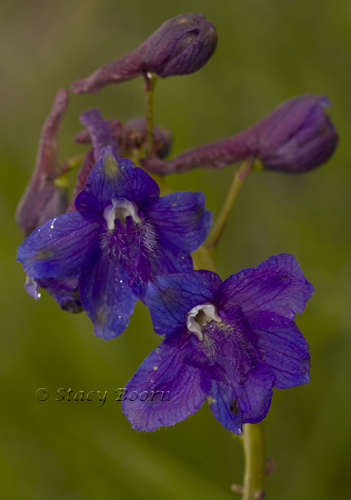
Parry's Larkspur - Delphinium parryi

Parry’s Larkspur – Delphinium parryi

The medicine/metaphoric power of elks includes stamina, strength, ability to pace oneself in tasks, agility, nobility, sensual passion, and respect for those of your own gender. ELK inspires us to make the best of our energy so that we don’t take on more than we are capable of accomplishing.

If ELK is your animal guide, you recognize the need for companionship. ELK teaches us that we do not have to do everything ourselves. Help is nearby if we are willing to seek it out.

Blessed be ELK!

Posted in Weekly 2 | Tagged , , , , , , | Comments Off on May week 4 – acknowledge the creature-teachers and PURPLE

May week 3 – New Lines from Old Ones

Dawn and dusk are precious times of the day. They not only gift us with prime light for photography, they also offer a beautiful and welcome time of silence. As we move from darkness to light and light to darkness these moments are also rich for meditation. Since most of the world is busying itself with morning and evening life tasks you usually have some otherwise peopled places in nature to yourself.

Lines left in sand by receding tide - MacKerricher State Park.

Lines left in sand by receding tide – MacKerricher State Park.

As much as humans need communal experiences and sacred rituals, we also need solitude for introspection. While engaged with the landscape intimacies set before us we often find an opening to the landscapes of our soul and heart.

Fields of wildflowers or a glassy pond reflecting a tree lined shore are scenes that help us focus on calmness and gentleness. Desert dunes and wastelands emulate inner struggles. Mountain peaks are metaphoric markers for high aspirations and the presence of the divine.

Lines often act as a guide for discerning direction, vision and ventures. As I continue in my vocation to transform sole leadership models to partnership communal processes, I find inspiration in the lines etched in sand, sky and waters.

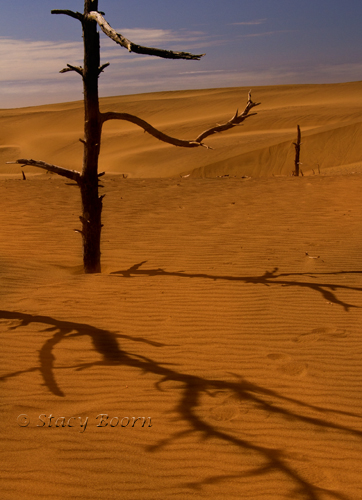
May 3 - WEB Dune TreesThe receding tide
creates her own icons.
Lines of inspiration etched
in sand, in sky, and path
entice my imagination
to the edge of Great Mystery.
 
Lasting or momentary lines
dance new images
in heart and soul,
birthing creation’s joy,
as I image my dreams to life.
Exploding into expression,
nature’s lines lift me
to revelations of her soul.
Silent reflection draws
new lines from old.

©Stacy Boorn, 2014

Horizontal lines project the idea of stability or a changeless concept in a changing world, like the ocean’s horizon that stretches beyond our peripheral vision. Vertical lines give you a sense of peace and groundedness. Often you will see this in rock formations, skeletons of trees and edges of buildings.

May 3 - WEB DockDiagonal lines give you a sense of motion, letting you know something is taking place. And they convey great dynamic feelings. Irregular and curved lines add further emotions such as tension, bending and unfolding choices.

Consciously or unconsciously, photographers employ lines to communicate all kinds of emotions as well as using them to lead the viewer from one part of an image to the other. I find that seeing and creating images with lines also works as a meditation – leading one in a new direction or pointing out a new vision. But sometimes the simple line itself is the entire subject of an image.

May 3 - WEB Bird SilhouetteIt is said that lines which point outside the image take you there. Usually artists avoid this kind of line. We want you to stay with our subject. But sometimes we must be directed outside of what is before us. May your silent reflections, via these images, help you draw new lines from old.

(Photos: Beach Sand,  Ma-le’L Dunes – Eureka, Morning Light on Stow Lake Dock – Golden Gate Park, and Birds and Twigs Silhouetted – MacKerricher State Park at Dusk)

Posted in Weekly 2 | Tagged , , , , , , , | Comments Off on May week 3 – New Lines from Old Ones

May week 2 – Water and Oneing – Natural Meditations

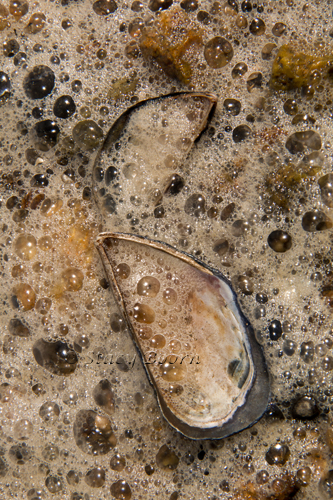
Bubbles on the Half-Shell - Pt. Reyes

Bubbles on the Half-Shell – Pt. Reyes

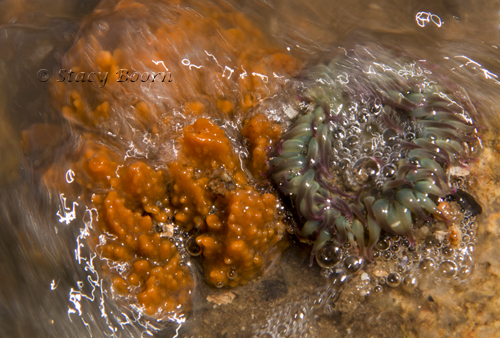
The water’s edge is one of my favorite places for both image-making and contemplation. The gentle sounds of the water as the tide recedes, and with it, the revelation of otherwise submerged life work together as a natural guided meditation. Sea foam creating bubbly designs between rock, shell and creatures tempts me to tiptoe into the water. It is at that point that I feel most connected to the elements that will become integral parts of the pattern forming in my mind and camera frame.

One of my favorite mystics is Julian of Norwich who lived from 1343 to 1416 (her death date is actually a mystery). She was highly sought after for her wisdom. Although voluntarily confined to the “Anchorage” and church from which she took her name, she had immense freedom. She reformed and re-visioned Christian doctrine into a universalism that focused on the goodness of both God and humans.

Julian’s teachings were never disputed or retracted. She is the first known English language woman author. Her feast day was May 8th so she has been particularly on my mind.

May 2 - WEB SpongeANShe publicized the concept of “oneing” through her writings and visions. For her there was no distance between the human soul and the Divine Presence. She wrote: “…all humans are oned, and one person is all people and all people are one person.” (Showings 51).

As the water tickled compositions out of the shoreline it was there that I felt the oneing with both the Divine Mother (Goddess and Julian) as well as the sea/landscapes before me. So I gift you with intimate seascapes: “Bubbles on the Half-Shell” and “Tide Washing – with Sponge and Anemone” as cairns in the watery vision of “oneing”.

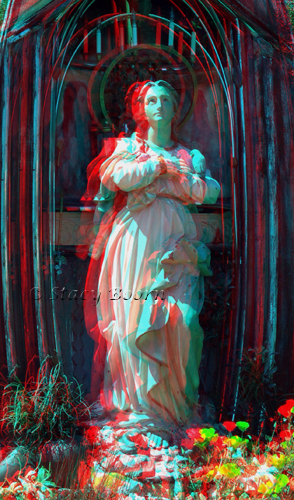
Our Lady of the Harbor - Pt. Reyes Station

Our Lady of the Harbor – Pt. Reyes Station

Afterwards my wanderings took me to the nearby memorial, “Our Lady of the Harbor,” at Point Reyes Station. With a little help from my 3-D app I tweaked her aura and ethereal presence. The sculpture is by David Best, the Petaluma artist known for his found-object collage, sculpture and wildly embellished art cars, as well as his art installations at the Burning (Wo/man) Festival. David constructed Our Lady of the Harbor in memory of a local child who drowned and as a memorial to other children in the community who have died.

Our Lady of the Harbor, erected in 2011, was standing in silence, much like the thousands of women at 1:00 PM on Mother’s day who demonstrated the posture of peace which longs for a safe world for the children and their children’s futures — a poignant stance as we remember the nearly three hundred Nigerian girls that were kidnapped nearly a month ago and remain missing.

If we could only return to the power of the “oneing” that Julian of Norwich, Spiritual Mother of Generations, taught! Like the sponge, the anemone, and the “other” next to us – we are all children of the universe needing to be loved and healed by self and each other!

Posted in Uncategorized, Weekly 2 | Tagged , , , , , , , | Comments Off on May week 2 – Water and Oneing – Natural Meditations

May week 1 – Georgia on my mind

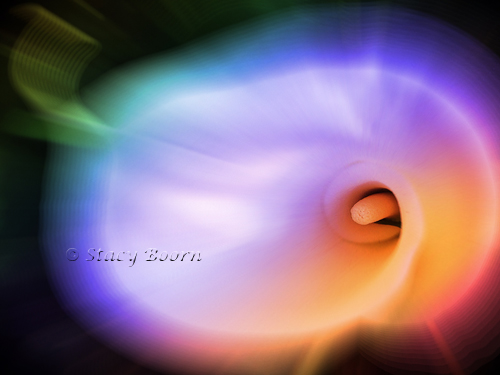
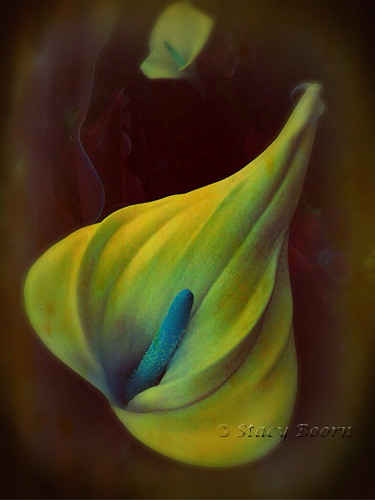
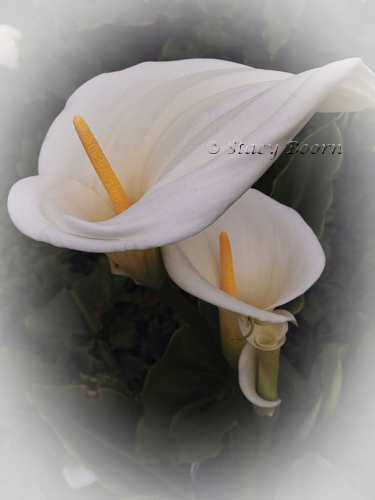
May 1 - WEB Calla Lily 007My passion for floral photography comes from my love of tracking down and snuggling up to spring wildflowers, visiting manicured New England gardens over the years with my parents, and the wild and emotive paintings of Georgia O’Keeffe. Being from upstate New York myself, I am particularly drawn to her works from Lake George.

O’Keeffe lived for part of each year, 1918 until 1934, at photographer Alfred Stieglitz’s family estate on Lake George in New York’s beautiful Adirondack Mountains. Her Lake George years were among the most prolific of her seven-decade career. The 36-acre property along the western shoreline served as a rural retreat for the artist, providing the subject matter for much of her art. From her art I have been inspired to seek ways to capture the natural spirit of plant and place.

May 1 - WEB Calla 008The O’Keeffe Lake George exhibition, which began its exclusive West Coast presentation at the De Young in February, is the first major exhibition to examine this body of work that Georgia O’Keeffe (1887‒1986) created based on her experiences in upstate New York. This exhibit is at the de Young until May 11.

Within a short walk from the De Young you can still find many verdant groups of Calla Lilies. The Calla Lily seems to have the soul of Georgia O’Keeffe with its flowers unfurling in similar yet unique forms on hefty long stalks flanked by broad twirling leaves. They are like flash mob dancers, moving together with a common beat yet making way for dissimilar posturing.

May 1 - WEB Calla 001I find the shape of the Calla Lily, although unrelated, reminiscent of the Jack-in-the-pulpits depicted in one of O’Keeffe’s oil on canvas paintings in this show. It is permanently housed in The National Gallery of Art, Washington. Many spring/summer visits with my parents included photography excursions to the Adirondack forest floors that hosted the greening of the “Jack-in-the-pulpits.”

The Lake George Exhibit at the De Young includes “the full range of work she produced—including magnified botanical compositions inspired by the flowers and vegetables that she grew in her garden; telescopic views of a single leaf or pairs of overlapping leaves that are based on the variety of trees that grew around Lake George; architectural subjects, including abstracted paintings of the weathered barns and buildings on the Stieglitz property; and panoramic landscape views of the lake and surrounding hills that influenced her subsequent work in New Mexico.” (from the exhibit brochure)

May 1 - WEB Calla 005Inspired by her work, I attempt to create images that present the quintessential nature of our Calla Lilies opening with anticipation of ceaseless love. These blossoms speak to me of the holiness of creation which seeks to move us into the joy of Shalom. The Calla Lilies represent elegance, grace and beauty.

The Calla Lily, like Georgia O’Keeffe, is a “female” that stands alone confident and proud and yet can stand harmoniously with others. Lake George represented transformative years for Georgia O’Keeffe, and now her work from there exudes transformative imaginative power for each of us!

Posted in Uncategorized, Weekly 2 | Tagged , , , , , | Comments Off on May week 1 – Georgia on my mind