April Week 4 – Too Cute to Pass By – Goslings

Newly-hatched Canadian Goslings are definitely a sign of the new life that blankets the earth each spring.
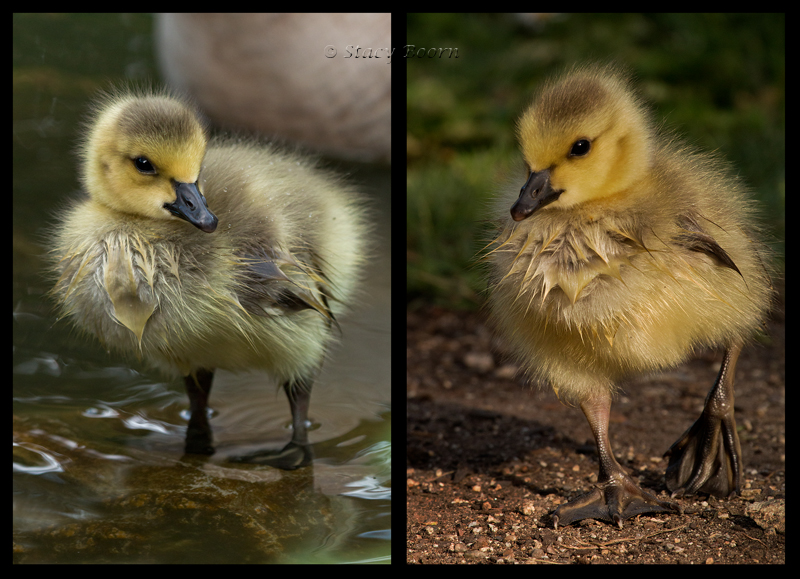
April 4 - 2 Chicks webI have written previously about the difference between snapshots and photography as art. A snapshot is a capture of a moment in time. Fine Art Photography methods create images that make the moments timeless. This is my attempt to follow the Canadian Geese at Stow Lake in Golden Gate Park and turning their behaviors into icons of timeless promises of spring.

Getting eye to eye with these goslings requires down and dirty postures. But that also provides for a renewing connection with the earth and the web of life. Low evening light and the soft light just after sunset were perfect for these captures. Timing and technique are just as important as subject and spirit to create standalone images and storytelling sequences.
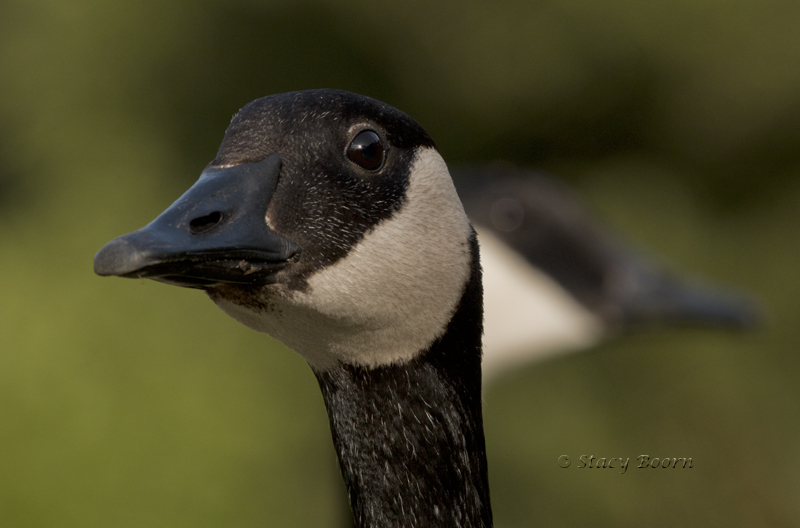
April 4 - Goose Head WebCanada geese (Branta canadensis) are among the most familiar birds in our area, easy to identify, and symbolize nature for many people. No one can miss the clear honking call of Canada geese when they fly overhead in their V-shaped formations.

There are two groups of Canada geese: migrating and non-migrating (often called resident) geese. For a goose to migrate, it must be taught the flight path by its parents. Resident geese will stay year-round in the vicinity where they were born.

Canada Geese begin nesting at age three and adult pairs stay together for life, or until one dies. They are able to raise one “clutch” per year. Eggs hatch after 25 to 30 days of incubation. The young, called goslings, can walk, swim, and feed within 24 hours. In areas where there is less danger of predators or hunters, the goose and gander may raise as many as ten to twelve goslings.
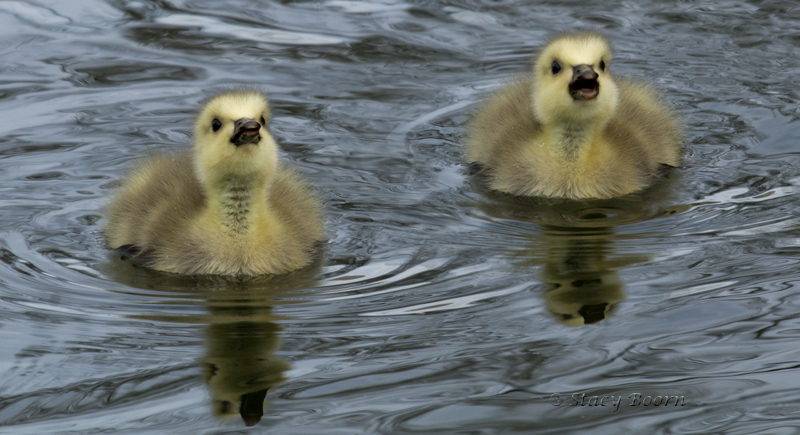
April 4 - Gosling Swim WebBoth parents (especially the gander) vigorously defend the goslings until they are able to fly, which is at about ten weeks. The young geese remain with their family group for about a year. Watching these icons of spring can lead us to see life in a new way – life itself is a creative act, full of goodness, vitality, passion and all things fuzzy and warm!
Posted in Weekly 2 | Tagged , , , , , , | Comments Off on April Week 4 – Too Cute to Pass By – Goslings

April Week 3 – In the most unsuspecting places

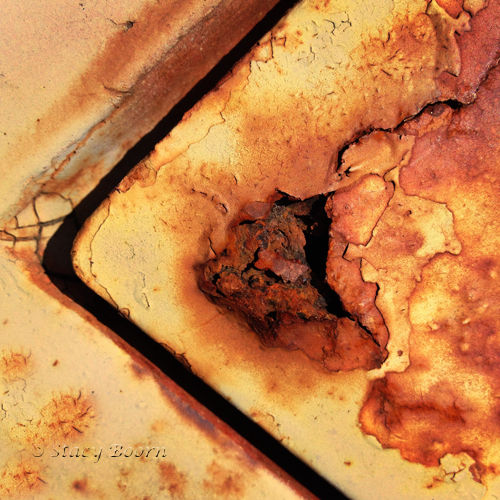
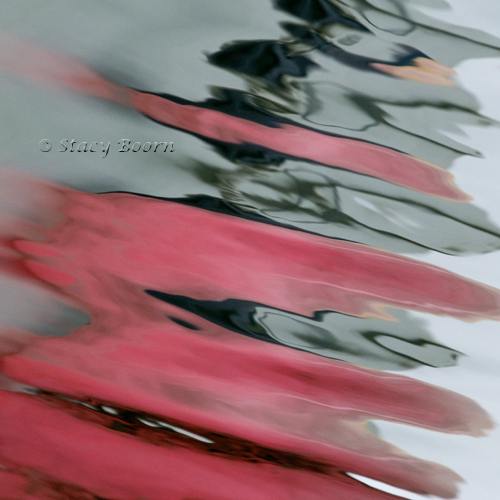
Beauty and form can often be seen in the most unsuspecting places: rusting cars, dilapidated farm equipment, weathered roofs, reflected objects, spilled milk, and countless other overlooked objects.

April 3 - Rust WEB

Rusting car hood detail

I don’t think of my images as photographs, but rather as ‘art’ – which just happen to be photographs. My camera is a means to an end.

Most of my abstracts are captured in-camera, although some images seem to scream for me to apply a few post-processing techniques. With these images, I wanted to present everyday objects from a fresh perspective and transform them from the ordinary into the extraordinary.

Abstract as an art genre was solidified in the 20th century.

Boat Bumper reflected in gentle rippled water

Boat Bumper reflected in gentle rippled water

When this style was in its formation, the term ‘abstract’ was more often applied to the cubism and futurism styles which depicted real forms in a manner that highlighted basic shapes as seen by the artist.

Later on, however, abstract art came to be regarded as art that more generally depicts things in a non-representational way.

Abstract images often represent emotions, sounds, and meanings in colors and compositions, spiritual ideals and simplified reality, where often only the essence is left. Such images are thought-provoking; they are created to evoke emotional responses.

Strong abstracts are able to catch the attention of the viewer and make one think. They generate a rainbow of emotions. Stop, look and think…., and repeat as desired.


Posted in Weekly 2 | Tagged , , , , , | Comments Off on April Week 3 – In the most unsuspecting places

April Week 2 – The snail is an excellent model

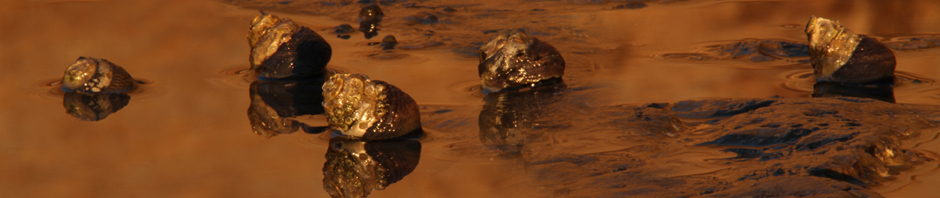
April 2 - WEB snailWhat do these images have to do with my comments?  That may still be your question at the end of these paragraphs.

Today silence and absolute calm converged on Boston as a time of remembrance was observed at the marathon finish line on Boylston Street.  One year ago today (April 15) two pressure cooker bombs exploded, killing three people and injuring an estimated 264 others.  As a tribute to the recovery from last year’s terror attack, next Monday’s Boston Marathon will host the second largest number of runners in its history.

At the very moment this news was breaking last year I was riding in a funeral procession with my brothers and their families to bury our father.  None of us asked why the funeral director suggested we not turn the radio on until after the interment.  Obviously, in his wisdom, we were spared the grief and agony of others so that we could have our moment of family mourning.

April 2 - WEB  Blue HeronSometimes it is important to stay focused on one’s personal experience and attend to the greater picture, the needs of the world, later.  Perhaps we can actually be more compassionate and open to other situations having cared for our own first.  Self-care and self-reflection are anything but selfish.  Watching a snail slowly creating its slimy pathway across a well-traveled sidewalk re-taught me this lesson.

My favorite images from last week are my attempts to capture the kind of single-focused stillness that reveals a deeper purpose.  The Great Blue Heron stands statuesque, and, in its movement, is graceful.  It is one of North America’s most familiar wading birds and very adaptable to different environments.  At four feet tall, with a six-foot wingspan, it is also the continent’s largest heron species.  While vocal in flight, Great Blue Herons are frequently observed standing silent and motionless along shorelines.

Standing silent and motionless is an applicable spiritual posture for this week we call holy, a time of focusing on the life-work and words of Jesus that led him to the cross.  “Incarnate, you have redeemed me; dying, you have awakened me.  Now you have brought all your works to fullness – in virgin nature you found pasture, in virgin nature you assumed flesh.” – Hildegard of Bingen.

What do these images have to do with my comments?  That may still be your question!

Posted in Weekly 2 | Tagged , , , , , | Comments Off on April Week 2 – The snail is an excellent model

April Week 1 – Connected to the ground (past and future).

Today my heart goes out to the people of Rwanda as they embark on their time of remembrance of the genocide that took place 20 years ago.  Their flame of remembrance has traveled to all the districts of their country and ignited the candles erected in the communities of all their peoples.  Now that flame has returned to the capital of Kigali.

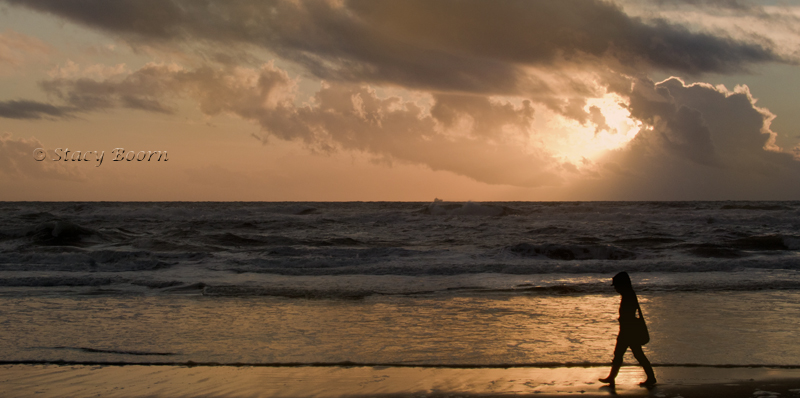
April 1 - Beach Walk WEBMy image of a silhouetted woman walking Ocean Beach was for me a moment of contemplation.  As the storm clouds began to break they left beautiful golden reflections on the still unsettled ocean waters.  The glistening sands seemed to whisper prayers of thankfulness.  Perhaps those prayers are for the empowerment of the people of Rwanda who have risen from the ashes of death to be re-birthed in the waters of their motherland, connected to the ground once soaked with the blood of their loved ones – mothers, fathers, sisters, brothers and children.

How do we fully relate and connect to the lands and peoples that cover the earth?  That journey offers as many paths as the number of people who take it.  Capturing the essence of that journey for me, of course, involves applying every f/stop my lenses offer.

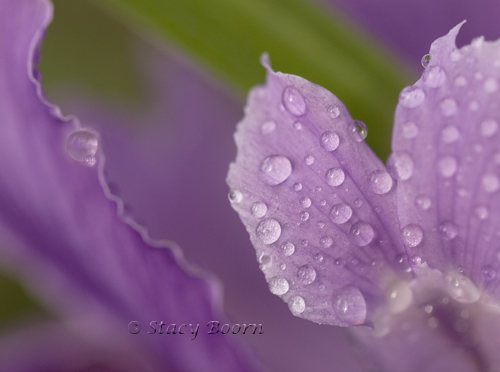
April 1 Iris DewDrops WEBSo, after and during the rains of this past week, I turned my image-making to water. The beautiful reflections of the setting sun upon the ocean waters and the minute rain droplets dotting wild irises provided sacred connections for me.

Composition rules say it is not aesthetically pleasing to place a horizon line smack in the middle of an image, but I did it anyway.  I kept running along until I got to a specific spot where a lone beach walker was in the right hand corner of my image.  The top half is sky and the bottom half is ocean and sand which become united by the walker (or so I think).

I have given you two iris images, one with enough depth-of-field to get all the petals in focus and one with a very shallow depth-of-field so that only a few of the water drops are in focus and the rest of the petals, those in the background, merge into splashes of purples.

Some of you have already received my iris prayer-poem with a different photo.  I went back to the same group of irises in the Strybing Arboretum in Golden Gate Park for the images here.

April 1 Iris WEBIris, Blooming in
the Morning Light,
You absorb the nutrients
   of Earth Mother’s bounty
and push your way from the womb darkness
   to the warmth of the light.
Between the green you unfold in amethyst beauty,
You play and dance in Ruah breeze,
   your unfolding petals sway in praise.
Flower within us, Sacred Song Sister,
that, opening to spring life,
we leave dormancy and death behind.
Deliver us into the gardens
   of new creations. 
Blessed be! Blessed be!
 
poem © Stacy Boorn 2014

 
Posted in Weekly 2 | Tagged , , , , | Comments Off on April Week 1 – Connected to the ground (past and future).

March Week 4 – Nature’s Palyful Patterns – Our Blessings!

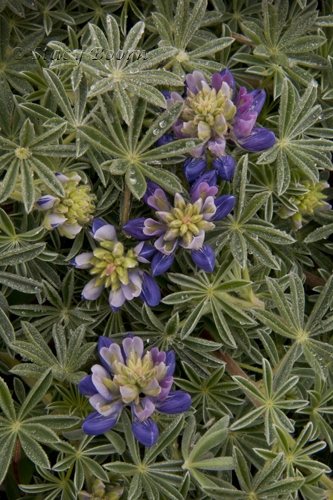
March 4 -LupineWEBThis past week my mind’s eye and melodic heart-beats were collaborating in capturing patterns. Although nature was my canvas the use of various photographic and post-processing techniques provided me with multiple ways to present what I felt rather than what I saw.

One of my favorite documentaries is Winged Migration. The film crew followed several patterns of migratory birds over a four year period.  These birds travel hundreds if not thousands of miles toward the equator in the autumn, and make the return journey to their higher latitude summer homes in the spring. Each species always take the same route, using the natural compasses of the universe, the stars, to find their way.

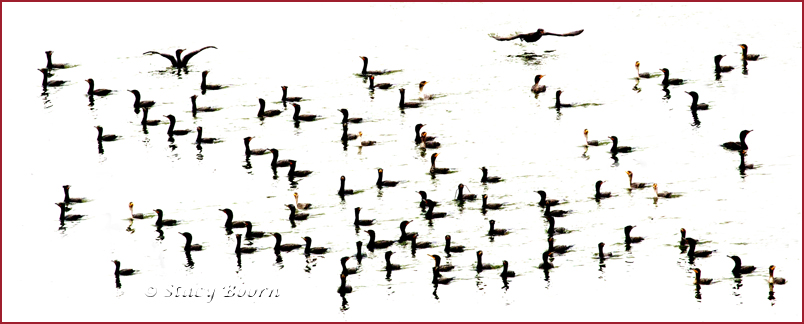
Large flocks of water fowl gliding in a communal performance on the surface of the water twinkle like the hundreds of tiny lights that make up the constellations above them.  Attempting to present the “constellation of cormorants” swimming near the newly opened and now gushing mouth of the Russian River, I photographed from the cliff-side along Highway 1. Boosting the contrast to render the image nearly pure white and pure black I present my own “winged migration.”

March 4 -Cormorants copyIn Winged Migration I learned that the travel over oceans is especially difficult as the birds have little refuge for landings unless there is something floating on the water. Otherwise they must continue flying until they reach land. Some will not survive the migration due to predators, including humans, illness or injury. Every continent is home, at least part of year, to a species of migratory bird.

Although the cormorants along our coast are residents, they still move from location to location between the shoreline and rock rookeries. They often form colonies on cliff-sides. The cliff-sides near these birds are covered with blooming lupine.  The dew and purple blossoms create playful patterns similar to the cormorants swimming near the sandy spit holding most of the rushing Russian River at bay, at least in my mind’s eye!

March 4 - RR WebThe golden evening brightens in the west.  Soon, soon to faithful woman cometh rest.  Your ten thousand names oh Goddess (mother nature) be for ever blest.  (A reconstruction of a verse of For All the Saints).  Patterns in nature provide us with wonderful blessings – do not miss them!  PS – the same group of cormorants can be seen in the above image near the spot the river is breaking through to the ocean.  Both bird images were photographed from the same overlook location (thanks to telephoto and wide angle lenses!).

Posted in Weekly 2 | Tagged , , , , | Comments Off on March Week 4 – Nature’s Palyful Patterns – Our Blessings!

March Week 3 – A Mystical Moment on the Mustard Path

Mustard in Vineyard reflected on curved surface of a red car.

Mustard in Vineyard reflected on curved surface of a red car.

Myth says the mustard was planted by California missionaries as they walked from mission to mission  dropping mustard seeds. They knew that, on the next years’ journey when the path was overgrown with grass and vegetation, the yellow of the mustard would mark the way. Each mission is planted about one day’s walk from the other.

Annually I follow similar paths in Napa Valley where I am welcomed by the yellows of the wild mustard planted among the vineyards. In addition to the mustard plant’s beauty it does serve several practical purposes. It provides habitat for birds that will eat specific bugs and worms (nematodes) that attack the vines. In addition, the mustard’s root system helps open up the soil to allow it to better receive the water and nutrients so necessary for the vines. Finally, when the mustard is plowed under, it too provides food for the vines.

For me, the mustard supplies oceans of yellow as subject or background color. The naked grape vines seem to emerge from the flowing yellow much like palm kelp at low tide. Lots of depth-of-field captures the merging lines of the rows of vines and the yellow pathways between them.

With lots of depth-of-field, everything is seen in focus. But if the camera is set to a shallow depth-of-field, it renders a mystical moment which gives me the feeling that all is well. By placing the camera lens close to mustard blooms, f/4.5 and focusing far down the vineyard row you can create wonderful yellow orbs, halos and blankets of color in your foreground.

Zoomed to 150 mm, f/5.6, I focused just before the Red Barn of Leap Frog Winery to create this mystic moment!

Zoomed to 150 mm, f/5.6, I focused just before the Red Barn of Leap Frog Winery to create this mystic moment!

English mystic Julian of Norwich lived in a time of turmoil (1342-1416), but her theology was optimistic and spoke of God’s love in terms of joy and compassion, the direct opposite to the law and duty proclaimed by the institutional church of her day. For Julian, suffering was not a punishment that God inflicted, as was the common understanding. She believed that God loved everyone and would save them all. Her saying, “All shall be well, and all shall be well, and all manner of things shall be well,” reflects her theology. Julian claimed these words were spoken directly to her by God.

I hope one or two stalks of mustard are still blooming on May 8, Julian’s feast day. I will hear the yellow flowers sing out: “All shall be well, and all shall be well, and all manner of things shall be well.”

You may find other vineyard shots in my Art on the Vine portfolio.

Posted in Weekly 2 | Tagged , , , , , , , | Comments Off on March Week 3 – A Mystical Moment on the Mustard Path

March Week 2 – Cherry Blossoms and the Tree of Life

March 2 - CherryB 010 webFor as long as I can remember the cherry blossoms in Golden Gate Park came and went many weeks before the festival in Japantown.  That will probably be the case again this year since the trees are right now swinging into full bloom.  Perhaps the festival is primarily about Japanese culture rather than just this iconic tree.

This year will be the 47th year of our local festival.  Each year, over 200,000 people attend this glittering display showcasing the color and elegance of the Japanese culture and the diversity of the Japanese-American community.  The Northern California Cherry Blossom Festival will be held on Saturday and Sunday April 12-13 and April 19-20, 2014, in San Francisco’s Japantown (on Post Street between Laguna and Fillmore Streets).

When I stand beneath the cherry tree’s umbrella branches laden with her delicate petals, I am grateful that the blossoms precede the festivities.  According to the universal language of flowers the meaning of the cherry blossom is “spirituality and beauty.”  The Ancients worshiped the Great Mother Asherah under every living tree, and certainly we can join them beneath the pink and white canopy of the cherry.

March 2 - CherryB 001webIn the Judeo-Christian tradition Asherah was also known as Mother Nature, and, gazing up from the trunk through these branches, I can see why.  Unfortunately, the King James Version of the Bible replaced the name Asherah with “tree” or “grove of trees” and her place of honor was deliberately deported to the recesses of failing memory.  But separated from the tree of life, our mother Goddess, we truly flounder.  So even a solitary walk among the cherry trees can help her seep back into our consciousness.  A bumper sticker implores us to “honor thy mother” and shows us a picture of the earth.  So, to honor our mother, I chose this week to focus closely on individual and groupings of cherry blossoms.

March 2 - CherryB 005 webYour camera flash (built in and/or external unit) is not something to turn to only when it’s dark.  In fact, flower photographers often use flash in broad daylight.  I don’t do much studio shooting, but I employ my flash unit to supplement, improve, and tailor the natural light I’m given.  You can make your flower stand out by obscuring or adding contrast to the background with your flash.  This is based on the fact that there is a fall-off in intensity as the burst of light travels.  The light that strikes a foreground flower is stronger than when it reaches the background a few feet away.  This differential registers as a darkened background and places your floral star in a dramatic spotlight.  (Totally black backgrounds occur when the light falls off at a point where there is nothing for the light to hit.)

You can also use the flash to counterbalance strong natural light that may be too overpowering for your floral subject.  For example, if you find very strong light in the background, your flower may look like a silhouette.  Add some fill-flash and you’ve corrected that imbalance quickly and simply.  This way you can have a well-lit cherry blossom and a beautiful blue sky — provided of course that it is not a foggy day.

Asherah, Tree Goddess, Mother of Life, I experience your presence in the cherry blossoms.


Posted in Weekly 2 | Tagged , , , , , , , | Comments Off on March Week 2 – Cherry Blossoms and the Tree of Life

March Week 1 – capturing the power of gentleness

March 1 - deer  WEBThe deer, ever gentle and graceful, beckon us into the wilderness of our hearts to learn the art of offering kindness to all living things.  At least that was the message I was hoping to capture in the portrait of this young deer in the Marin Headlands, just a few miles from the financial district of San Francisco.

I have learned from Jamie Sams (Medicine Cards Santa Fe: Bear and Company, 1988) that deer invite us to consider that there are other ways than violence to deal with one another and our environment; they show us that there is a power in the gentle word and touch, and that strength comes through caring.  Who can look into the eyes of this gentle animal and not be moved to feel compassion and kindness — towards others and ourselves?  Gentleness has the power to melt hearts of stone.  Those huge eyes seemed to be pleading: “Come, let us practice tenderness and loving-kindness in our lives today”

In the photograph, the background tonalities are the same as the deer, so, in order to both “see” and “hear” the message of the deer, I chose to render the background soft (out of focus) so it would not compete with the deer for our attention.

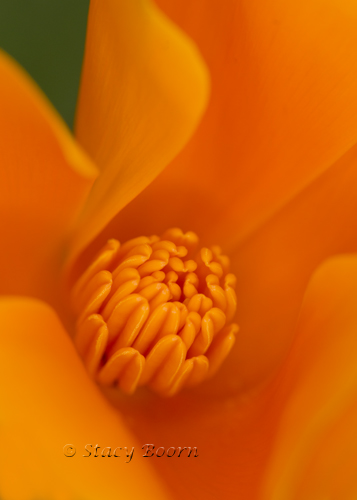
March 1 - poppy WEBSelective focus is a cherished artistic tool as well as a powerful skill for visionary planning.  Everything around the main subject/point needs to gently flow away or towards the focus point.  That is the mood that the center of a California poppy evokes when the petals are represented as cascading hues of orange and yellow.

The rains are returning to the drought-hardened mountains and meadows of California.  The wildflower crops may be fewer, but the first blooms don’t have the seasonal tall grasses to overshadow them.  If you pass a meadow of wildflowers and see someone sprawled out among them, it is likely to be me.  Please stop and say hello.  I urge you to try out my method of close-up nature photography – sit down on the ground, anywhere, and start composing!

A prayer so appropriate for the wildflowers blooming around and within us comes from Mary Kathleen Speegle Schmitt in her Seasons of the Feminine Divine – Cycle A.  Christian Feminist Prayers for the Liturgical Cycle:

Rainwoman,
You fulfill your promise of grace
through the pouring out of yourself
    upon the sun-scorched land
that thirsts, that cries out for your
    nourishment.
Raise up within us the flowing stream
    of your Wisdom:
that, fed by your mercy and compassion,
we bring into bloom your justice and peace,
    world without end.
Posted in Weekly 2 | Tagged , , , , , | Comments Off on March Week 1 – capturing the power of gentleness

February week 4 – Snapshot and/or Fine Art, whose moment?

Feb 4 - Retro Hat WEBPink showed off her amazing vocal talents during her performance at the Academy Awards when she sang “Over the Rainbow.”  During the performance colorized clips of Dorothy from Kansas were artfully projected.  The 34-year-old singer paid tribute to Judy Garland and the 75th anniversary of her classic film, The Wizard of Oz.  Host Ellen DeGeneres later came out dressed as Glinda the Good Witch!

At another moment in the show, Ellen crashed twitter by posting on its site the “selfies” she took of herself surrounded by celebrities, all taken with her in-phone camera.  The irony is that these snapshots may have gotten as much attention as the Oscar’s wonderful cinematography and visually stunning sets.

Snapshots are being made by the billions every day.  They capture moments in people’s lives and, thanks to technology, can be spread all over the world in minutes.  Some of these captures can be very artistically presented, but the main purpose of the snapshot is to show you a moment – a baby’s first step, a well-worn pheasant-feathered hat, a birthday pony ride, sky diving, river rafting, cruising the inside passage, and a billion other daily happenings or friendly teasers.  Then it is time to move on.

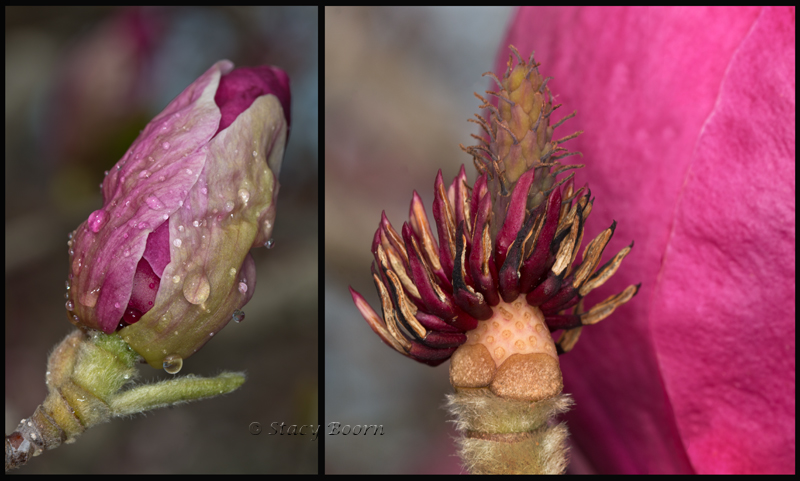
Pretty in Pink - Magnolias take the stage in February

Pretty in Pink – Magnolias take the stage in February

On the other hand, fine art photography and other visual presentations insert aesthetic dimensions into the preserved moments to lift, move or challenge the viewer.  Creating such art is deliberately different from capturing a scene or a happening.  Snapshots have their brief time in the spotlight of Facebook dialogs and Instagram sharings, but fine art is meant to hang around (literally) for a long period of time.

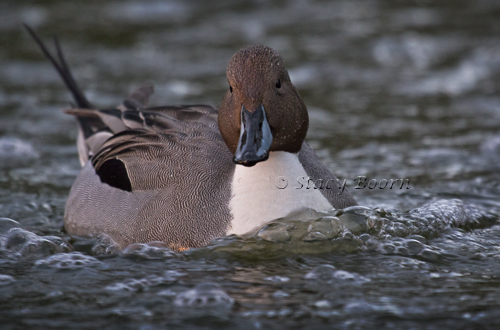
A Northern Pintail winters in the Bay Area

A Northern Pintail winters in the Bay Area

Some snapshots are made with high-end camera equipment and some fine art images are generated from smart phones.  With the swimming Pintail I wanted to use my camera to move beyond a clean-cut identification image to something that conveyed movement without motion blur.  I waited for the sun to set in order to maximize the cool light that dusk provides.  This required me to set my camera with a wider aperture and higher ISO so that I would have enough light to make the capture.  I also knew that the narrow depth-of-field resulting from these settings would make the foreground and background water soft while holding the bubbles in the water immediately around the Pintail in focus.

I also chose to take the photograph from ground level allowing the viewer to be eye to eye with the Pintail, giving the viewer the impression that she or he is right there in the bubbly water.  This deliberately chosen angle also provides a hint of the tail which gives the duck its name.

Snapshot or fine art – perhaps it depends upon the viewer as much as the maker.

Posted in Weekly 2 | Tagged , , , , , , | Comments Off on February week 4 – Snapshot and/or Fine Art, whose moment?

February Week 3 – Transitions in the forest and each of us!

Feb 3 - RW Bark web

Redwood needles lodged in moss-covered Redwood bark

Walking into the redwoods in Mt. Tamalpias State Park always proves to be a sensual experience: the feel of the soft-needled floor of the forest, the smell of the bay leaves, the sounds of silence interrupted by the call of the raven, the sight of everything green, and the cool of the brisk still-winter morning air.

Since I don’t take extensive notes of these forays I pay special attention to the few I have.  “April was a bit late for the western trillium.  Try next year mid-February,” I wrote.

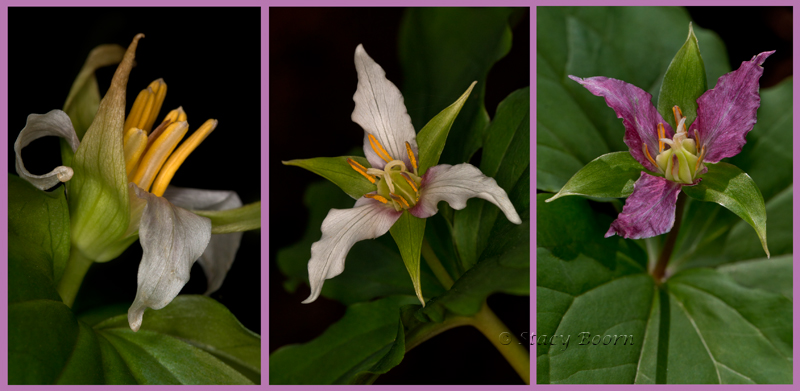
Because I was returning to a familiar location, I thought I would present the western trillium differently.  But  I chose to compose the photographs in  rather “classical” ways, although the trillium itself is in constant transition.

Having grown up in New York I was accustomed to seeing trillium in the forest that had broad petals some 3-6 inches long.  Or maybe they grew larger in my imagination.  But the Bay Area’s western trillium are quite small with each thin petal about one or two inches long.

Feb 3 -Trillium Trio WEBAlthough our winter rains were practically non-existent, the trilliums are still blooming. They stand only 8 – 12 inches high so you best commune with this exquisite plant by lying on the ground.  The coziness of the layers of soft Redwood needles provides the experience of truly “living in the lap of the Goddess!”  (That phrase is also the title of Cynthia Eller’s well-known book on the feminist spirituality movement in America.)

As the trillium (three petals and three sepals) under the coastal redwoods begin to fade they will go from white to pink to a cranberry-ish color.

This progression prompts me to remember that aging can be seen as beautiful transformations rather than something to cover up, dread and fear.  (I am trying to convince myself of this as I turn another year older in a few days.)

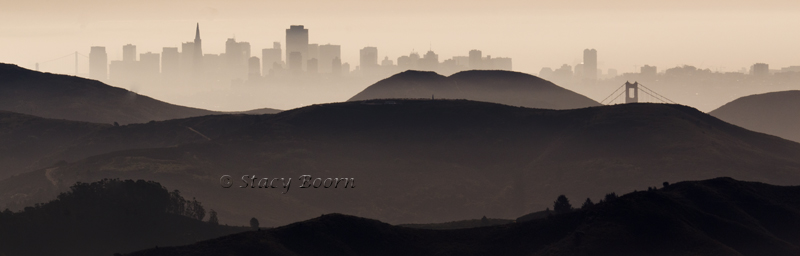
Feb 3 -CityMarin WebLooking out from the winding road heading to the top of Mt. Tamalpias you can see the rolling hills and the outline of San Francisco.  What to do on a very hazy morning?  I was tempted to simply return later when the light would be in my favor.  But I thought of using the haze and then boosting the contrast later to get a redeemable or even stunning image (as noted above).  What do you think?

Posted in Weekly 2 | Tagged , , , , , , | Comments Off on February Week 3 – Transitions in the forest and each of us!