April week 2 – “…moves on the water…”

Recently I have been listening to Ruthie Foster sing “God Moves on the Water – the Sinking of the Titanic.”  There is something hauntingly beautiful about both her voice and the melody that recounts the tragic events of 100 years ago. The Titanic, the world’s largest and most luxurious ocean liner, was traveling from England to New York when it struck an iceberg at 11:40 p.m. on April 14, 1912.  Three hours later it had sunk, dooming 1,500 persons to the deep and less than 700 surviving.

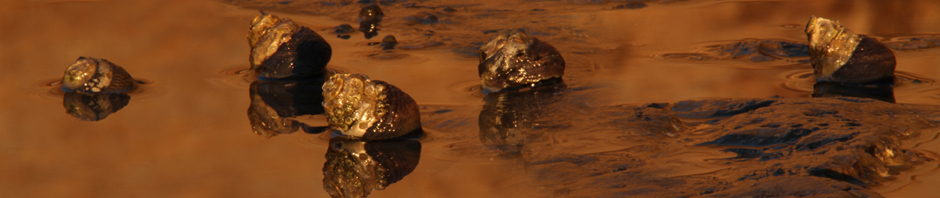
Perhaps intuitively for this anniversary I was drawn to photographing water images. Water can be both tranquil and fierce at the same time and there are many photographic techniques and unique angles that can convey those emotive powers.

This last week has been so unseasonably rainy (climate change you say?) with thunder and lightening in the Bay Area that seemed to rival that usually experienced in the mid-west.  The haunting words that Ruthie Foster sings are about destruction that seems to be directed by divine doom.  I don’t see measures of natural destruction from that prospective.  Yet I do sense within the natural world a divine presence and try to capture that in my photography.

With a strong storm brewing on the bay I did not want to get out of the car.  So I figured I could use those sheets of water being wickedly blown across the windshield as a creative tool to measure the “movement on the water.”  No Photoshop used here just wind whipped water creating a grey painterly effect.

What I like about the image is that you don’t quite know what is happening.  Why is the pier appearing to be liquefying and trailing off into the distance diagonally across the water?  Also the lack of contrast makes it feel like the sky and the bay and the water and posts are soon to become indistinguishable.

When you want water to look silky or capture the movement from one place to another you usually use a long shutter speed – you need to experiment to find the perfect timing.  With waterfalls you might start with two seconds and you must put your camera on a tripod – hand holding it will never do – and never use flash.  Choose a small depth of field like f/16 so that the image looks sharp.

BUT I was hand holding because the incoming foamy tide was moving fast enough to give me some streaks at 1/20 of a second at f/22.  Remember to choose the lowest ISO you have available to you (for most that will be ISO 100) so you can get a slow enough shutter speed.

I stood in the incoming surf and waited for it to recede back into the ocean to photograph it moving over the pebbles. The best shots included some areas where little or no water was flowing over the pebbles.  Sun on the water makes the streaking sparkle.

And in a moment of creative chaotic splashing it was “God/dess moving on the water” but this time in celebration and joy.

Posted in Weekly 2 | Comments Off on April week 2 – “…moves on the water…”

April Week 1 – What’s in the Background?

Lambs“What’s in the background and how will it be recorded?” is often the question I ask before creating an image.  The background has as much importance as the main subject.  If it is too busy or too bright in comparison to the subject your image is likely to have little impact on your viewers.

I was reminded again today that “life imitates art.”  So we hope the artists and poets, dancers and musicians will be filled with a social consciousness of compassion which will bring about change.  Mostly my images are about beauty, form and the emotions that are teased out of or into nature images based on my vision and camera techniques.

Choice of depth-of-field and exposure makes a world of difference in how a subject is presented.  In the case of both these images for the first week in April the background made a difference.  The little plump lamb stood tall and sassy as she walked towards me in a friendly gesture.  The mother sheep kept a close eye yet held her distance.

CemChildBy making the mother out of focus I wanted to say she was deliberately fading into the background so her youngster could have both the lime light and her independence.  Although, sometimes those that fade into the background are forced there by silence, submission and subjugation. (But for me this is more a subject for social action sermonizing rather than my photography).

I used a long 400 mm lens at f/9, ISO 400 and 1/640 of a second to freeze the slight motion of the lamb and blur the background.  With animals, I confess, I often hand hold because it is easier for me to track them.  When you can’t get close enough to wild animals to fill your frame there are likely to be a few barn yard pals near by.  Lots of sheep pasture in Marin and Sonoma Counties along Highway #1. Most of the lambs are born in December or January.  (Try Dillon Beach Road).

I wanted to create images this week that said “Easter” or “Love Rises Up” but I wasn’t successful at that.  The closest I came to a moment of peaceful contemplation in pixels was with an image of lichen on a cemetery cherub.  Producing a “peaceful” background was important.

SunRiseIt was an over cast day which was nice for the lighting of the statue but made for a gray dull sky.  So I positioned myself at the only angle possible to use the muted colors of the distant budding trees.  Again I used my telephoto lens at 170mm at  f/9 and ISO 400 at 1/160.  I added fill flash (Canon 7D pop up flash) so that the texture of the statue and lichen would be slightly high lighted.

However you celebrate resurrection and/or rebirth, may these words recorded by “The Incredible String Band” in the 60’s bring you hope and peace:  “May the long time sun shine upon you.  All love surround you.  And the pure light within you guide your way home.”

Bonus image this week is from Sausalito.  At the moment of sunrise a rower made her way into the sun rays reflected on the water.  I will be leading a Photo Class and Trek: Wildflower Techniques, April 20-22.  Email me for details at sboorn@aol.com ALSO drop by A Woman’s Eye Gallery for our special April exhibit: “Colors and Contrasts: Morocco” – Images by Chris Kibre, Maureen McGettigan and myself.  See announcement

Posted in Weekly 2 | Comments Off on April Week 1 – What’s in the Background?

March Week 4 – into the forest

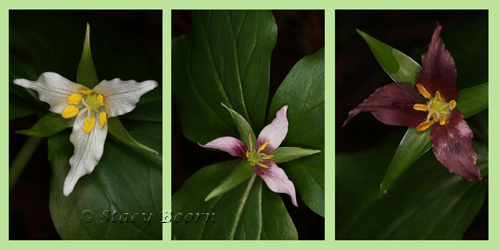
The winter rains (yes it is spring now) usually bring the trilliums to bloom under the coastal redwoods in Marin in February.  But our rains have been late,  so many trilliums were blooming this past week.  This flower is a member of the lily family and thrives in the cooler climate of the redwoods. This three-petaled white flower blooms in the spring.

Having grown up in New York I was accustomed to seeing trilliums in the forest that had broad petals some 3-6 inches long.  Or maybe they grew larger in my imagination.  But the coastal trillium blossoms in the Bay Area seem to be quite small with each thin petal about one or two inches long.  The dew drops on the trillium petals glistened and were like crystals of Tsoygol Latso Water (from India).

As the trilliums under the coastal redwoods begin to fade they seem to go from white to pink to cranberry-ish colors. The day was overcast when I discovered these trillium …making the forest dark and dreary.  But the fog provided perfect even light for forest-floor photography.

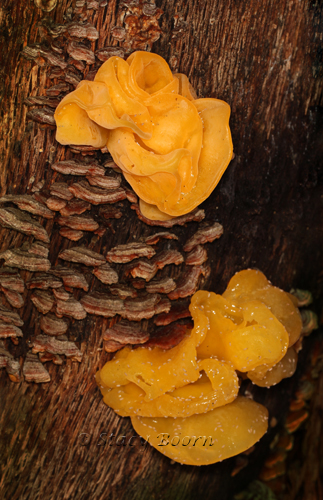
polypore and stereum

I would have needed an extremely slow shutter speed to obtain my desired depth-of-field, which is doable when there is no hint of a breeze.  Thanks to the Canon macro ring light I did not need a shutter speed slower than 1/125 of a second.

On the moist forest floor the ferns dance like geisha fans hovering over the fallen tree limbs adorned with mosses and fungus.  The rust brown colored old redwood branches and cones carpet the soft dirt ground and lightly traveled paths.  Every inch is a new composition of natural arrangements.

Three petals remind me of all things triune – Maiden-Mother-Crone, Father-Son-Holy Spirit, Root-Trunk-Branches, Waxing-Full-Waning Moon, Morning, Noon and Night.  So putting the trillium in a triptych seemed just right. Seeking tranquility in the midst of a stressful day or disturbing news broadcast?  Walk into the forest and make your home there  — if for but a moment.

If you live in the area and haven’t been to A Woman’s Eye Gallery this is a good month to stop by.  There is a special exhibit of images from Morocco by Chris Kibre, Maureen McGettigan and myself.  Viewing a print is much different than seeing images in a digital file.  See you soon, enchala.   (678 Portola Drive, next to the purple church).

Posted in Weekly 2 | Comments Off on March Week 4 – into the forest

March Week 3 – Morning is for Walking

SF SR

Sunrise from Crissy Field - SF

Morning is my favorite time for photographing because much of the world is still sleeping or running through rituals that prepare people to head off to their daily routines.  Morning is also a wonderful time for walking.  You experience the world differently then.  Already an hour after the sun has risen most city-scapes return to their concrete medium grey dull tonalities.

It is difficult to stick to a plan for a brisk walk when so many image possibilities surround you, but to that end I usually leave my “big” camera bag  at home.  Instead I will clip a Canon PowerShot S95 to my belt determined to only “draw it” when something is absolutely stunning.  Well, isn’t everything stunning?

KOI circle in Tea Garden

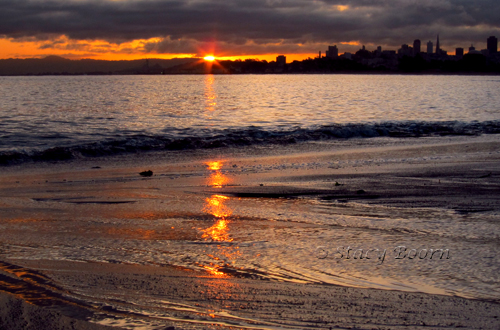
The captures I am sharing from last week were taken on my morning walks when the sun was pretty determined not to rise from behind its morning cloud coverage.  Along the walk from Crissy field to Fort Point I noticed it was low tide and more of the beach was accessible.  As the sun began to rise it shone through a sliver of clearing between the distant East Bay Hills and the cloud coverage.  The small aperture, and wide angle provided maximum depth of field and the “staring” effect of the sun.  From a low angle you could see the sun’s orange rays reflected on the wet beach.

The KOI image was taken at the Japanese Tea Garden in Golden Gate Park on a rainy dreary day.  The tea garden opens at 9 AM and if you are lucky you might even get in a little earlier when the gardener opens the door and invites you in.  Right now everything is so meditatively beautiful with cherry blossoms and emerald green grasses and deep purple Iris blooming.

Sausalito Pilings at Sunrise

It was so dark I thought about keeping that PowerShot in its case.  But you can make creative choices with that kind of dim light.  Seeing the koi in the pond I choose to set the camera at ISO 100 and the smallest aperture opening.  This gave me a slow shutter spend which would definitely make every image blurry.  So I rotated the camera while photographing the koi and a tree reflection in the pond.

The Japanese are revered for breeding beautiful varieties of koi fish. The Japanese Koi is a symbol of strength and the “Nishikigoi” is the most decorative and sought after for individual and park ponds. All carp are said to be offspring of the Japanese black carp known as “Magoi.”

The history of the koi goes back to  20 million year old fossils found in China and perhaps originating in the Caspian Sea. “Koi” comes from the Latin name Cyprinus Carpio meaning Carp

These walks and the images they bring remind me of Cat Steves (Yousuf) from decades ago singing “Morning has Broken.”  The lyrics  are by Eleanor Farjeon

Morning has broken, like the first morning
Blackbird has spoken, like the first bird
Praise for the singing, praise for the morning
Praise for the springing fresh from the word

Sweet the rain’s new fall, sunlit from heaven
Like the first dewfall, on the first grass
Praise for the sweetness of the wet garden
Sprung in completeness where his feet pass

Mine is the sunlight, mine is the morning
Born of the one light, Eden saw play
Praise with elation, praise every morning
God’s recreation of the new day

Posted in Weekly 2 | Leave a comment

March Week 2 – Around and Under the Board Walk

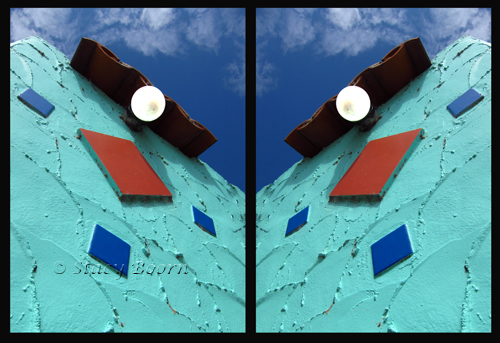
No wildflowers from this last week because I was “managing” and arm and face worth of poison oak from the previous wildflower trek.  So as to avoid expanding the “big itch” these images are coming to you from “standing positions.”  One of my favorite places for shooting at eye level is around the historic and funky condos of Capitola.   Although every angle brings new possibilities – like looking up!

CapitolaThere is no need to saturate your images here; the condo association’s painting crew does that for you.  So your challenge is to create an image that is not just a record shot of the beautiful or outrageous exterior paint jobs.  A sunny day will do just fine with a deep blue sky and even a few puffy clouds in this location.  The intimate beach village of Capitola on the Monterey Bay just south of Santa Cruz is worth exploring with your camera.  If you get tired of creating your own art there is plenty of galleries and shops in which to enjoy the works of other artists.

I chose to use a fairly wide angle lens with a small aperture (f/22) so that I would have lots of depth of field.  I could practically put my lens on the plastered façade and aim to the sky.  I found that thinking in terms of geometric designs helped me frame my images.  KISS is a term I learned years ago from photographer Carol Leigh – Keep it Simple, Simple!  Or maybe it was “keep it simple stupid.”

Capitola2Photography is often the art of deselecting objects and colors and subjects to hone in on a strong composition. Focusing on the beauty and power of the simple abstract helps eliminate not only that which is distracting but that which is devastating.

We may not be directly involved but we are effected by such events as the killing of civilians in Afghanistan or Moroccan law that allows a rapist to not be persecuted if he marries (his choice) his victim. We need our art, our song, our dance, or drama, our loves to help us navigate through and beyond the obscenities of destructive systems and situations.  Color and design can be healing and hope-filled.

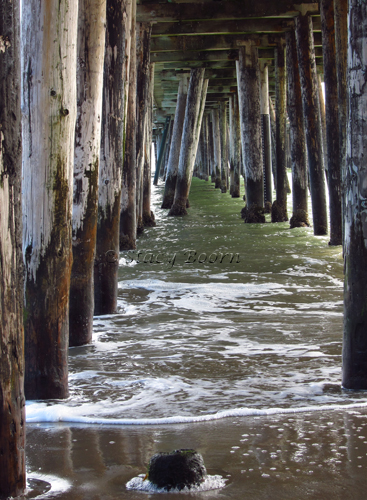
Near the colorful Capitola condos (beach rental units for the most part) you have the fishing wharf.  From the beach you can walk under it.  It provides great opportunities for thinking about converging lines which are meant to take you somewhere.  Sometimes that somewhere is to a subject where the lines converge (come together) and sometimes it is just the feel of movement to a greater beyond.  It is the later I was hoping for with the picture of these pilings that hold up the wharf.

Take me beyond the worries of the day.  But if you can’t actually get under the board walk – let your/my image take you there!  Just start singing with the Drifters, “Under the Board Walk….”

Posted in Weekly 2 | Leave a comment

March Week 1 – Pride of California, flower of our state

Poppy

Stamen and Petal – Poppy

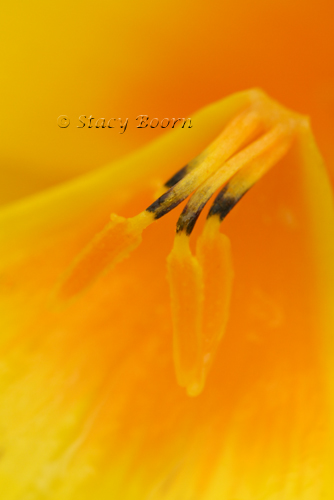
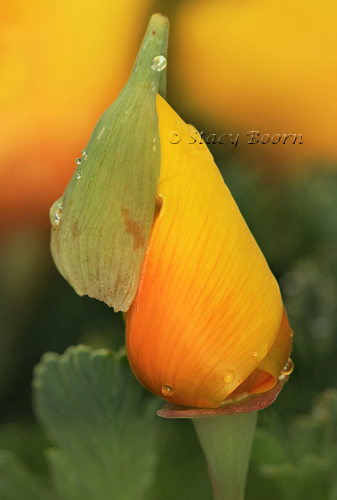
Interior Designers tell us the beautiful warm colors of yellow and orange go well together.  You only need to look at the coastal poppies to know that.  Perhaps these colors which call spring out of the earth and us also bring their own balm of healing.   Yellow and orange seem to have a special nature that signals both comfort and vibrant emotions.

It is perhaps the power of these colors that speaks to my heart most on this day, one year to the date, of the earth quake and tsunami in Japan.  Here this is still much needed restoration, rebuilding and rebirthing.  May the power of the orange and yellow be a symbol of our solidarity with those still mourning and remembering their lost loved ones, devastated properties and destroyed livelihoods. So I offer these image of the coastal poppies and their own magical properties to the memory of those 20,000 lost last year, swept into the sea.

Although you can find some poppies blooming somewhere all year long in California, this time of year in the Bay Area you begin to see them more plentiful coast side and urban street side.  They even have their own song.

California Poppy Song

  • Poppies, golden Poppies, gleaming in the sun,
  • Closing up at evening, when the day is done.
  • Pride of California, flower of our state
  • Growing from the mountains, to the Golden Gate.
  • Flower of the hillside, flower of the plain.
  • Flower of the sunshine, flower of the rain.
  • California’s children, be they far or near,
  • Love the golden poppy, of our state so dear.

Coastal Poppy Interior Design

For some years I felt a little intimidated trying to make poppies one of my main focuses.  After all I was living in the same state with the poppy photographer par-excellence.  Although George Lepp no longer resides in California his legacy of poppy photography is still in the very air we breathe.  But after learning many techniques from George Lepp I am finally confident that I have my own vision of the art of the poppy.

Poppy Tossing Cap in Early Morning Light

The images I am sharing from this past week were taken at Kehoe Beach in Point Reyes National Seashore where you can usually find some of the first of the wildflower shows.  They weren’t quite there yet, although some lovely individual blossoms and groups of coast poppies were prominent.   While the California Poppy is one shade of orange the coastal are both yellow and orange.

Wanting to just capture the feel of the colors I choose to get in close using a 100mm macro lens and a shallow depth of field so only a small selection of the composition was in focus.  The wind usually blows pretty strongly in this location even early in the morning.  So using a shallow depth of field (here 2.8) you can obtain a pretty fast shutter speed.  You just have to be careful that the intended point of focus is not blown out of its position.

Although I advocate for using your tripod, I went off it so I could rock back and forth, even moving with the breeze, until my narrow focused area was right on.  I love how the ends of the petals go quickly out of focus at this aperture.  Mere splashes of color engulfed me from lens to heart and back again.

Yellow and Orange remind me of the painting “Mother and Daughter” by Meinrad Craighead.  It is on the cover of her book “The Mother Songs -Images of God the Mother.”  It may be more red and yellow, because the shared fruit between the mother and daughter is a pomegranate, but nonetheless the two looking eye to eye have the comfort and challenge that the yellow and orange need to bring to us this day.

Posted in Weekly 2 | Comments Off on March Week 1 – Pride of California, flower of our state

February week 4 – Wildflowers are going wild

Mission Bell

The wildflower season is well underway in the Bay Area.  Although February is usually for the early flowers, the sunny days may have hasten some blossoms.  The lack of rain seems to also have kept the grasses short so the flowers are more visible.

Get up and out early is the rule for wildflowers because surely before noon the wind will pick up and make it difficult or impossible to photograph the splendid colors atop thin steams ever waiting for a little breeze to set them in motion, dancing on the hillsides or in the meadows.

Star Lily

There are some wonderful finds right now on the Fairfax-Bolinas road below Mt. Tamalpais.  You will find pull outs quite often and a variety of floral subjects everywhere:  Douglas Iris, Morning Glory, Wallflowers, Milkmaids, Star Lilies and a few Mission Bells.

The backgrounds are pretty busy so you will want to isolate your subjects by making sure the background is at a distance and in the shadow.  I like to use a shaded background so it goes very dark or black.  Sometimes you have to get into very “contorted” positions to achieve this angle.

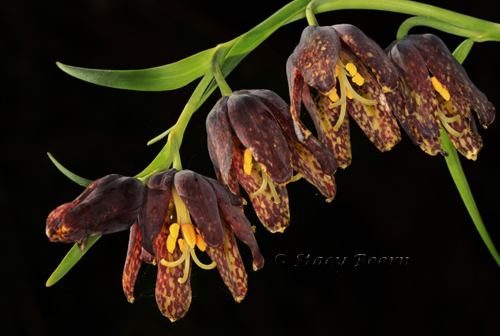
For both of these images I was still getting some distraction in the background so I chose to use a ring light flash.  I used a diffuser for the Mission Bell because the sun was very bright and then filled in the shadowing areas of the bloom with the flash.  The Mission Bell is found among oak and brush, but you must look closely to see it because it blends in with the background.  Another name for these bowl shaped flowers is the “checker lily.”  The roots of the Mission Bells were eaten and used in medicines by Native Americans.

Also in the Lily Family near by were many Star lilies on the rocky outcrops.  This is a very showy flower with multiple star shaped flowers.  Since all parts of this flower are poisonous another common name is the Death Camas.

Posted in Weekly 2 | Comments Off on February week 4 – Wildflowers are going wild

February Week 3 – Light and lens

There is nothing more exciting to most photographers than a beautiful sky at sunset, except for a silhouetted subject in front of it.  I had both these elements before me last week at Pigeon Point Lighthouse.

50 miles south of San Francisco, on our central coast line, a 115 foot high Lighthouse raises from the cliff side.  It is one of the tallest in the USA and has been guiding mariners since 1872.  The lighthouse is run by the California State Parks. Entrance to the lighthouse has been closed since 2001 when a portion of the cornice on the exterior of the lighthouse fell off.  Presently funds are being raised and the restoration project is underway

“Its five-wick lard oil lamp, and first-order Fresnel lens, comprised of 1,008 prisms, was first lit at sunset, November 15, 1872. The lens stands 16 feet tall, 6 feet in diameter, and weighs 8,000 pounds. It sits in a lantern room that had been constructed at the Lighthouse Service’s general depot in New York before being shipped around the Horn. Although the original Fresnel lens is no longer in use, the lighthouse is still an active U.S. Coast Guard aid to navigation using a 24 inch Aero Beacon. “

Sunset photography can be an exposure challenge.  I suggest you set your camera on the spot metering mode and select a location about 30 degrees off  the sun.  Take your reading and dial it in manually. Or you can set your camera for negative compensation of 2/3 to 2 stops, and watch your histogram.

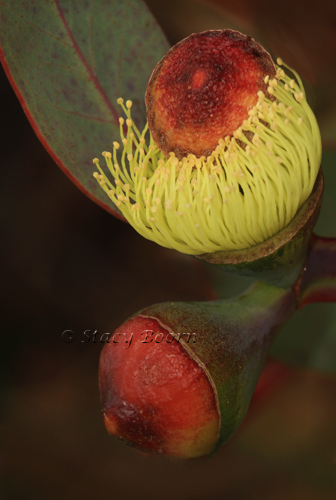
Budding and blooming Eucalyptus plants are among my favorite floral subjects.  As the bud begins to open it throws off its cap like a French Brett being tossed aside so one can let the wind blow through her hair.

I was using my 100 – 400mm lens at 400 mm with a 12mm extension tube.  Extension tubes are designed to enable a lens to focus closer than its normal set minimum focusing distance. Getting closer has the effect of magnifying your subject (making it appear larger in the viewfinder and in your pictures). They are exceptionally useful for macro photography, enabling you to convert almost any lens into a macro lens.

Using 400 mm instead of 100mm or wider helps me narrow the background and keep out competing  and distracting colors or subjects.  I also use a relatively shallow depth of field (f/8) so that nothing in the background is in focus. Usually the Eucalyptus blooms are far above my eye level but at the Santa Cruz Arboretum there are some young trees making this subject more accessible.

But by noon my hair was blowing in the wind and so were the floral subjects.  There is a reason to get up and out before sun rise!

Posted in Weekly 2 | Leave a comment

February Week 2 – pruning one shoot at a time

Although it is still winter the days are getting longer and warmer.  Well, at least in the Napa Valley.  The hills are turning green, daffodils and tulips are sprouting, the first of the fruit trees are in blossom and the vines are being pruned.

Just two weeks ago I enjoyed photographing at Frog’s Leap Vineyard because of the copious mustard crop.  The vines had last year’s shoots reaching skyward some five feet from their point of origin.  Occasionally you could see a few old dried up grape clusters or leaves that never fell to the ground.  But upon return, while scouting for a photo-trek I was leading, poised to take a shot, a half dozen men lined up at the beginning of each row right in my frame.

A signal was given and in sync they methodically began to rip off last years shoots.  No clippers for this crew. Apparently there are many methods of pruning.  By the time I realized the beauty of this art they were already 100 feet into the job.  I was only able to get a few shots framed.  But I knew the storm clouded sky would be dominant in the image even though the work of the pruning crew was fascinating.  After the initial overall shot I did move in to photograph an individual pruner.

If a sky is beautiful it can be the majority of the picture.  If it is so-so than a little is the way to go and if it is dull than leave it out all together!

February is the month for pruning and some of the workers wear yellow waiters that appear to mimic the tall mustard plants. This important vineyard operation sets the stage for vine management throughout the rest of the growing season.

“The purpose of pruning is to reduce the number of buds to a manageable number that will promote a balance between shoot growth (vigor) and number of grape clusters (yield). Each bud theoretically will produce one shoot that will contain two clusters. A well-balanced vine will produce just enough vegetation to fully ripen its fruit.”  Read more about pruning.

Robin gets into the Mustard

Other wonderful subjects around the winter vineyards are the wetlands used by migratory birds.  The one in front of Ram’s Gate winery delightfully reflects the rolling hill, winery and winter skies.  What the website for the winery says about itself is similar to my experience with image making:  “The best things in life don’t happen by accident. They require passion, attention and above all time. We’re crafting a winery of exception. One bottle at a time.”

I am attempting to craft portfolios of beauty one image at a time!  Please enjoy them.

Coming from the south, Ram’s Gate Winery is just past Infineon Racetrack (Sears Point, HWY 12) on the right. It’s the first winery you’ll see in Sonoma.

If you want to creatively expand your own photographic techniques consider attending one of my “Photographing from the Heart” classes.  My next offering is March: Sea/Landscape Creative Capture – Sunday March 18 at 6 – 8 PM (class), Thursday, March 22 (the phototrek) and Sunday March 25th at 6 PM (the follow-up).  Email me at sboorn@aol.com

Posted in Uncategorized | Comments Off on February Week 2 – pruning one shoot at a time

February week 1 – Diagonal

One of the key factors in most images is the use of lines.  Are they converging or diagonal, parallel or random?  LINES define edges of shape.  SHAPES fill space two dimensionally, but don’t show depth.  TEXTURE gives depth and relief to shapes.  PATTERN is the repetition of shape.  And CURVE is a type of line which twists through the frame maybe sharply, maybe gently as an arcing C or snaking S.

Nature is full of these captivating elements of form.  Although, we humans also have the capacity to be creative with our own life evoking lines, like the ones captured in the reflection of the balconies of the Infinity Luxury Complex in San Francisco.  Early morning light brings out the multiple colors not seen at other times of the day. The curves of the windows bend and reshape the diagonals of the reflected building.

Trees – their limbs, roots, trunks and bark patterns are some of my favorite lines in nature.  When no other subject seems to be calling out to photograph it you can always walk into the woods/forest and be surrounded by sharp and soft lines to spark your creative juices. That is the way it was for me among oaks and pine at Point Reyes National Seashore this past week.

Unfortunately I was in a group of oaks where many had succumbed to sudden oak death.  Several trees had already fallen and others were cracking and losing all their bark.  Yet in the midst of the sadness the lines running up and around these once thriving trees were still beautiful.  This one particular dead tree caught my eye with its Andy Goldsworthy earthquake like cracks. A wind-tossed leaf was stuck to the trunk.  So I picked up another one from the ground and placed it also on the tree trunk for what I felt was a story in detail of what was and what will be for this majestic remnant of the Old Oak Tree!

Maybe we need to tie a yellow ribbon around the oak tree for the sake of the oak tree and ask “How better can we love the planet!”  Sudden Oak Death is a recently recognized disease that is killing oaks and other plant species in the western U.S. First noticed in 1995, the disease has been confirmed in the coastal areas north and south of San Francisco, and in a relatively remote location in southwestern Oregon. The pathogen responsible for the disease, a fungus-like organism.

We may not be the cause of sudden oak death but human pollutants surely are the cause of much of the wounding of the earth.  But together we can protect our climate and our future.  Be inspired by Jann Aldredge-Clanton’s Hymn “Creation Calls to Us”

  • Creation calls to us for help; the earth cries out for care.
  • The Loving Spirit shows the way to save earth’s treasures rare.
  • Then let us work together now, our gifts to freely share.
Posted in Weekly 2 | Comments Off on February week 1 – Diagonal