January week 5 – Mustard in the Vineyards

Yesterday was the opening reception for two artists at A Woman’s Eye Gallery Annex.  The room was vibrant with watercolors, acrylics, color pencil and art stix in swirls, lines, and imagination captured in “Themes and Variations.”  While people were sipping wine and discussing texture and techniques, I overheard this question:  “How long did it take you to create this piece.”

I don’t remember if the answer was in hours or days.  But unfortunately it seemed that the inquisitor was trying to calculate the “per hour” price of the piece.

Sometimes I wish people would ask that of one of my images especially if they feel the “price tag” is too steep.  I’d love to say, “Well, this vineyard shot took no less than 10 hours to create.”  After all I had to get to the location specifically with this or a similar image in mind.  Sometimes I need to go back several times for the conditions to be right which might mean it took me weeks!  Then there is the post processing and printing time.   But those of you who are photographers already know all this. Seldom is an image produced by “happenstance” or just jumping out of the car on your way somewhere else.

So here we are in Napa Valley where January and February welcome the yellows of the wild mustard (planted) among the vineyards.  In addition to it’s beauty it does serve a practical purpose.  It is planted to provide habitat for birds that will eat specific bugs and worms (nematodes) that attack the vines. Also the mustard’s root system helps open up the soil to allow it to better receive water and nutrients.  The mustard once plowed under also provides “food” for the vines.

For me the mustard provides oceans of yellow as subject or background color. The vineyards at Leapfrog Winery are particularly bountiful right now.  With late afternoon sun the naked vines seem to emerge from the flowing yellow much like palm kelp at low tide.  Lots of depth of field captures merging lines of the rows of vines and the yellow pathways between them.

Another fun subject in the winter vineyard is the left over curls of the vine tentacles and the few dried up clusters of what was once voluptuous merlot-to-be. Using a long lens (400mm) with a shallow depth of field (f/6.3) will isolate a subject and cause the mustard field behind to become one sheet of yellow.

Other subjects at this time of year are fun to play with:  old fences covered with moss and lichen, vines with a few old leaves still clinging to them,  lines and curves in the fields and winery buildings, cows under silhouetted oak trees, and empty glasses (to mention just a few)

Myth says the mustard was planted by missionaries dropping mustard seeds, so on the next years’ journey when the path was overgrown with grass and vegetation the yellow of the mustard would mark the way.  Each mission is planted about one day’s walk from the other.

So how long did it take to capture these images?  Let’s just say, enough time to create a “priceless piece of art!”

Posted in Classes | Comments Off on January week 5 – Mustard in the Vineyards

January week 4 – Wide is Wacky

If you desire fun and funky images you’ll want to try a fisheye lens, where distortion is super emphasized.  Canon’s 8 – 15 mm fisheye can give you both circular-image and full-coverage when used with a full-frame EOS body.

Use this lens on an ordinary or every day subject and transform it into a global fantasy.

Here are two examples from my first day with this lens.  The Cyprus Trees above the Sutro Bath ruins at land’s end in San Francisco took on a new life.  By just touching the trunk of one tall tree and pointing the lens up the Cyprus bent in directions that even 110 miles an hour wind can’t do to them.  (The weather has already created  branches that dance away from the ocean side.)

The Windmill and Queen Wilhelmina’s Garden at the western end of Golden Gate Park becomes a cyclorama scene with this 8mm. These images were taken at f/22 at 1/30th of a second.

When looking through this lens you have to be very careful not to get your legs and feet in the picture (unless you want that).  I could hardly keep from singing “The circle of love goes around, around” while photographing with this lens.

With a Fisheye, if you don’t want to have the barreling distortion you simply need to keep the horizon in the center of your image. But wide is wacky and wonderful!

Posted in Weekly 2 | Leave a comment

January week 3 – Bay Bridge at 75

This past week’s two images are not what I would call “stand alones” worthy of hanging on your wall or invoking guttural sounds of appreciation or inspiration.  But they are a part of a larger picture and segments of a story or a collection of memories.  This is important photography as well.

The Bay Bridge opened to traffic 75 years ago on November 12, 1936. “The Year of the Bay Bridge” will conclude until November 2012, with activities to celebrate this monumental structure. Visit  history timeline to learn about the bridge’s 75 years of service (enjoy the video).

The new section from Oakland to Yerba Buena and Treasure Island is well underway and the single Self-Anchored Suspension tower is elegant even with the construction crane on top of it.  The tower is composed of four separate pentagonal legs, each of which is made up of five vertical sections or lifts, connected by shear link beams.  Eventually the old bridge in the foreground will be taken down so this conglomerate can only be photographed for a short time.

The sun rise wasn’t outstanding but the way the colors were divided by the bridge deck intrigued me as well as the reflection in the bay waters off Treasure Island. After mounting my camera on a tripod, and I got in a few shots, the lights on the bridge were turned off.  Never hurts to be early when waiting for the dawn colors.
My second image is the beginning of what looks like a cable of the Bay Bridge from the San Francisco side.  This is on Beal Street near Bryant, photographed on a different morning.  The yellow is from the artificial lights on the street. The pre-sunrise deep blue of the sky is a nice complement to the yellow.  After sunrise this detail of the bridge will be a dull grey grounded in a dull colored cement.  Timing and light makes all the difference.

The 75th anniversary of the Oakland-San Francisco Bay Bridge is reason to celebrate.  But on this day I/we celebrate Roe v. Wade’s 39th anniversary and yet attacks are still waged against women’s constitutional rights to reproductive health care even though a majority of Americans agree with the Roe v. Wade decision and support a woman’s right to safe and legal abortion care.  289 days left until election day …  may the wisdom of the ancient shamen women guide us!

(and if your politics are different from mine, I hope you still enjoy my images….)

It was a toss up – talk about “anniversaries” or the defeat of the SF 49er’s.  Hopefully next week I will get back to migratory birds, mustard in the vineyards or Chinese New Years….hum, always something to fill the camera’s view finder.

Posted in Weekly 2 | Comments Off on January week 3 – Bay Bridge at 75

January week 2 – exposed on the beach

Rodeo Beach in Marin County on the other side of the Marin Headlands always has something worth photographing.  Its beach is made of sand and pebbles in which you may often see jasper, carnelian and agate.  The bluffs and lagoon also offer picturesque opportunities.  And wintering migrations of various birds stop by.  Right now a couple of Barrow’s Goldeneyes have joined a few common mergansers, coots, eared grebe, western grebe, buffleheads and the resident mallards, killdeers, egrets and great blue heron.

“For the protection of the beach and the endangered tidewater goby—which burrows in the lagoon’s soft shoreline sediment—people and pets are not allowed in any part of Rodeo Lagoon.”

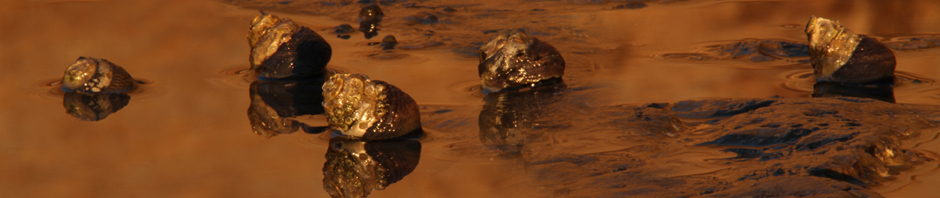
Recent roiling waters dislodged some mussels and goose barnacles and tossed them on the beach.  This provided great photo opportunities.  Unlike most other types of barnacles, intertidal goose barnacles depend on water motion for feeding, and are therefore found only on exposed or moderately exposed coasts.

Since these barnacles were dislodged it was easier to see how they attach themselves to rocks and the filter system they use for feeding. This capture was possible using a 100 mm lens, mounted on a tripod.  To me they look like long toes with multifaceted nails from some ancient and exotic queendom.

I used a little fill flash and threw a black scarf in the background to cover all the distracting pebbles so that the barnacles would stand out.   I used aperture priority and get my meter (exposure) reading and then set this reading manually –  F/16 at 1/5 of a second (ISO equivalent 100).  Then I adjusted my shutter speed a little faster (because I am adding light) 1/10 of a second and dialed in -1 for my on camera flash (using a Canon 7D).

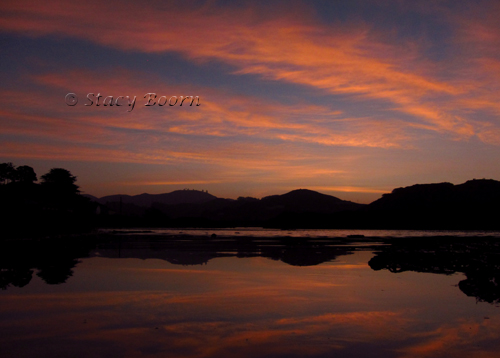
My second shot is from the same location at dawn before the sun came over the hills. The sky had just enough varied clouds to catch the dawn reds which got reflected in the lagoon.  Obviously a very low angle with a wide lens made this capture possible. Even though I haven’t used slide film in almost a decade I still underexpose for the brilliant, vibrant and deep colors of the sky.

Winter, summer, spring or fall the edge of the water is always teeming with life and mystery, beauty and unfolding story.  Usually Rodeo lagoon and the ocean meet in the winter but our lack of rain has kept the lagoon waters trapped behind the cresting berms. Maybe next week, with the long hope for rains the two will once again join in their winter sandy nuptial ritual.

Only a “record shot” but here are the goldeneyes in Rodeo Lagoon.  The colorful water is the early morning reflection of the sun hitting the buildings of Fort Cronkite.  These diving ducks are rather shy and difficult to get close to, so my 400 mm lens was pretty insufficient.

Posted in Weekly 2 | Comments Off on January week 2 – exposed on the beach

January Week 1 – Waves and Artichokes

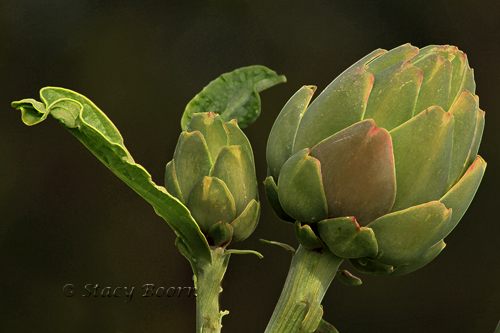
Growing up in upstate New York in a meat and potatoes and carrot/peas household I had never tasted, seen or even heard of the “artichoke.”  But having been in the Bay Area now for half of my life I am pleased to say I love that “mysterious green thing” (my first description of the artichoke).

Among the winter crops along the coast south of San Francisco you can now find artichokes being harvested.  Even though a friend thought my artichoke images blander than my child hood vegetable selections, I beg to differ.  I suppose the way in which we view images and art in general can often be that subjective, magnificent to one and less than note worthy to another.
What makes this particular image of the artichoke pleasing to me is its simplicity although it is a blossom among thousands.  I used my 100 mm lens at 400 mm to isolate the two artichokes and found an angle where the distant trees were in the background making a pleasant darker solid color (using an aperture of f/11 the background was totally out of focus because it was so far away).

Even though I find that the artichoke on the right is a little heavy and makes that side of the image lopsided it keeps you from exiting the image as you read it from left to right.  It is about green that is not from peas or pine….

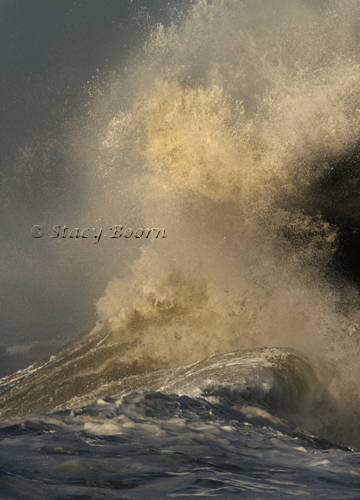
The crop was growing along the edge of the ocean near Davenport on Highway One south of San Francisco.  Later in the week the waves along the coast were doing their winter ritual swirling dervish motions and splashing.  One needs a fast enough shutter speed to prevent the image from being a blurry mess (say 1/1250of a second).

Early morning light on the splashing waves makes for stunning images.  Occasionally waves break against each other, or so it seems, and their splashes celebrate their coming together.  The spray of these waves welcomed the 12th Night as ceremoniously as baptismal sprinklings from the font.

As Kahlil Gibran offer us the “Song of the Wave” as a love poem may “Visions of the Waves” evoke in us poetry in motion to celebrate love and life.  Or am I all wet here? (I would have been with 18mms!)

Posted in Weekly 2 | Comments Off on January Week 1 – Waves and Artichokes

December Week 4 – Auld Lang Syne

At the end of the year and the precipice of the next you hear the various musical renditions of Scottish Poet Robert Burns’ 1788  lyrics  “Auld Lang Syne”  written for a traditional folk tune.  Billy Joel performed “Auld Lang Syne” in his live CD titled 2000 Years: The Millennium Concert, and is known to perform it in his concerts during holiday seasons (my favorite)!

Pretty much the words mean “days gone by” or “old times” which we want to remember fondly and not forget yet at the same time look expectantly  to what the new year will usher in.

The San Francisco waterfront intones those sentiments in its holiday lights leading up to New Years.  A wonderful time to photograph holiday lights and skylines is for 15 minutes after sundown.  The sky still has color in it and the edges and silhouettes of the buildings are not yet merging into the darkness of the night.  (Photographed from Pier 1, also a good winter AM location where the first rays of sun turn all the Ferry Building windows orange.)

The lights reflecting in the foreground bay waters become a silky glow when using a slow shutter speed.  At ISO 100 and f/22 you need about 20 seconds to capture the image.  If you want your street lights and other lamps to star set the aperture as small as possible  (f/22, f/29, f/32) while using a fairly wide angle lens.  You will get some vignetting and key-stoning but these can be corrected in your processing software (Photoshop, elements, lightroom, etc.) under lens correction or perspective correction.   Or you could leave it as is for a rather eerie feel.

If I have photographed something grand I enjoy including something intimate or just a portion of the extensive subject.  This section of the bay bridge was photographed in the last light turning the gray painted cables and towers silvery-gold.  Diagonal lines are much more dramatic so why not tilt you camera to add them to your composition.

“And there’s a hand, my trusty fiere !
and gie’s a hand o’ thine !
And we’ll tak a right gude-willy waught,
for auld lang syne”


Posted in Weekly 2 | Comments Off on December Week 4 – Auld Lang Syne

December week 3 – Winter Solstice Light

“Let there be light” could be a scientific equation as well as a metaphorical and experiential spiritual quest.  This past week I felt the divine presence creeping down the sides of one of San Francisco’s recently built 42 story luxury residential complexes.  And there was light and it was exhilarating.

Ireland’s most notable icon is the archeological site tomb of Newgrange built over 5,000 years ago.  It predates Stonehenge by 1,000 years and the Egyptian pyramids by 400 years.  What makes it phenomenal is not only it’s size and age but its connection to the winter solstice.

The monument was designed to capture the first rays of sunlight on the morning of the Winter Solstice, no doubt ritualize the reminder to the people that they are coming out of the darkest of times and will be birthed again into the light.

Indeed, the whole monument was designed around capturing the first rays of sunshine on the morning of the solstice.  The San Francisco Chronicle on the morning of the winter solstice had an article noting that some 60 (those known) Spanish and/or adobe churches built 200 years ago or more recently have a center aisle and altars that catch the first rays of sun on the winter solstice and bath their tabernacles in golden light.

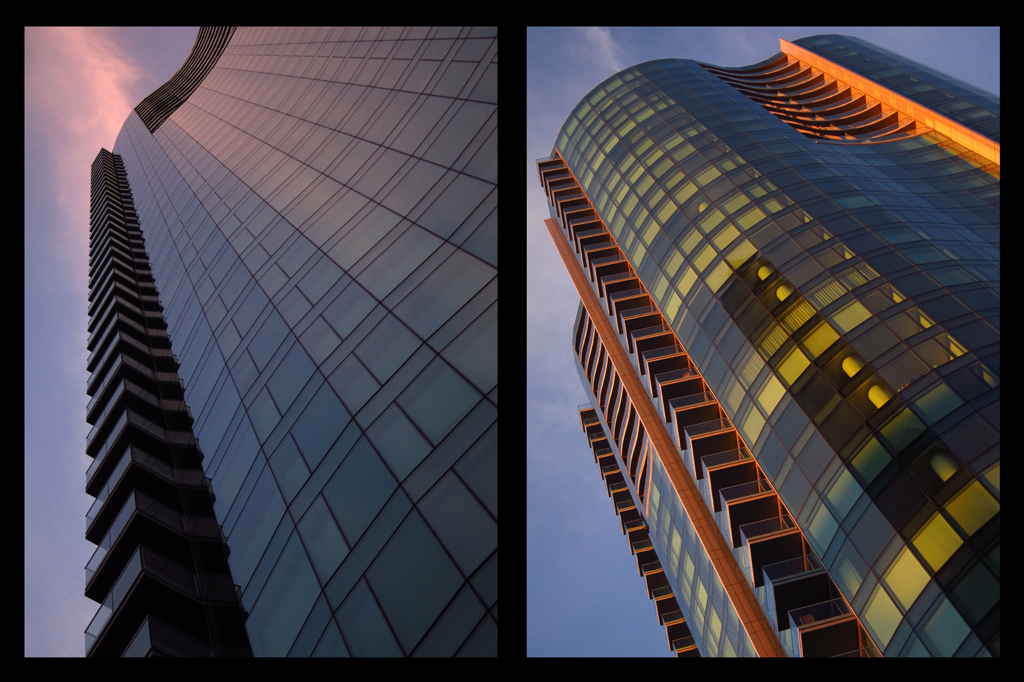
I don’t know if the architects/designers of the Infinity Towers in San Francisco had faced their buildings in such a way to change the colors of their windows and decks from green/blue to orange and yellows when the winter sun hits them.  But that is the phenomena I saw this year.  The arrival of the first rays of winter solstice light a signal of the lengthening of the days and the return to life from the depth of the tomb or womb.

Capturing this is worthy of prize winning images.  I have included one of the buildings before dawn, beautiful in itself and the other as the first light hit its same colored windows and decks.  The second shot is the two buildings in one image using the windows of one building as a mirror for the other.  The Infinity at 300 Spear Street is a mixed-use residential condominium development.

The Infinity 2 bed and 2 bath condos are out of my price range at a mere $999,000 to 1,250,000. But their beauty is available to every one’s digital single range lens cameras or point and shoots.  Look up and go wide!

A second day of walking near the financial district between 7 AM and 8 AM also provided beautiful light turning concrete buildings to golden surging rockets.  Wide angel will distort the buildings with various degrees of key stoning.  Instead of seeking perspective correction with a Tilt and Shift lens or P\perspective correction software go for the skewed look which adds drama and motion to the monoliths.

Yes, “Let there be light” to show us beauty and move us to just and peaceful commitments for the coming new year.  And within it I suspect we will see the divine presence. Merry Christ-Sophia-mas!


Posted in Weekly 2 | Comments Off on December week 3 – Winter Solstice Light

December Week 2 – Fog and Fly Amanita Mushrooms

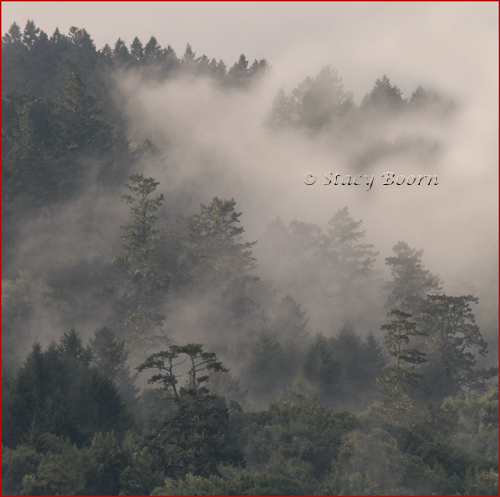
Although we have had dry days in the Bay Area we still see weather changes in temperatures and the various kinds of fog it produces.  Fog rising from the forested hillsides along the Tomales Bay at Pt. Reyes is a beautiful sight.

As I was watching the details of trees coming and going in the uphill movement of the fog I waited for a ray of the morning (low angled) sun to find a break in the horizon clouds.  I knew a little bit of light could nicely accentuate a foreground tree.  I choose a 400 mm lens to select a portion of the forest.  You want a fast enough shutter speed to freeze some of the motion of the fog in order to give it texture.  Other wise you just get a wash of white.

After an hour the fog had vanished and the trees in their entire splendor were left to be bathed now in sunlight.  One would hope that the leaving of the US troops from Iraq this day might go as well leaving behind the splendor of what is in that countryside.  But after so many deaths and so many years of war the lifting of the fog is probably more akin to the extinguishing of a firewall.

Underneath the trees on that hillside, peeking through the fallen pine needles is the community of Fly Amanita Mushrooms.  This year they are not too plentiful without the seasonal rains but still brilliantly dressed in red.

They tend to grow in little clumps reminding you of family units. They are the “Fairy-tale” toadstools.  But don’t eat these gorgeous mushrooms other wise your spirit will be going the way of the rising morning fog.

A grouping of three mushrooms reminded me of the “holy family” we encounter this time of year, a sign of hope and peace for the greater human family. Since the Fly Amanita will not flee your frame I suggest you spend lots of time with them. Pay attention to the background so that it best compliments your subject. With this image I looked from several directions but found that including the near by tree trunk worked best.  And getting just the right composition is worth the time it takes to look at your subject from every angle. This is where live view is a real help (even better than a right angler viewfinder). Getting low on the ground is a must.  With lack of rain I didn’t have to lie in the mud!

With prayers for the victims of the flooding in the Philippines I offer these photos in their honor and blessings for your holy days.

Posted in Weekly 2 | Leave a comment

December Week 1 – Foam and Fenders

Light is the magic word for photography.  In fact photography is exactly that “painting or drawing or imaging” with light.  As I have mentioned time and time again, the intensity of light changes depending on time of day and season of the year.  The light at sunrise and sunset can turn an otherwise ho-hum image into an eye popper. Low angled intense light brings enchantment to even the most mundane subjects.

The winter is a wonderful time to use this light. Sunset comes early in the evening or late afternoon.  So you don’t have to spend 16 hours waiting for it.

This beach foam and reflected cliff side in low-tide water-covered sand is an example of late afternoon light making everything from the water to the foam bubbles glow.  To accentuate the relatively large clusters of sea foam I used a wide angle, 18mm lens.  I was not using a full frame sensor camera so the 18 mm is about 28mm, which is still quite wide.  Also I got down very low and very close to the sea foam.  It reminded me of “snow banks.”  Having grown up in upstate New York my fond childhood memories include jumping into 3-6 foot snow banks.  But now I prefer the ocean side and my feet in the sand.

I use a tripod nearly 95% of the time.  But on the beach it was easier to fall to my knees and plant my elbows in the wet sand.  I also needed a fairly fast shutter speed (1/250) to freeze the movement of the sea foam that was gliding along like ice skaters pushed along by the strong winds.  Yet I still wanted a pretty small f-stop to get great depth of field (in focus from close to far),  f/22 in this case.  As I walked toward the surf I was able to position myself at an angle to the sun and the cliff side so that my polarizing lens was pretty effectual.  This will make your colors richer and cut some of the glare off the water – but don’t rotate it too far otherwise your reflection will disappear.

My second shot was captured with my PowerShot S95 while walking at sunrise in Sausalito.  An old Chevy pick-up was parked on Bridgeway.   I might have normally passed it by but Photochrome has on its agenda for 2012 a “headlights and grills” theme night.   The fun thing about having assigned subjects or concepts is that it opens one up to a wider field of view.  Again it was the light and angle that made this picture.

It is no wonder that all which is holy and sacred, peaceful and just (God/dess) is called the “light.”  Of course, without it’s partner “darkness” the metaphor and reality of light has little power.  So as we head toward the winter solstice and experience again the shortest day and longest night we are reminded of painting with light and awakening our hearts and souls to that which is “awesome and good.”

Do join the community of herchurch in San Francisco for a candle light Christ-Sophia Mass on Sunday December 18th at 10:30 AM to celebrate light and darkness and the rebirth of the Divine Feminine in our world and hearts.  Blessed Be!  Enjoy the brass quintet, harpist, inclusive hymns and inspiring word/wisdom.  And there is a lunch provided afterwards.

We are at 678 Portola Dr.  And then you can hoop over to A Woman’s Eye Gallery where we are having a colossal sale – all images are 25% off.  (Okay, this has now officially become an advertisement).

Posted in Weekly 2 | Comments Off on December Week 1 – Foam and Fenders

November week 4 – Thanksigivings and Transformations

Just 40 miles northwest of San Francisco you will find the awe-inspiring diverse ecosystems of Point Reyes National Seashore. My favorite route is Necasio Valley Rd into Point Reyes Station (stopping for the Bear Claws at the Bovine Bakery) and  then along Tomales Bay to Inverness and the western most parts of the park.

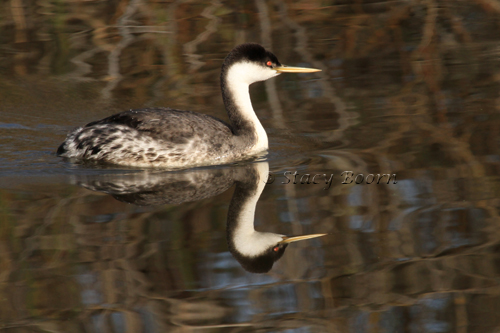
The southern end of Tomales Bay is feed by the Pepper Mill Creek and wetlands and the north end joins the Pacific Ocean and Bodega Bay.  With the tides the profile of the bay is constantly changing.  Mud flats and migratory birds  (like the Western Grebe, below) are impermanent parts of the puzzle.  Black Mountain, often reflected in the creek and bay, rises at the southern end behind the town of Point Reyes Station.

On the east side of the bay which you can follow on State Route 1 you traverse rolling grassy hilled dairy farmland and oak woodland.  The west side is the Inverness Ridge forested by Bishop Pine and Douglas Fur.  This was my destination to hunt for mushrooms which begin to be plentiful after the first rains of fall.

But the morning light was gracing the creek and beckoned for me to create a wonderful set of images.  Sometimes in pays off to stay and photograph in the same area or return there different times of the day. Make panoramas or crop for one when you have a stream, creek or river.  I think it gives you the sense of a long flowing artery.  The low light and the clouds are what makes this image pop.

Between the morning and late afternoon light on Pepper Mill Creek I enjoyed photographing some images around the parking lot for Shell Beach.  Many mushrooms grow on the fallen and decaying limbs of the pine and fur trees.  My approach to the mushroom is to capture them as art in nature thus not making it necessary to always use the image as a means of identification.

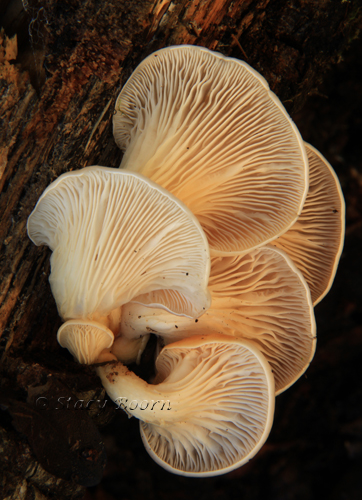
Mushroom and fungus photography requires getting low – either on your belly or sitting down and communing intimately with your subject.  Here I usually prefer a 100mm macro or my 28-135mm lens.  Since the gills of many mushrooms can only be seen from the underside you need to get very low.  Or in this location just turn over the fallen limb as I did to reveal the beauty of these oyster mushrooms.

“Pleurotus species are characterized by a white spore print, attached to recurrent gills, often with an eccentric (off center) stipe, or no stipe at all.”  Its name comes from the white shell like shape and not it’s taste.  Although I think they are edible.   But I am not going to try it even as “Oyster Mushrooms Rockefeller” unless served in a restaurant.

I used a reflector to give this grouping a golden glow.  If you were making this a scientific recording you would want them to be their true white color. Needless to say with a DSLR you need your tripod so that you can use a small aperture, like f/22 to get depth of field (focus) in all the mushrooms.  This will give you a relatively slow shutter speed.

But I have seen people with their point and shoot walk up, stick their camera under the mushroom about an inch away and walk away in less than a minutes’ time.  Turns out their image rivals any I have spent hours on – except for the large format print I will make afterwards! And hopefully my composition and lighting.  For me creating imagery is a form of visual thanksgiving and transformation while being connected to the source of all that is.

Posted in Weekly 2 | Comments Off on November week 4 – Thanksigivings and Transformations