June Week 3 – Mill and Marmot, Justice and Love

With each particle of my soul and cells I sensed that the ground on which I was walking was holy.  Each step seemed heavy, and not because of the heat and high humidity but because of the humming of the voices of history that resonated from the very soil on which I stood.

I was in Seneca Falls, New York, making my way from the visitor center at the Women’s Rights National Historical Park to the home of Elizabeth Cady Stanton.  I passed some buildings on the main street that were over 200 years old and still in use.  These buildings are along the Seneca River and Canal.  Across the canal is the old Seneca Falls Knitting Mill.

Elizabeth Cady Stanton was one of the key figures at the first Women’s Right’s Convention in July, 1848.  More than 300 people crowded into the Wesley Chapel where the “Declaration of Sentiments” declaring that “all men and women are created equal” was presented.

Mary Ann and Thomas M’Clintock, Quakers and leaders in the abolition movement, hosted the meeting for the writing of that declaration.  Relatives Jane and Richard Hunt owned a knitting mill (I don’t know if it was this one) and refused to use cotton in their clothes or any other material in their garments that had been produced by slave labor.

The crumbling mill creates a beautiful image when reflected in the still waters of the Seneca River.  Puffy clouds surrounded it in the morning but knowing the light would be much better in the early evening I returned then.  The low angle of the light and the stillness of the water take this image from being a record shot to a beautiful rendition of a surviving part of our past.  “The National Women’s Hall of Fame is engaged in a vigorous capital campaign to renovate the historic Seneca Knitting Mill.”

Wanting to portray the “old and lasting” nature of the building itself I later applied Old PhotoPro to the image (a free app downloaded on my iPhone).  Although I captured this image many times with my Canon D7 this image was taken with my iPhone.

Voices from history as well as in nature can energize our own creative vision. The high pitch shriek of a marmot alerted me to her presence as she staved off a hawk above her young.  I share this Golden Marmot image with you because it is so darn cute (or so I think).  Marmot mom seemed to really love her offspring!  Spending a little time observing animal behavior helps you anticipate their movements.

Using a 400mm lens I was able to be far enough from the marmots to not be intrusive and close enough to get frame filling images.   Get down low so that your lens is at eye level with your subject!  Voices from history and the wild are unmistakable cries for equality and respect!
Posted in Weekly 2 | Comments Off on June Week 3 – Mill and Marmot, Justice and Love

June Week 2 – Glacier Lily and Old Faithful

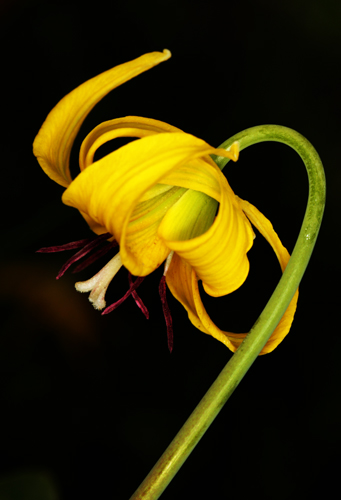
One of the things I love about a wildflower is its common names which often changes from location to location.  There is a wonderful image of a wildflower my mom took, dad printed and framed, at my parents’ home in Schenectady, New York.  It is a local plant called the Yellowbell or Yello Violet.  I haven’t seen this flower in a long time and was pleased to walk among them under the Douglas Fir, Englemann Spruce and Lodgepole Pine trees in Yellowstone.  There it is referred to as the Glacier Lily.

The Glacier Lily,  like many of the Yellowstone flowers that I encountered, were very low to the ground so joining them there was an imperative.  By using my ring light flash I was able to isolate them from a distracting background that was only inches away from each bloom.  Although  they are a considerable size, one inch or so in diameter, I used a 100mm macro lens. I found my favorite patch at the parking lot to the brink of the Upper Falls in the Canyon area.

Because the hydrothermal areas are so unique and attractive one might pass by all the wildflowers.  I scheduled a day to seek them out.  But the day I scheduled was extremely windy and cold.  Regardless, you can always photograph another pool, mudpot or geyser.  That is exactly what I did when I drove from my planned photographing area in Mammoth Hot Springs (especially for the Larkspur) to West Thumb Basin where there are geysers and pools along Yellowstone Lake. The $.50 trail guides for each area are really informative and pinpoint each feature.

After the 100 miles with some stops for “bison crossing the road” I arrived at the edge of the lake greeted by beautiful puffy clouds.  The sunny 16 rule and puffy clouds, postcard making weather, is still a proven asset to photography.  My favorite spot here was Lakeshore Geyser which is under water in Spring and early Summer.  It has two vents and gives the water above it a little ripple effect.  The last eruption was seen in 2003 and it was only a couple of feet high.  Earthquake activity often changes the arrangement of the geyser “plumbing” so the activity of the geysers is subject to change.

If you don’t need to rush to the next site, waiting for the movement of the clouds can dramatically change your image impact.  My mantra:  “Good sky use it, bad sky leave it out.” And by the time I walked around the boardwalk area a second time the sky was all filled in with clouds so I knew it was time to return to the wildflowers.

Being in the same location for more than a few days allows you to return to interesting sights when the light is better situated for capturing a pleasing or emotive image.  Photography for me is not about recording what you see but visually sharing what soul/heart, mind and body are experiencing.   To do this I try to mesh my best aesthetic and technological skills together.  From my soul to yours! (Old Faithful Geyser, above).

Posted in Weekly 2 | Comments Off on June Week 2 – Glacier Lily and Old Faithful

June Week 1 – Yellowstone

I spent six days at Yellowstone National Park. It’s our first national park and this was my first visit. It’s an amazing place with beautiful geysers, hot springs and pools, animals and mountains, snow and sunshine, rivers and raptors.

The one photographic tool that I used the most here was my polarizing filter. Although, now I have to replace it, because all the mist and spray from the geysers can quickly spot and pit your filter or lens. So having the filter on the lens was good protection. But also it made for wonderful deepened blue skies and rich colors when the sun was at its low angles in the morning and the evening.

Although it was June, most days started out at 30 degrees and some snow. Stormy weather often gives you wonderful clouds – so don’t stay in bed.  To prepare for this tip I used a book I highly recommend:  “Photographing Yellowstone National Park” by Gustav W. Verderber.  This was a solo journey for me which I highly value although miss conversation and community reflection.  The advantage is that you have total control over your movement and time frame.  But it is harder to get out at 4:30 AM to find your sunrise location.  (To witness I have no sunrise shots.)

Early morning journeying in the park is essential if you want to capture some of the wildlife at their most active times.  But he bison will roam on the road at almost any time of the day.

Yellowstone is one huge volcano and has more geysers than any place in the world.  The caldera itself is some 30 by 45 miles.   The colors in the geothermal areas vary from grays, oranges, blues, yellow and every other color.  Many of the colors are caused by bacteria which grow in the hot waters.  This post gives you three of my favorite shots and the next post the next three.  Yellowstone National Park was a 6 day stop for me as I am driving from San Francisco to Schenectady, New York and back.

Grand Canyon of Yellowstone

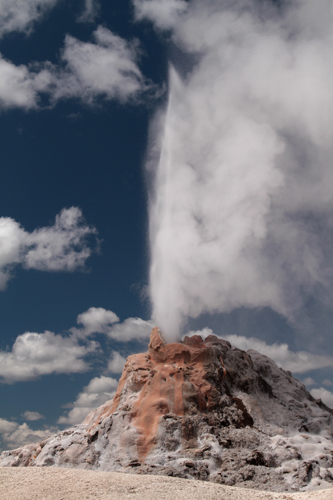
Some of my favorite bubbling caldrons and exploding fountains of hot water were foun on the Firehole Lake Drive just north of Old Faithful (which is worth seeing but not the most photogenic).  On Firehole Drive I stood at the White Dome geyser, pictured above, for about 30 minutes and then was engaged by its towering thin spray which lasted a couple of minutes reaching probably 50 feet.  The clouds and the mound colors help make this image. Geysers and pools can be easily photographed from 10 AM – 4:00 PM when the direct sun brings out the water in the pools.  The bluer the pool the deeper it is I understand.

An easy everyone-gets-shot is the Grand Canyon of Yellowstone.  And at 9:45 AM a luminous mist turning to rainbow appears on the lower falls, visible from Artist Point which is a short walk from the parking lot.  In this image lower falls is at the top and upper falls is not viewable.

I found that there was nice light in the canyon also in the afternoon.  There are plenty of people around but they come and go and even in these crowded areas if you hang around there are moments when you have the views all to yourself. One of the greatest gifts to yourself in a place like this is “unrushed-time.”

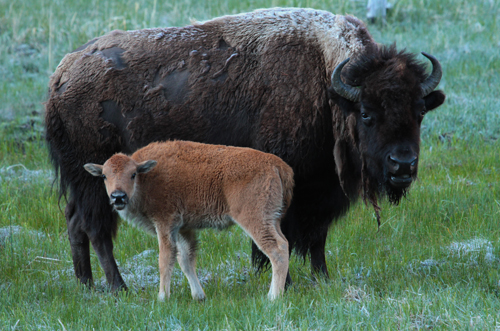
In addition to the geysers, hot springs, fumaroles and mudpots one obviously goes to Yellowstone for the wildlife.  I did not see any bear or wolf but rejoiced in all the bison and their calves that filled my frame.  At this time of year the little ones are still auburn orange and at day-one they are jumping and running and keeping up with the heard.  Already they are head-butting one another between feeding times.  Using a 100 – 400 mm telephoto lens brought me in tight enough at times to see the sparkle in their eyes!

Why we humans try to control and thus corrupt the earth remains a sad mystery to me.  Standing in the grandeur of Yellowstone is a great reminder that we are but one small member of the Mother Earth and the beautiful web of life she has spun!

Posted in Weekly 2 | Tagged , , | Leave a comment

May week 5 – The Golden Gate and Gertrude

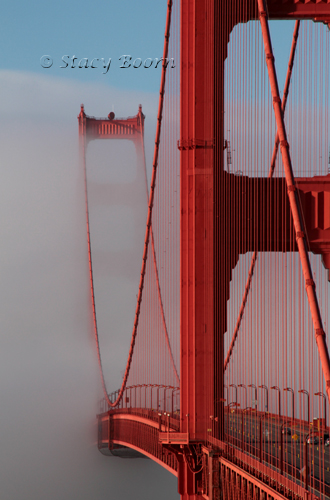
This past week the hoopla in San Francisco was swirling around the Golden Gate Bridge as she turned 75.  Crowds gathered to commemorate this architectural marvel with tributes, parties and fireworks.  The towers and cables were bathed in memories and celebrations.  But for me it is the almost daily dance of the fingers of fog under and over the bridge that best partners with the bridge to showcase her beauty.

The overlook on the north side (Marin) of the bridge is the most tour visited vista so I avoid stopping there for the view or a photo op.  But today it was the place to be.  The early morning rays and the position of the fog only lasted long enough to get out of the car, set up and make a couple of captures of our iconic span.

Since it opened in 1937, more than two-billion vehicles have crossed the 1.7-mile-long bridge named after the Golden Gate Strait, the entrance to the San Francisco Bay from the Pacific Ocean.

Using a 200 mm lens the two Art Deco towers appear closer to each other than they actually are (compression).  One tower was in sunshine and one tower (South) disappearing into the fog.  I wanted to give the impression that perhaps the bridge comes to an abrupt end in mid air causing us to wonder if there is any thing else hued in “International Orange” beyond our view.

The Golden Gate Bride was the most famous project of the Morrow and Morrow architectural firm of the 1930s.  Yes, one of those Morrows was Gertrude, although she did not get credited for her consulting work in the design of the bridge with her husband and consulting engineer Joseph Strauss.  (See Early Women Architects of the San Francisco Bay Area by Inge Schaeffer Horton)

It is about this time of year that the grasses and shrubs on the hills, in Marin County and at the San Francisco entrance to the bridge, begin to turn golden.  But the wildflowers that are usually waning are still plentiful. The yellows are normally just coming into their own in the summer months.  Two very accessible and bountiful wildflower blooms are found along the road in the Marin Headlands and the parking at Lands End Lookout.

A new find for me is the Fitch’s Spikeweed whose bud tips are “International Orange.”  The beautiful defused light in the fog is perfect for photographing wild flowers.   I did add a little fill light to this shot by simply using the pop-up flash on my Canon 7D with a 100 mm macro lens.  If I were any closer the flash would not make it over the lens to the subject. (In that case come back on a day that isn’t windy – good luck at finding a calm day!)  Although, with all this beauty – the calm really  begins from within.

Happy 75th!

Posted in Weekly 2 | Comments Off on May week 5 – The Golden Gate and Gertrude

May week 4 – visual prayer

 
Place a flower
   it the hand
   of the Buddha
 
Place a flower
   in the heart
   of your love
 
Place a flower
   on the path
   of those who
   struggle


their scattered seeds in the lands 
become justice’s  replantings.
 
-Stacy
Posted in Weekly 2 | Comments Off on May week 4 – visual prayer

May week 3 – Diagonal drama from fence to flower

Fences with rusting nails and rivets, peeling paint and metal spikes on brick corners can make for interesting abstract images especially when illuminated by early morning light.  This series of details is on the fence enclosing the PG&E pump station from public view right next door to me.  So no long jaunts for these kinds of images.  Diagonal lines and complimentary colors emphasize these abstracts.

If you don’t want to deal with Photoshop or other processing programs you can do some creative tweaking in camera.  For example I like to change the white balance.  Often I will set my white balance to “flash” when I am not using a flash.  This acts like a welcomed warming filter (81B)in many nature settings.  On this fence the metallic knob was almost a flat cobalt-blue color, but with the morning light and the white balance set to “flash” it brought out the rusty-orange which I prefer in this image.

Details and abstracts of larger views create a new world in which you often cannot determine the actual scale of the things in the picture. This tends to hold the viewer’s attention when she or he is trying to figure out what they are looking at.  And all the more better if they never figure it out.

Returning to a familiar location can often pay off especially if the changing weather disrupts a predictable bloom.  That was the case for me when finding a few wild columbines blooming at mile marker 12.43 on the Fairfax Bolinas road heading toward Stinson beach.  A month ago the grasses, plants, scrubs and branches had been cut down along the road and it looked like these plants would only be blooming down the near cliff slope.

Beautiful is the red crimson columbine
    like a fire cracker ablaze in the forest
Dancing to a mellow tempest
Blooming the orange-gold smiles
   of the waning spring
Edging the roadside of wonder
   and bringing joy to the soul
   of earth and her two legged travelers.


Wild Columbines are difficult to photograph because their stems are so thin and long that even the gentlest of breezes will set the flower in rapid motion.  Using a flash can help greatly so that you have a fast enough shutter speed to freeze the motion caused by the breeze.  This way you don’t have to shoot wide open which gives you very little depth-of-field.  Better to let the background go black, due to the distance the flash is able to land on, than to have a blurry image.

In fact I like a black background occasionally with a wild flower.  Although your viewer might not know the image was captured in the wild.  Positioning the Columbine’s stem in a diagonal from left to right (like the fence crack and rivet) provides drama and excitement.

Posted in Weekly 2 | Leave a comment

May Week 2 – We Have a Beautiful Mother

Orche Star Eats Clam

I am posting these images on “Mothers Day.”  This day’s origin began in 1870 with Julia Ward Howe’s call to women globally to unite and declare a day for protesting war and seeking ways of peace.  12 years after she wrote the lyrics of the Battle Hymn of the Republic, not a “feminist theme song,” she was tired of war and killing and declared “From the bosom of a devastated Earth a voice goes up with our own, it says Disarm! Disarm!”

I offer you two images (photographed in the second week of May) from the body of mother earth: “Tears on an Iris” and “Star Eats Crab.” On this Mothers Day we each remember our mother and all mothers we know, Mother Earth and the Eternal God/dess Mother.  The words of Alice Walker enable us to do just that in her poem “We Have A Beautiful Mother.”

  • We have a beautiful
    mother
    Her Hills
    are buffaloes
    Her buffaloes
    hills.
    We have a beautiful
    mother
    Her oceans
    are wombs
    Her wombs
    oceans.
    We have a beautiful
    mother
    Her teeth
    the white stones at the edge
    of the water
    the summer grasses
    her plentiful
    hair.
    We have a beautiful
    mother
    Her green lap
    immense
    Her brown embrace
    eternal
    Her blue body
    everything
    we know.
    Shallow depth-of-filed used to select focus on water (f/2.8  – 100mm  macro lens, diffused light, reflector)
Posted in Uncategorized | Comments Off on May Week 2 – We Have a Beautiful Mother

May, week 1 – In the Fog

400 mm lens compresses hills

Photographing fog can produce eerie and moody atmospherical images.  Although, often a fog subject will provide little contrast and look flat or washed-out.  Photographing in fog is like shooting in a natural light box which defuses and evenly scatters the light.  This works very well for outdoor portraits and with wildflowers.  The morning fog is also beautiful as it hugs the Marin Headlands and wraps around our sky scrapers.  An excellent place to view this is from Mt. Tamalpias.  Since the fog is lighter than a medium gray (tonality) I remembered to over expose the shot by one stop.  I prefer to make as many good technical choices in camera as possible, even though you could do all this in post-processing.  But if you begin with an excellent capture, both technically and aesthetically pleasing, the end results will always be stunning.

Often the fog roles in and covers San Francisco in the evenings.  I noticed how golden and muted the lights of the street and city became with a blanket of fog bedding us down for the night.

Peering through the church kitchen window after an evening meeting I noticed the swirling fog was muting the streetlights.  A row of glass vases sat on the sill as the street lights shone through them.

I had been meaning to get rid of some of these dusty old glass flower vases but this particular night caused me to recant my resolve because the colors of the night lights were glowing orange and gorgeous through them.  Without the fog to mute the harshness of the bright lights this shot would not have been as attractive.

There are images in every path of our vision waiting to be seized by our hearts, minds and palettes (camera or other media as you wish).

Posted in Weekly 2 | Comments Off on May, week 1 – In the Fog

April Week 4 – Wet and Windy yet Exquisite

Water and wind can be two of the most frustrating elements for a photographer yet at the same time they are two of the most creative tools in image making.  I encountered both these elements this week at the same time.  Although resigned to be blown home by the coastal gales, colors and patterns kept presenting themselves to my viewfinder.

Right now the wild Douglas Irises are peaking at Point Reyes in the pastures, along the roads and at the cliffsides.  But they were hysterically dancing the zumba. (Zumba combines Latin and International music with a fun and effective workout system.)

The fog was low and dripping which made every thing wet. This low fog makes neat little dew drops which are impossible to photograph using a flash.  (Even a diffused or fill flash get’s reflected in the water and droplets).   So what to do?

I set a wide open aperture (2.8) on my macro lens. This captures a very shallow depth of field – a few of centimeters at most.  I would rock back and forth with my subject until a small section of the image came into focus.  Try high speed continuous shooting to guarantee that one of the blowing petal edges ends up in your field of focus.  In the end my imaging in the  Iris and Butter Cup patch was about color.

No spray bottle can reproduce the kind of balls and diamond shape dew that fog leaves behind, especially on Lupine leaves.   A coastal patch of ground lupine growing among ice plant at Duncans Landing just north of Bodega Bay was full of fresh fog-created jewels.  Here I wanted as many of the water drops and leaf edges to be in focus as possible.

I like to saturate the colors so the foggy day and underexposing the image helped deepen the greens and blacken the shadowed background.  Just when the weather, again, seemed so uncooperative for wildflower photography its inclemency turned to creative possibilities.

The commentary this week may be more for photographers but the images are for everyone – enter their beauty and be blessed.

Point Reyes National Seashore turns 5o this year, and it continues to be one of the Bay Area’s most popular and significant parks with its diverse ecosystems, beaches and wildlife.

Posted in Weekly 2 | Comments Off on April Week 4 – Wet and Windy yet Exquisite

April Week 3 – Iris for Earth Day

As we celebrate Earth Day I offer you these images to highlight the beauty blooming profusely from our parks to coastal dunes: the purple wild Douglas IRIS.  It is a common native flower in coastal areas of Central and Northern California as well as Oregon. Many clumps are peaking right now in the pastures and the grasslands of Point Reyes.

But this beauty is regarded as a noxious weed in the pastures because it inhibits other vegetation, and its leaves are bitter and unpalatable to the cattle.  Fortunately we just eat it up with our senses, souls and sensors.

For all three Iris images I used my 100 mm macro lens with a Canon Ring Lite MR-14EX Flash.  Because the background leaves were so busy I used the flash to eliminate the distractions (the light of the flash did not reach them, making the background black).  Closer leaves received enough of the light from the flash so that a hint of the environment was included in the image.

        “We give thanks to you, dear Earth,
          For your gifts so rich and rare,
          For new life you bring to birth,
          Teaching us your tender care.” 
                Hymn by Jann Aldredge-Clanton
 

The second image is first light shining on an old tug boat.  I liked where the shadow of the ladder fell.  As well the simple combination of three colors:  red, white and blue makes this capture a strong image.  Noticing lines and design is a fun self imposed photo assignment.  This tug boat was rusting in place but the glowing morning light gave it new life.

Posted in Weekly 2 | Comments Off on April Week 3 – Iris for Earth Day