September week 5 – Look and Look Again

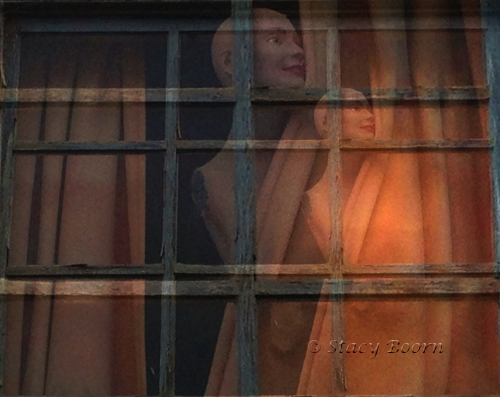
Sept 5 - Window webAs a child I liked to play the game “Look and Look Again.”  At least that is what we called it.  Items were placed under a towel and then the towel was removed for 15 seconds.  We were instructed to use that brief time  to look at everything.  Then the items, such as a rubber band, fork, light bulb, pine-cone and bottle cap were covered back up.

Next we were asked to list as many of the items we could remember.  Often I remembered all of them, but I never won the game because I didn’t know how to spell many of them and was too afraid to make that known.  So consequently I would only have a few items listed on my piece of blue-lined yellow paper.
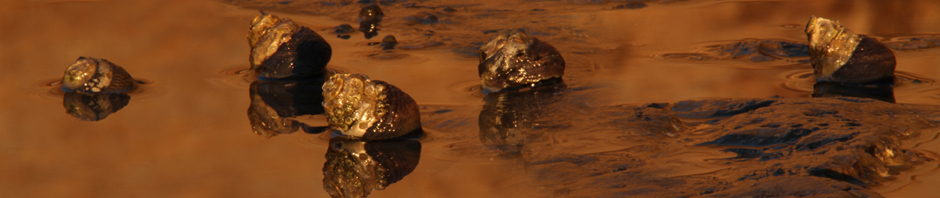
Sept 5 - boat detail webI have used a similar version of this game with a handful of girls aged 6–10 in our “Spirituality for Girls” program.  As their teacher, I chose most of the items to spark conversations that would lead us into the theme of the day — things like a Goddess rosary, purple candle and Tibetan bell.  I would throw in some other things just to make it seem less obvious — chewing gum and ear rings.

Remembering my own embarrassment about spelling, I gave the girls a choice of making a list of the objects they saw or drawing them.  One of the girls always tried to fool me by drawing some of the same items two or three times.  And when I caught on she changed her method to drawing the same items in different sizes and facing different directions.  It turned out that these were wonderful pieces of art in and of themselves and not just a way of beating the system.
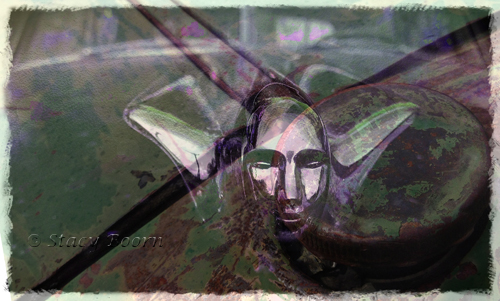
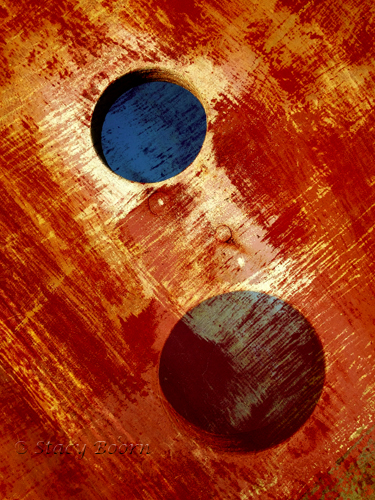
Sept 5 - Car Orna webLook and look again at these images.  They are double exposures.  This method transforms the original subjects and offers a new presentation.  I am not going to tell you what they are otherwise your imagination might not choose its own path.  Too much commentary, rubrics, explanations, rules and instructions can become obstructions to the unfolding mysteries worthy of encounter and experiential exchange.

That probably extends to the Great Mystery as well.  (Great Mystery is a term used by some Native Americans for what we call God/dess.)

OKAY -  if you really need to know:  a boat detail, car hood ornaments, and a mannequin were the starting points for these images.  These double exposures were created in post-processing, but now, finally, Canon gives us a reasonably priced 70D which offers in-camera multiple exposures.  Nikon, I hate to admit, was ahead of the game on this one.

Look and look again.

Posted in Weekly 2 | Tagged , , , , | Comments Off on September week 5 – Look and Look Again

Reflections – more than a mirror image

AK-bouyReflection web

Small Boat Harbor detail – Valdez

There are a number of ways to digitally create reflections and mirror images, but I still seek them out as they are naturally unfolding.  Often their perfect symmetry is unpredictably interrupted by something as simple as a jumping fish or wind-blown-ripple. This alteration of the reflection adds drama and esthetic nuance to my images.

Before I begin posting my weekly two images and commentary from Northern California, I am sharing with you final reflections from Alaska.  Reflection images require, of course, a body of water, even if a mere puddle.  Most of my 70 days of wandering was near, on or over water.  Water is the life blood of our EarthMother and that seemed so evident along the coastline of south-central Alaska and in the rushing glacial run-offs that feed the rivers of the interior.

AK-T Puffin web

Tuft Puffin

It often astounds and frustrates me that patriarchal religions tell us we are courting heresy when we find the ultimate sacred presence embodied in the earth.  Yet a greater respect and honor of the earth leads to nothing short of preserving, protecting and safe guarding the sustainability of the earth.

The reflections of her beauty I found in the Alaskan waters provided my daily meditations.  I was twice seeing living reminders of both the strength and fragility of the web of life. As are the reflections of our actions, the reflections in nature were sometimes images as clear as the sources and sometimes swirled and rippled into abstractions.

AKValdezReflection web

Mountains surrounding Valdez reflected in marsh waters.


The Lu-lu Belle (boat to Columbia Glacier), Black Bears, Kittiwakes, Pink Salmon, fog-shrouded mountains, waterfalls and rain were the highlights of Valdez which is located in South-Central Alaska on the northeast tip of Prince William Sound.  The population is just 4,350.  On the road system, it is 305 road miles east of Anchorage, and 364 road miles south of Fairbanks.  I found my way there at the beginning and ending days of my journey.  I don’t have one all-time favorite Alaskan location, but Valdez is close to it.

AK-BearsClaming web

Sow and Cub look for clams in Cook Inlet low tide waters

The city was founded just prior to the turn of the 20th century as a gateway to the All-American Route to interior gold and copper fields. The most notable historical events include the 1964 earthquake, being chosen as the terminus of the Trans-Alaska Pipeline and the 1989 Exxon Valdez Oil Spill. All these events intertwined with the “water” and reflect our footprint therein.

On my journey I read “Rising Voices – Writings of Young Native Americans.”  The book contains the writings, each a page or two, of over 60 young people who reflect on the feelings, moods and climates of the world of their heritage. Jennifer Yazzie, a Navajo high school student, began her entry with these words: “The wind had a message, the sun had a message, the sky had a message.  All I had to do was listen…our people are thankful for what the earth gave us.”

As I continue to reflect on the images, sounds, and sensational input from my 12,650 miles of driving among the creatures, human creations, and the big sky of the north, I am thankful for what this part of the EarthMother has shared with me.


Posted in Weekly 2 | Tagged , , , , | Comments Off on Reflections – more than a mirror image

Journey to Alaska – Post 5 – Frozen in Motion

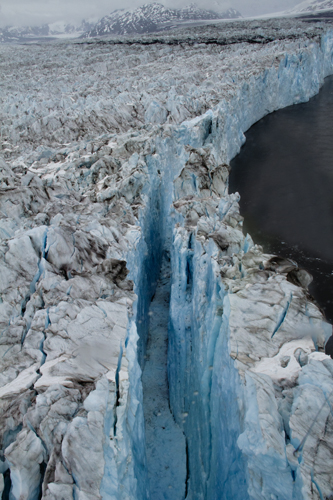
300 feet high edge of Columbia Glacier from helicopter

300 feet high edge of Columbia Glacier from helicopter

You know the old saying that “nothing is guaranteed/consistent/unchanging except for change itself.”  When thinking of dramatic changes in the vast landscape and web of life in Alaska the words motion and migration come to my mind.  The ever-daunting glaciers seem motionless, but they are always on the move.

Glacier flow destroys all life in its path. Nothing will survive its advances as it crushes forests and buries meadows, lakes, and wetlands under debris and ice.  Granted this doesn’t happen overnight.  But when the glaciers melt a whole new world is left behind. New residents move in and inhabit the plains, rivers and lakes.  Plants take hold and beautiful landscapes arise until the next glacier advances.

But naturalists, ecologists and geologists are rightfully worried that the natural courses of many glaciers are being altered at a rate the earth herself cannot handle.

Columbia001 web

The Columbia Glacier moves through three valleys.

The 2007 Intergovernmental Panel on Climate Change declared that “warming of the climate system is unequivocal, as is now evident from observations of increases in global average air and ocean temperatures, widespread melting of snow and ice, and rising global sea level.”  Fortunately we have the tools, knowledge and ingenuity to better understand these changes and make informed choices.  But do we as a species and as individuals have the “will and desire” to change our habits, consumerism, and use/abuse of the natural resources?

HSeal008a webHenry David Thoreau asked, “What is the use of a house, if you haven’t got a tolerable planet to put it on?”  And the earth is the only planet we can call home.

In Southeast and South-central Alaska the Harbor Seals make their home on the icebergs close to the face of tidal glaciers.  A seal will have her pup on the iceberg because predators like bears will not venture there. What a beautiful sight to see the harbor seals using these cold and barren icebergs as a sanctuary.

CraneFlying005 webA more noticeable movement is the migration patterns of Sandhill Cranes who have used the Tanana Valley near Fairbanks for thousands of years as nesting grounds and a stopover in their migration south.  They have been flying this route since the Ice Age.  At the end of August they begin to congregate in the fields of the once-productive Creamer’s Dairy in Fairbanks.

I was determined to spend time in Alaska photographing something new.  That subject turned out to be the Sandhill Crane. I watched their patterns of flight in the mornings and the evenings for three days.  The best time for me to catch these eloquent birds in flight, with light on their face and feathers, was in the evening as they gently flew from one field to another with outstretched necks and trailing long legs.

CranesField001 webThe young cranes are easily identified because they haven’t yet developed their red heads and use a distinctive high piping call.  My visit to these fields was at the beginning of the staging for their migration, so thousands of birds were still on the way in.  But the numbers already there made it obvious that this was their “home,” and the humans delighting in their beauty and flight were indeed the visitors.  Their flight is truly grace in motion.

For more than 16 years and at a cost of over 6 billion dollars, we in the Bay Area have been waiting for another kind of mass migration:  drivers on the new Bay Bridge between Oakland and Treasure Island.  Despite the many problems in its construction progress, the end result is beautiful and ensures our safety in an area where there is earth in motion.  Although scheduled for a Tuesday 5:30 AM opening, it looks like the chain will be cut anytime now (writing Monday at 5:00 PM).  More expensive but more modest than the November 12, 1938, opening of the first Bay Bridge, tonight’s event will still be a great cause for celebration.

Glaciers, cranes and bridge traffic are my favorite things in motion!

Posted in Weekly 2 | Tagged , , , , , | Comments Off on Journey to Alaska – Post 5 – Frozen in Motion

Journey to Alaska – Post 4

Pica webWhen the grand vistas are not visible you can always focus in on the small details, and they can be just as magnificent.  That is exactly what I had to do on my foray into Denali National Park which began on Monday, August 19.  From the precise time that I boarded the bus with thirty other journeyers to Camp Denali/Northface Lodge, 89 miles into the park, it began to rain.  The rain did not stop until after we exited the park at noontime on Friday, August 23. 
 
Denali is the name of the National Park which President Woodrow Wilson signed into law in 1917 after nearly 10 years of campaigning by Charles Sheldon.  Though white explorers called the mountain at the center of the park Mt. McKinley, for tens of thousands of years native  Athabascan people called it Denali, meaning “the great one.”   Its base begins at 2,000 feet, much lower than the base of Everest, which begins at 12,000 feet.  This means that Denali, rising to 20, 320 feet, has a greater vertical rise than Mt. Everest.  And she, the Great One, even produces her own weather patterns.  But from inside the park I was not privileged to catch even a little glimpse of her.
 
Berries webSo I looked elsewhere: down to the ground, between the trees and into their branches. I was enthralled by the wonderful colors and carpeted patterns, and creatures mostly spotted from a distance.  It was then that I saw my first Pica, a small rodent slightly bigger than a mouse whose cuteness grows on you.  But I wondered how such a small animal could survive in the harsh winters and predator-rich 6 million acre terrain.
 
Yes, how can this tiny creature flourish?  It made me think of Darwin’s theory of the “survival of the fittest.”  Just the night before, an ecologist lecturing at the lodge pointed out that Darwin’s theory had been misunderstood, misrepresented and manipulated.  He felt that Darwin actually intended to show us the survival of the “fit,” referring to the plant, element, creature, and human that was able to “fit” into its symbiotic system, a system which would promote self and communal survival.  And when we “fit” into the system, no matter how complex, those systems eventually come to find our individual and unique contributions necessary.
 
Ptarmigan with a little showing

Ptarmigan with a few white feathers showing

Therefore this theory is not about domination, brute strength, power over or oppression; rather it is like the little pica that can find its home in the rocks in the tundra and build multiple caches of vegetation for the winter.  Or the ptarmigan that is smaller than a chicken but camouflages itself among the trees and bushes, turning white in winter to blend into the snow. These are indeed the “fitting into ones.”

 
Although I did not see the “Great One,” I found valuable insight into survival for us all in the little ones who are least in the food chain and least in power and might.
 
The Great One’s base is embroidered by caribou and bears, bunch, crow, lingeon and blue berries and an ever-growing population of spruce among the scrubby tundra (the spruce are flourishing because of the rising temperatures).
 
National parks did not just happen.  More often it took heroic personalities and hard workers who understood stewardship of the land.  Challenges continue to confront the preservation of Denali:  Wolves are hunted in Alaska at the borders of the park, the climate is changing, the permafrost melting and habitats are disappearing. But thoughtful people can affect the common good!
Posted in Weekly 2 | Tagged , , , , , , | Comments Off on Journey to Alaska – Post 4

Journey to Alaska – Post 3

2 cubs 02 webIn Native American Medicine traditions it is said the Bear is the keeper of the dream time, and she stores the teachings of dreams until the dreamer wakes up to them.  Many tribes have called this space of inner-knowing the Dream Lodge.

Perhaps we should start listening to the Native Elders who provide alternative pathways to our personal and communal goals of wholeness, peace and abundance for the earth. The medicine of the bear includes a journey to the quietness of our cave where we can hibernate in silence. After dreaming we might be ready to discover the honey waiting in the Tree of Life.

This image of the bear-dream-keeper kept returning to my minds’ eye as I stood, sometimes less than 30 feet, in front of several brown bears in Lake Clark National Park.

Cub learning to clam at low tide.

Cub learning to clam at low tide.

I arrived at the Silver Salmon Lodge on the coast with 6 other photographers for a five day foray into the wilderness and among the gentle giants of the area. I never imagined we would be standing so close to them that my 100-400mm lens would be sufficient to fill my frame with their routine of munching grass and playing.  Nor did I know I would hear their chewing and breathing and cub calls.

In the wilderness areas, monitored by the National Park’s system, the bears seem to recognize the humans nearby with little attentiveness.  There are few people and none who are careless with garbage or food sources.  So the bears go about their routine of browsing the sedge grasses and clamming at low tide until the fish begin to swim upstream.  They need to eat a great deal because Alaska bears spend 5-7 months in hibernation living off body reserves.

Cub in Grass 1 webBears are difficult to photograph because their eyes are so deep set and surrounded by dark fur.  The catch lights are slightly easier to see in the cubs’ eyes.  They also seem so human like when they stand up to look for mom.  We saw mostly cubs and sows and younger females.  Boars and sows usually live separately except for the mating times or sharing fishing territory.

Playing cubs are like human siblings, rolling around one moment and then boxing and biting each other.  After they have tired themselves out they just fall over and nap until mom has had enough feeding time and then offers to nurse them.  We were so close we could hear the sucking sounds and even see the milk dribble down the face of one of the cubs. (Although still a challenge to photograph because of high grasses, merging heads and other furry bear parts.)

Bear Prints 01 web

Bear Tracks on Beach with Razor Clam Shell

After one day it felt like I was a part of the wilderness. Even though there were a dozen guests at this lodge, and the same for the neighboring two camps, there was still solitude around every bend in the river and the streams between the base of Slope Mountain and the ocean’s mudflats.  Lake Clark National Park is set aside to preserve this stunning beauty of volcanoes, mountains, lakes, wildlife, resources and the indigenous and local folks that share the land and water.

I suspect the important issues are grounded in the “sharing” of the natural resources. Nothing is there simply for the “taking” except pictures and memories and profound insights from our animal and elemental sisters and brothers. I have returned from these particular few days of wilderness wakening knowing I am the “learner” even behind the camera.

Posted in Weekly 2 | Tagged , , , , , | Comments Off on Journey to Alaska – Post 3

Journey to Alaska – Post 2

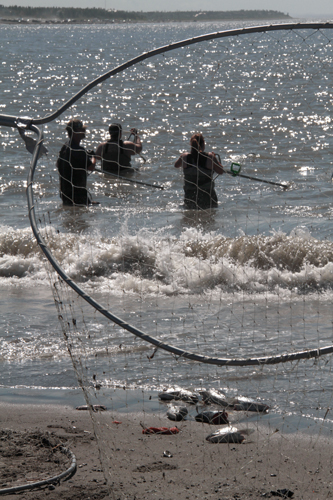
Dip-Net fishing on the Kenai

Dip-Net fishing on the Kenai

It is called the jewel of Alaska, but it’s not found in mines and it doesn’t have a golden glitter.  It is found in the waters, along 34,000 miles of Alaskan coastline and in countless pristine lakes and flowing rivers.  It is the “fish,” and Alaskans and globe trotters are out there for the catch!

There are five species of salmon that can range from pan-sized to 80 pounds. A Halibut can easily weigh in at over 150 pounds.  I would imagine the most lucrative businesses (besides the oil industry) are the ones who outfit and transport those who have come for these jewels of Alaska.  A stylish pair of chest waders goes for about $120.  Then there is the license, the guide, the dip-net, the fly-ins and the flash freeze!

At the Anchorage Museum there is a wonderful display of the his/herstories of native Alaskans which includes artifacts, tools, clothing and continuously playing video narrations.

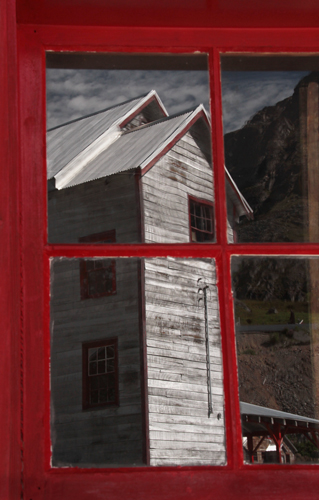
Old Bunk House at Independence Mine

Old Bunk House at Independence Mine

I was moved by the images of an older woman hanging fish that would be smoked and how she used every part of the fish.  This was in stark contrast to the fishing I observed at the mouth of the Kenai River, where, once caught the fish is filleted on the spot and the head, bones, skin, roe and much of the body is discarded on the beach (the rules say the remains must be thrown back into the river).

If we used the whole of something, like the fish, would we take less?  Would it have a different impact on us and on the EarthMother?  So for my small part I am making sure to use my refillable water bottles!  Can’t say I am willing to eat the fish heads though.

Jamie Sams writes about her Healing Quest (which focuses on the feminine energies and needs as opposed to the Vision Quest which includes deprivations suited to the masculine warrior needs), and she recalls the wisdom of Grandmother Cici.  “We come from the bones of our ancestors.”  Grandmother Berta told her that “animal bones give us the structure we need in order to learn the Medicine that particular Creature offers us.”

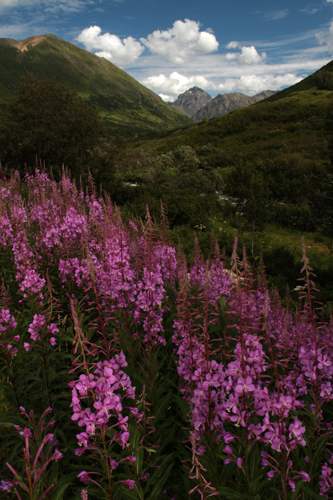
Wildflowers and Moutains near PalmerI am not on a Healing or Vision Quest but do have time for insightful reflection.  A good start has been reading Jamie Sams’ book, “The 13 Original Clan Mothers.”  Sams is a member of the Wolf Clan Teaching Lodge and offers us a powerful and engaging method for honoring and owning native feminine wisdom within our own daily lives.  (I guess I can call this a sabbatical now since I am discovering and integrating new ideas into my vision and being.)

Tomorrow I am off to Lake Clark to photograph bears.  Lots of them I hope.  So far most of my bear sightings have been of mounds of sleeping fur or grass-browsing lethargic giants.

Although the temps for the last few weeks have felt more like Hawaii, the landscapes and endless fields of fireweed shout “Alaska.”  One of the names of the 13 Clan Mothers is “Loves All Things.”  She represents the 7th moon cycle.  I haven’t read about her yet, but when I go from location to location enjoying the wilderness I feel like I know her!

Posted in Uncategorized | Comments Off on Journey to Alaska – Post 2

Journey to Alaska – Post 1

Eagle at Anchor Point

Eagle at Anchor Point

 I think John Denver was right when he sang about the sight of eagles flying: such a sight makes our lives full, rich and blessed.  The size of their wing span and their silent gliding is magnificent.  I would love to photograph an eagle flying right toward me with the low sunlight on her/his white-feathered head and with a twinkle in that yellow-rimed eye.

But I am now convinced that photographers with those images must have placed some salmon on their own heads to catch an eagle flying toward them (just kidding, I think?).  And, for that low light, you need to be on the beach this time of year at 11:00 PM at Anchor Point, north of Homer, for the last half hour of light.  It’s so beautiful just before the sun sinks behind the snowcapped mountains across the ebbing tides of the Cook Inlet.

The best I could do was to capture an image of an eagle eating the discards of a fish recently caught and filleted, now washed ashore.  But as you will see in this image an eagle still provided a dramatic sight in the golden light here in the land of the midnight sun.  I fall asleep by midnight and it is still light, and sometimes I awaken at 4:30 AM and it is light.

One sea lion and many gulls on iceberg from Columbia Glacier – Prince Williamm Sound from Valdez

Most of my trip so far has been within the confines of South Central Alaska (a huge area of course).  The wild lands and wild life offer breath-taking encounters.  I am not alone; this is the path-way taken by RVs by the hundreds, driven by retirees from the lower forty-eight and younger German tourists.  It is also the breeze-way for the buses of the Princess Cruise line.  With all this sun and the beginning of various salmon runs, the Alaskans are also taking advantage of this magnificent playground in their own backyard.

But, if you walk paths for a half mile or so, you have the grandeur pretty much to yourself.  Then you begin to hear the swishing of an eagle’s wings as it takes off from the tops of the trees or the song (as I did) of a pod of humpback whales frolicking before the face of the Aiaklak Glacier.  The whales, of course, were seen from a boat with 16 other passengers.

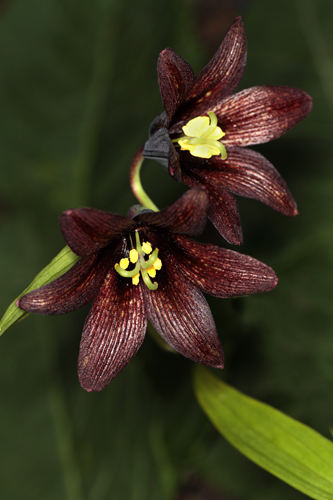
ChocoLily 01 web

Chocolate Lily – Valdez

Although the land is lush and endless, it is interrupted by our human spoils — oil rigs in the Cook Inlet, fish-head lined rivers, rusting cars and abandoned log cabins.  Yes, let us remember the heart-song of the Goddess:  “Earth my body, water my blood, air my breath and fire my spirit.”

So far I have driven 6,150 miles, but now I am slowing down to find a location and stay for several days to explore its details – from the wild fire-weed to the granite boulders in swift-running creeks.  And of course I am compelled to rate the tastes of the halibut (and salmon) at each stop along the way.  Belive it or not my favorite Halibut and Chips was served up in Chicken along the Top of the World Highway. Tomorrow,  Halibut in Anchorage???

Posted in Weekly 2 | Tagged , , , , | Comments Off on Journey to Alaska – Post 1

June Week 1 – Colorfest on the Coastline

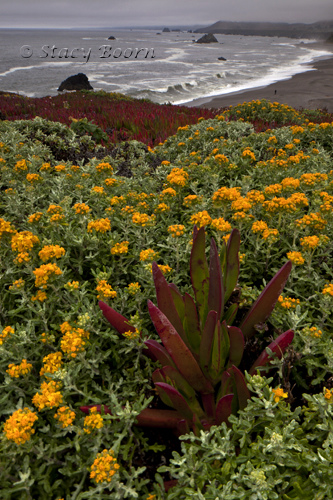
June 1 - DuncansLanding1 copyOne of my favorite chants constantly on my lips and in my heart begins with the words “O Great Spirit, Earth, Sun, Sky and Sea.  You are inside and all around me.”    In particular these words resonate within my being when I am at the water’s edge and all these cosmic elements are present.

Wanting to photograph the evocative feel of this Native American tune I spent time on the Sonoma Coast.  The wildflowers and spring color-fest at Duncans Landing is often waning by June.  But for some reason this past week they seemed more explosive than earlier in the year.

How blessed we are to walk on such sacred ground and listen to the calling of Shekhinah (the female presence of the divine) from the ocean lapping at the sand beaches and rock coastline while the wind’s song creates a whistling harmony.

Plump red ice plant spears are interspersed in the blooming Lizard Tail’s shrubby mounded clusters.  Native Americans once dried and ground Lizard Tail seeds into flour. This hardy plant is helpful in controlling coastal erosion. Although I don’t think the rising ocean level will be held back by the robust Lizard Tail.  Perhaps it is time to work more diligently on modifying our habits that are speeding up climate change?

Using a full frame Canon 5D and a 24mm tilt-and-shift lens allowed me to keep in focus the near foreground and miles away background.

June 1 - LupinesQuite often I have overheard visitors in the A Woman’s Eye Gallery saying of the photographs that they are (supposed to be)  “true captures of  exactly what we see.”   While that is possible that kind of end result ignores 95% of the ways in which one can use a camera to create an image.  Perhaps it is time to get out of the “green” zone on your camera and play with all the settings available to you.  If you don’t know what that means I will be happy to help you. (That is after my sabbatical journey to Alaska which begins in one week.)

Notice the same lupine scene that I have placed side by side.  If you understand how your aperture works you can choose what portion of your image you want in focus.  My eye never saw the image on the left  – but my imagination did.  Photography is about creating imagery that presents emotion – visual spirituality, if you will.  Earth, Sun, Sky and Sea is inside and all around me/us.

Posted in Weekly 2 | Tagged , , , , , , | Comments Off on June Week 1 – Colorfest on the Coastline

May week 5: On the Rocks – our future!

On the rocks may be the way to order your Long Island ice tea or scotch, but for me that is my low tide mantra. Ochre Sea Stars, Blue Mussels, Keyhole Limpets, Giant Green Anemone, Nuttall’s Chiton, Goose and Leaf Barnacles, Kelps, Rockweed and Tar Spots are just a few of my favorite clinging, dangling and hanging subjects revealed when the tide goes out.

May 5 - Star Anemone WEBEach beach and cove is uniquely carved by the tides.  Two times a day the tides rise and fall revealing the enormous ocean diversity just a few feet beyond our usual vista.  How powerful the ocean proves to be as it moves around all that water tugged by the moon and sun.

The lowest tides locally are anywhere between a negative foot or two.   The most dramatic sea level change on the West Coast is Puget Sound, Washington with up to 20 feet difference between the highest and lowest tides.

Finding and framing your subject is perhaps the most important aspect of “on the rocks” photography.  With smaller subjects it is easy to control your light with diffusers and reflectors.  Fortunately, many mornings on the coast are cast in fog providing a wonderful even light which teases out the vibrancy of intertidal zone colors.

Every time I walk on the mussel or seaweed covered rock-shelves and accidentally step on a closed or hidden anemone it squirts up a stream of water reminding me I have wounded it.  I try to ask of it forgiveness and promise to be more careful.

These days I think we need to ask the earth at many levels for forgiveness as we promise to do better at not wounding, destroying and poisoning it. For me every dramatic landscape image or small detail shot moves me not just to awe at its beauty but heightens my consciousness for its preservation.   I hope some of the images I share with you in these blog pages and portfolios will bring the same challenge to your thoughtfulness.

May 5 - StarOnRockWEBRebecca Clarren, in the Spring MS Magazine, wrote a provocative, articulate and well researched article: “Fracking is a Feminist Issue.”  We need to be aware and educated about the affects of natural-gas drilling, with the injection of thousands of chemicals into the ground, on the health of the earth and each of us.  There are no environmental safeguards set in place.

“Congress has exempted fracking from the Safe Drinking Water Act and aspects of the Clean Air Act and Clean Water Act.”  The committee set up to study the issue doesn’t include a single medical expert.  The results of the first epidemiological study to determine water quality and the health of people near fracking operations are still 18 months out.  Thank you Vermont, for being the first state to ban hydraulic fracturing outright!

We need energy and we need jobs but we also need our Mother Earth as whole and well as possible!  Our health depends on hers.  We can’t keep stepping on her and asking for her forgiveness without amending our practices and polices.

Posted in Weekly 2 | Tagged , , , | Comments Off on May week 5: On the Rocks – our future!

May week 4 – Full Moon rising from every direction

The New Moon always rises at sunrise.
The first quarter Moon rises at noon.
The Full Moon rises at sunset.
The last quarter Moon rises at midnight.
Moonrise takes place about 50 minutes later each day than the day before.

But moonrise over Alcatraz happened this way…

May 4 - MoonAlcatrazWebI am not ready to give up on my DSLRs and my 20 pound back pack of equipment.  But I will confess I consider my iPhone and an array of apps an additional powerful tool for image making.  Plus, your iPhone (or other mobile devices) is always with you.

Last week when I saw a beautiful cloud over Alcatraz I couldn’t resist figuring out a way to render it more dramatically than what the flat late morning light and hazy atmosphere were offering.

A super moon was in the sky this past week but fog prevented me from seeing it.  That moon would have made for a spectacular picture if I could also have figured out where to stand to position it over Alcatraz or some other recognizable foreground.  But this image is the aforementioned iPhone capture manipulated in the app called LensLight.

May 4 - AgapanPaint webA fellow photographer recently went on and on about how using mobile devices/apps just provide the world with tons of images that all look alike.  I disagree.  Photograph,y like other visual arts, is about using your tools to present your vision.  In addition to choosing a particular application to transform one’s capture there is the possibility of applying the app in a variety of ways/degrees and then adding several other apps in any given order.

The second image is an Agapanthus bud.  After choosing my angle and capturing the image with Camera Plus, (love the way you tap for the focus area and the second tap is on the area you desire your exposure reading), I then optimized my image with slight adjustments in Snapseed.  Next I used the app “Colorblast” which converts to black and white and then you paint back in the areas you want in color.    Finally, I used the app Auto Paint 3 with the “chalk” effect.

I have only begun to scratch the surface with new ways to expand my art, vision and world.  It is my new moon.  How about you?

Posted in Weekly 2 | Tagged , , , | Comments Off on May week 4 – Full Moon rising from every direction