November week 3 – Dabbling and Darkness

You would think education and awareness should be enough to lead us to a healthy, sustainable and earth friendly diet.  But when the spirit is willing and the “will power” is still weak it takes a little more.  I think photography will eventually be that “little bit more” that helps change my eating habits.

Wikapedia tells us that “the American Wigeon is often the fifth most commonly harvested duck in the United States, behind the Mallard, Green-winged Teal, Gadwall and Wood Duck.”

A few years ago I categorized those with wings and feathers as either birds or ducks.  Now that I take note of the migration patterns of coastal birds, I am beginning to identify them, at least by their common names.  The Wigeon is a dabbler who will often wait for the diving ducks and birds to surface and then snatch their food away.

My sighting of American Coots, Gadwalls, Wigeons and Ring-necked ducks in the ponds of Golden Gate Park are signs that their migration has begun.  Here you can also get pretty close to the ducks because this stopover seems to have taught that in this location humans are not a threat and often a source of a snack.

Photographer George Lepp once said, “don’t be a part of the problem (feeding the wild birds) but photograph of what is before you (get frame filling images of the birds).”

Low afternoon light, getting yourself on the ground to be at bird’s eye height and a long lens will be your best tools for stunning bird images.

Photography is the fine art of creating images with “light.”  Depending on the quality of light you have to work with, any ordinary subject can be transformed into a spectacular presentation.

One candle and different colored glass candle holders, photographed from below this Plexiglas table, make a wonderful “holiday” subject.

Light and darkness are two parts of a blessed whole!  Be sure to enjoy Jann Aldredge-Clantons’ hymn “O Holy Darkness, Loving Womb.”  She has posted it on YouTube with a wonderful slideshow and accompaniment by soloist Shannon Kincaid.  (address forthcoming)

Posted in Weekly 2 | Tagged , , , | Comments Off on November week 3 – Dabbling and Darkness

November Week 2 – Porcini and Oysters – Wild Mushrooms

The most sought after popular wild mushroom, the Boletus edulis, is different from other mushrooms.  The Boletes have pores rather than gills on the underside of the cap.  This spore-bearing area resembles and acts like a sponge. The Italian name porcini is a more familiar name if a restaurant or market is your primary location to spot them.  But in the field they are simply the King/Queen Bolete.

Boletus edulis is indeed impressive and hardy to behold, with its fat, bulbous stem decorated at the top with a network of lacy white veins and its nourishing brown cap held high above the forest floor. There are many other types and colors of the bolete.

Here on the west coast several days after the first heavy rains fall, often in September or October, young forms begin mounding up the pine needles under the trees.

Mushroom Hunter’s Bolete Collection – reflection on car hood

Boletes are mycorrhizal, forming relationships with trees. There has been little success cultivating boletes, so they are always collected from the wild, making them uncommon and expensive in supermarkets. However, the good news for collectors is that because they are symbiotic with certain trees they will recur in the same places each year. So it is no surprise that mushroom “hunters” will not share their favorite locations. Fortunately one such collector let me peak into his bag after I made it clear I was only there to photograph them.

Oyster Mushroom – Pt. Reyes

It is supposed to be easy to recognize a mushroom as a bolete, but identifying your bolete to species can be more difficult. This is an important step, because many boletes are either poisonous or simply not pleasant to eat.  I will eat those from the farmers’ market, Mollie Stones ($29.00 per pound) or at certain restaurants. All the wild ones are there for the photographing!  This way maybe a collector or two, after swearing me to secrecy, may show me her favorite sites.

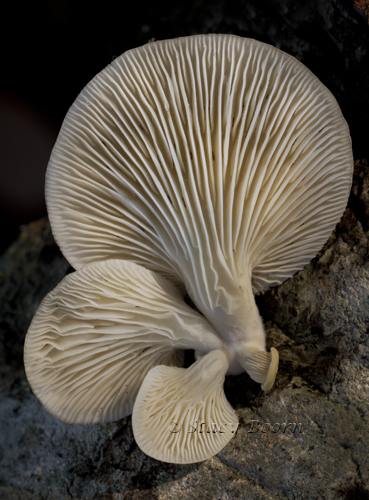
One mushroom really lives up to its name—it looks, smells, and tastes like oysters. With virtually no stalk, this mushroom’s oyster-shaped caps usually grow in layers on dead deciduous wood, like clusters of oysters. I think I have identified this mushroom correctly, although I am not going to eat it to verify the find.  I will let them be a feast for my eyes.

I love to photograph mushrooms because you can control the light ( with diffusion and reflection) and often turn over the log on which a particular specimen is growing.  But it is not easy work and can often be quite frustrating!  So don’t ask me too many questions while I am at work among them otherwise you might suspect I have discovered a new specimen – the crabby mushroom!

A tripod is a must and a kneeling pad and gardening gloves!

Posted in Weekly 2 | Tagged , , , | Comments Off on November Week 2 – Porcini and Oysters – Wild Mushrooms

October Week 5 – Moon Rise for We’moon

Check your moon rise times.  If it is coming up 20 minutes before the sunset it will be a beautiful orange ball at the horizon line.  Otherwise,  your digital or film capture will be just a moon in the dark sky, unless you are doing some double exposures or just lighting a landscape by the moon’s glow.

I observed the full moon rise from the edge of the bay.  When the moon was rising behind the Bay Bridge, for a moment it seemed cradled in the crux of one of the towers like bread in a chalice.  I should have gone the day before because by the time the moon reached the top of the bridge it was a very dark sky.

Just five years ago I was introduced to the We’Moon calendar.  Subsequently, I cannot look at the cycle of the moon any longer as just some passing, barely-noticeable event.

Bay Bridge Cable in front of Moon

The cycles of the moon are synced with the cycles of women. So each time the full moon shines I am reminded of the resistance of woman to the misogynistic oppressions they face every day globally: depriving girls of adequate food, health care  and education: female and children trafficking: rape as a weapon of war and control: aborting female fetuses: honor killings: forced childhood marriages…etc.

This year is the 31st  year of the creation of We’Moon and her community of artists, writers, ritual makers.  The collections in these beautiful feminist datebooks remind us how precious and life giving is the natural world.  Each year there is a wonderful theme that ties together the art and writings and Gaia Rhythms.

“We’Moon: Gaia Rhythms for Womyn is more than an appointment book, it’s a way of life! We’Moon is a lunar calendar and a handbook in natural rhythm, and born of international womyn’s culture. Art and writing by we’moon from many lands give a glimpse of the great diversity and uniqueness of a world we create in our own image. We’Moon is about womyn’s spirituality (spirit’ reality). We share how we live our truth, what inspires us, how we envision our reality in connection with the whole earth and all our relations.”

A small aperture like f/22 will cause your lights to star

Useful moonrise info for photographers and everyone:

Posted in Weekly 2 | Tagged , , | Comments Off on October Week 5 – Moon Rise for We’moon

October week 4 – Orderly Disorder

In times of stress and frustration, as is the case for me at election time, I look for ways to find calm in chaos, hope in despair and empowerment in oppression.

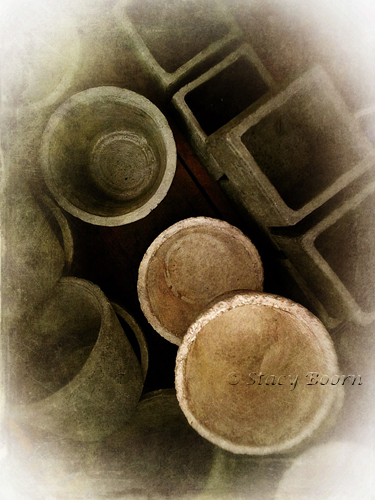
The images that I created this week I refer to as “orderly disorder.”  In both the fallen acorns and plant pots I didn’t find an organized pattern on-site.  But the objects were not in total chaotic disarray. So in both cases I saw beauty in their repeated colors and shapes and then moved them around a little bit to get them into positions that provided a less static presentation.

This week the phrase “harvest child” from poet Sherri-Rose Walker was bouncing around in my head.  These images are my harvest-child offerings to you, for calm and hope, as we approach elections and the possible calamity of epic super-storms and war from many directions.  May the actions we take in them provide for renewed hope and empowerment, especially for women!

Yes, especially for women because when the world is a better place for women it is a better place for us all.  When the economy is better for women it is better for all.  When health care is available and affordable to all women it is a healthy world for us all.

How will you find or create or birth your “harvest-child?”

Photo Tips:

The acorns were scattered on the ground at Mt. Tamalpais State Park, CA.  I had gone there in hopes of getting a grand vista but the fog was so thick that you could barely see the tree shapes 20 feet in front of you.  This kind of lighting is wonderful though for colorful objects.  Mount your camera on a tripod so that you can use a small aperture to achieve your desired depth-of-field (here f/16).  Remember, when photographing objects very close you have a very shallow depth-of-field so be sure to use the highest f-stop possible (i.e. f/16, f/22, f/32).  In post-processing I applied a “grunge” filter to give the appearance of scratches and then blurred the edges.

Think of creating monochrome images with color capture.  I don’t mean changing the image to gray scale or de-saturation in Photoshop or other programs.  I mean find your subjects basically that way and use your in-camera skills!

Posted in Weekly 2 | Tagged , | Comments Off on October week 4 – Orderly Disorder

October week 3 – Technicolor Dream Door

Doors:  in their cultural facades or minuscule details, we enjoy looking at them, photographing and painting them. Perhaps it is because it gives us both a sense of graphic beauty and mystery.  We wonder once they are open where they might lead us.  In our imaginations we begin to travel into their projected promises.

I chose a particular detail of a mundane door that was starting to age.  But a little tilt of the camera lens creating a vertical line started the dramatic explosion of possible designs and Technicolor patterns.   In my mind’s eye I envisioned what it would be like if the paint was pealing, or multiple colors had been put on this door, or the knob had been polished or rusted more, or mold began to take over.

These are a few examples of some twenty post-processed images from the same original capture.  Ansell Adams played in a dark room and now we can play in a light room.

Posted in Weekly 2 | Tagged , , | Comments Off on October week 3 – Technicolor Dream Door

October week 2 – A Post-card Thank You

I have said it before: photography for me is a form of visual spirituality.  Creating and then revisiting images are powerful means of meditation.  Of meditation, in her book “Crones Don’t Whine,” Jean Shinoda Bolen says: “Heartfulness and meditation come together in the instant we really see and appreciate something beautiful, and in this moment send the equivalent of a prayer as a postcard thank-you, as we let the beauty in.”

For example it’s a meditative art to seeing the beauty on and around the grapevine.  In capturing the art on the vine with your camera, the possibilities are endless.  But there are six invaluable techniques that can be remembered easily with the acronym GRAPES.

  • Get in close
  • Reflectors
  • Aperture
  • Polarize
  • Exposure
  • Spritz

I don’t always apply all of these techniques.  Sometimes the clumps look best with a little bit of water and sometimes not (Spritz).  Regardless,  you always want to pay close attention to the use of light when choosing your composition!  Water drops in your image can help with your focus and give life to your shot!

Although harvesting begins in August for some grapes, I enjoy the last crushing because the leaves are more colorful in October and into November.  Even after the harvesting you can find clumps of grapes here and there and your presence in the vineyards isn’t as intrusive or threatening to the vines and growers.

Add Neutral Density Filters and Zoom

When grapes remain longer on the vine it gives them a higher sugar content needed for certain kinds of wines so this harvest will often happen when the leaves are turning colors.

These images are my thank-you postcards for entering the beauty of mother earth through my images!

You may taste wine blindfolded to enhance your experience.  But when you go to the wine country you will journey with eyes wide open – the images you create will rival all others.  If you haven’t looked at my portfolio “Art on the Vine” – go to it.  Stop by the AWE gallery at 678 Portola Dr. sometime and I will be happy to flesh out the G. R. A. P. E. S. methods for you.

Posted in Weekly 2 | Tagged , , , | Comments Off on October week 2 – A Post-card Thank You

October week 1 – Pagoda

At the edge of the water, below Strawberry Hill, at the east end of Stow Lake in Golden Gate Park, San Francisco, you find a picturesque pagoda.  This pavilion with its red columns and green roof glows when bathed in early morning light. It was presented to San Francisco on America’s Bicentennial by its sister city, Taipei, in 1976.  In either sun or fog this small structure seems like a cultural beacon catching the eye of every passerby.

The pagoda’s rooftop is adorned by intricate carved wooden beams and colorful painted designs on the interior. The exterior roof tiles are clay surrounded by fanciful dragons, monkeys and other animals that climb along each ridge of this eight-sided pavilion. The stone tables make for a wonderful place to enjoy lunch or play a game of mahjong.

I enjoy photographing a subject from various angles and applying different processing techniques.  This pagoda is an accessible subject which I can come back to often.

If there is a beautiful sky you always want to take advantage of it in your capture.  In this case its reflection in the lake allowed me to keep the pagoda in the top portion of the image while using the reflection as a lead-in diagonal line.  Wide angle is often very challenging because so much gets included the picture.

Remembering that early visitors took horse-drawn carriage rides around the lake, I wanted to render an image that felt much older than the structure.  Adding a little blur and some stress lines to the picture of this thirty-six year old structure makes it look like it has been in place since the 1900s.

Most pagodas were built to have a religious function, most commonly in Buddhist traditions, and were often located in or near temples.   Often you will see wedding parties and local squirrels posing in this pagoda/pavilion. But they too, in their own rite, are religious activities.

Just today someone asked if one of my photographs was a picture of a painting.  When I was in college I wanted my drawings and paintings to look like photographs and ever since I have worked at making many of my photographs look like paintings.  Sometimes this is achieved with Photoshop techniques and sometimes traditional in-camera choices.

It is surprising that there are still many people who do not consider photography a “legitimate” art form.  As I mentioned last week, we photographers just have a much bigger canvas – the very cosmos itself!  On that canvas this week I could have found blue angels, America Cup racing boats, blue grass performers, Giant’s fans and much more.

But the simple pagoda found its way into my viewfinder and heart!


Posted in Weekly 2 | Tagged , , | Comments Off on October week 1 – Pagoda

September week 4 – The Earth as Canvas

One of the things I love about the artist Andy Goldsworthy is that nature seems to be both his canvas and palette.  Not to mention his creative playground.  It is with respect and gratitude to the earth that he uses her elements to construct his vision.  Ice, drift wood at low tide, leaves moving in a stream are among  the many things that Goldsworthy fashions into temporary art, standing until the tide or sun moves them along into a new location.

Andy Goldsworthy is a British sculptor and photographer, an artist who produces  site-specific sculpture and  land art situated in natural and urban settings. He lives and works in Scotland although he is often seen on location right here in the Bay Area!  For his ephemeral works, Goldsworthy often uses only his bare hands, teeth, and found tools to prepare and arrange the materials; however, for his permanent sculptures he uses tools and machines and sometimes cranes and other people.

Most of us tend to bend down and pick up a colorful leaf, sparkling pebble, a floating feather or fallen pine cone.  Sometimes we just examine the object with every sense available to the task.  But other times we can’t resist taking it with us, providing there is no sign prohibiting it.

Some nature and outdoor photographers boast that they create images with things in their found positions and never confess to placing the red maple leaf on a rock in a fast moving stream.  I find that the earthen canvas is also my playground.   If you can’t take the pebbles with you, why not move them on location into particular compositions, even corny ones like this outline of a heart of white pebbles in a group of black ones.  I enjoy gently running my hands over stone ledges and the curve of beach boulders; connecting with their distinctive energies is mystical and cathartic.

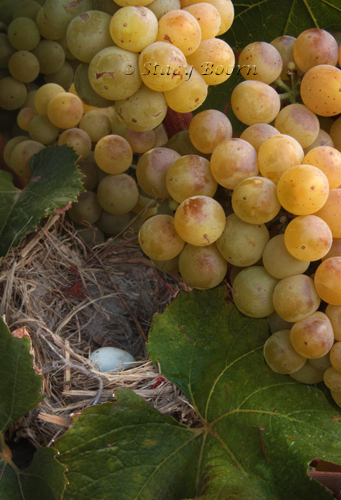
Keenly looking at everything, you may come across hidden treasures waiting detection.  When I focused in on some white grapes nestled against their corpulent vine I noticed a tiny bird’s nest no more than three inches in diameter.  In the nest was a little egg not much larger than the surrounding wine grapes. Although these small items appear close together, you need lots of depth of field to render both subjects in focus by using a very small aperture opening.  I chose f/22.  Another method would have been focus stacking.

If you haven’t viewed the 2004 documentary “Rivers and Tides” about the work and person of Andy Goldsworthy I suggest you look it up.  It is timeless!

Posted in Weekly 2 | Comments Off on September week 4 – The Earth as Canvas

September week 3 – Circles, Light and Darkness

One of my favorite chants is “Light and Darkness.”  Those words are just repeated over and over again.  It brings home the equality of their importance in the cosmos and each person’s individual existence.  I am singing these words right now on the Autumnal Equinox. The ebb and flow of all nature seems to come back to the relationship of light and darkness.  (Also the two most important tools of photographers.)

Equinox – an equal amount of light and darkness — is a sign of the importance of each particular part that makes up a “whole.”  Like the right and left side of our brain which I mentioned in the last post or things like complimentary colors or grapes and  leaves.  At this time of the year I seek out circle shapes – moon, grapes, candles, frame drums, pumpkins, labyrinths and community.

Everyone who has traveled in the wine country is convinced that you can jump out of your car at any and every vineyard/winery and snap a prize winning shot.  You would think so because the scenery is incredibly lush and eye popping! But as with every image it usually takes some planning and deliberate choices to present your mind’s eye view.  It takes both left and right brain skills.

In the fall I never leave home without a diffuser and reflector and, yes, that little spritzer bottle.  The sun is usually shinning every day in Napa and Sonoma in the fall to finish off the ripening of those grapes harvested late for high sugar content.  This is the best time to photograph clusters because the cold nights begin to cut off the chlorophyll process to the leaves and the reds and yellows begin to show.

Low morning or late afternoon light on your subject is best but it still will produce dark and deep shadows and high contrast.    So I either diffuse the light by placing a diffusion disc between the sun and my subject or add fill flash or reflected light to open up the shadow areas.  It may seem strange to add light to a subject that is already bathed in sunlight but it helps even out the distribution of the light without making it feel flat.

Under the leaves that have not been cut back you can often find some grapes that are behind schedule in the ripening process.  They make for a wonderful contrast of color and growth pattern when photographed next to the plump deep purple orbs.

The Celtic Blessing proclaims, “May the circle be open but unbroken.  May love of the Goddess be ever in your heart.  Merry meet and merry part and merry meet again.”  Circles are a blessing.

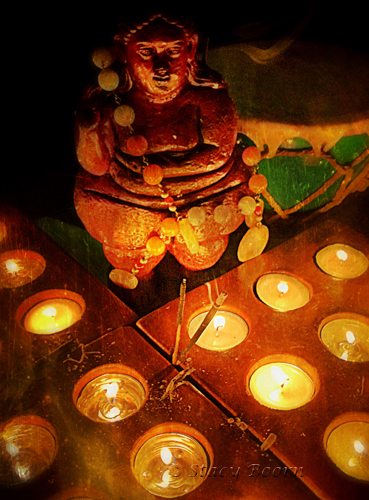
This Maltese, wide hipped Goddess draped in rosary beads surrounded by the round votive candles also seemed an appropriate Fall Equinox symbol.  She is encompassed by the light and darkness from both within and without.  The islands of Malta and Gozo in the Mediterranean were once occupied by a prosperous culture who worshiped the great Goddess of early agricultural people. In the period between 4000-2000 B.C., they created art in her image, ranging from life-size statues to delicate hand-held figures. Even their temples, the oldest in Europe, were solidly built in the shape of her life-giving body.

Posted in Weekly 2 | Comments Off on September week 3 – Circles, Light and Darkness

September Week 2 – Right Brain Resurrection

Anthuriums – at Flower Nursery

While sitting in a cafe with friends there was a moment when all of us were on our “smart phones” at the same time.  When the server noticed she told us she wasn’t going to get into using a smart phone because “it will be the downfall of our abilities to communicate with one another.”

It just happened that each of us at that table was looking up something to share with the others to enhance our conversations.

Our smart phone technology may just have the potential for “re-wiring” our own internal hardware for building peaceable and compassionate communities, especially with the imagery that we see and create with them.  Creating and engaging with imagery we can nurture the right side of our brains.

Rows of 2×2 Succulents – blurred edges

The proposal of Leonard Shlain’s book, “The Alphabet Versus the Goddess – the Conflict Between Word and Image,” is that, when the alphabet was created, with its venerated focus, it over-nurtured the left side of the brain. When driven to primary left-brain thinking cultures shifted from egalitarian community to patriarchal misogynistic patterns.

Shlain argues that “learning to think without resorting to images is indispensable to alphabet literacy.  ‘Make no images’ is a ban on right-brain pattern recognition.  All who obey it will unconsciously begin to turn their backs on the art and imagery of the Great Mother and, reoriented a full 180 degrees, will instead seek protection and instruction from the written words of an All Powerful Father.”

Goddess in Light – herchurch

I agree with Shlain’s “optimistic appraisal that the proliferation of images in film, TV, graphics and computers is once again reconfiguring the brain by encouraging right hemispheric modes of thought and bringing about the reemergence of the feminine.” – Hungry Mind Review.

Canon, Nikon, … iPhone … lets have at it.  The more engaged we are with imagery the more possibility there will be for a paradigm shift from patriarchal domination to egalitarian compassion!  I think the succulent and anthuriums are with us on this one.

“Oh Great Spirit, earth, sun, sky and sea.  You are inside, and all around me.”

Posted in Weekly 2 | Comments Off on September Week 2 – Right Brain Resurrection