September Week 1 – Fog and fiction

Pillar Point Harbor – Foggy Day

Gray mass oozing from
the realm above
entering into earthen caverns
swiping sea swells in its path
we call it fog!
We feel its dense moisture
draping us as partners
shrouded without contrast
in the path of its journey
we call it fog!
we smell our mortal souls within
and seize a world beyond
we call it fog!  -sb
 

Recently at a Photochrome meeting (San Francisco Imaging Club/society) a photographer showed an image of a person fishing at the edge of the ocean.  In that image the fog was as thick as my recent day in Princeton, CA.  A critiquing photographer suggested adding contrast to make the blacks truly black in the foggy seaside image.

But in my opinion, that alteration will diminish the true experience of the thick fog that came to rest at ground/sea level.

Substantial fog equalizes all the tones in its wake.  Because of this an image could feel very flat or you could use it to convey foggy feelings.  Here I did add a little contrast to the kayaker  so he stands out from the gray marina.  Throw off the shackles of rules and expectations and create the images you want.

Even rusting chains on the ground have a story to tell.  Some images and how they are processed are best not explained by their creators.  Viewers, weave your own narratives.

See your mortal soul within
and seize the world beyond!

-sb

Posted in Weekly 2 | Comments Off on September Week 1 – Fog and fiction

August week 4 – Water, Living Water!

In some parts of the country people would love to be playing in the fountains because it is scorching and other places dried up fountains would be preferred to those six feet under water.  For the peoples of these places we wish health and healing, relief and restoration.
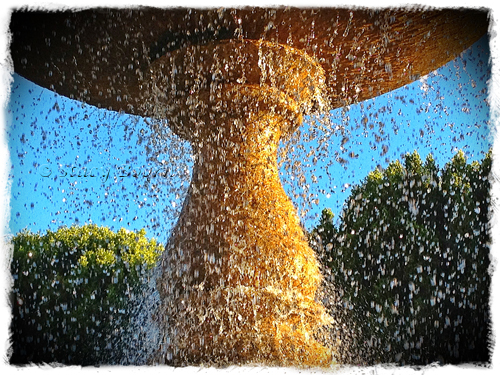
Nonetheless, this past week I was drawn to the sparkling spray of a particular fountain in Sausalito which dazzled in the early morning light.  Capturing the feeling of being in its sprinkling relief and restoration was my photographic challenge.

First I have to say, there is nothing more refreshing and renewing for my soul these days than the words of former Secretary of State Madeleine Albright in an interview with the Huffington Post:  “But I think there are some who believe they are actually protecting women, you know, and that it is better for women to be taken care of. I think women want to take care of themselves, and I think having a voice in how that is done is very important. And frankly, I don’t understand — I mean, I’m obviously a card-carrying Democrat — but I can’t understand why any woman would want to vote for Mitt Romney, except maybe Mrs. Romney.”
No matter what you think, photography also is political!  Our images convey some specific messages:  environmental care, hope for the poor, the spirit of the athlete, etc…. Even abstract and creative images have a message, although not always obvious or offering single points.

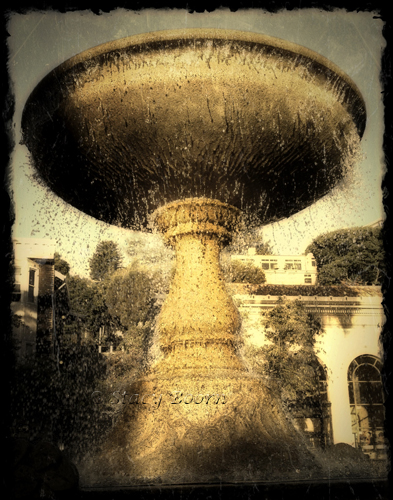
Water, living water – the right of every human being is the message of these images.  I chose early morning light to help convey the golden glow in each drop – since water, clean water, is more precious than gold.  Women in almost every country must carry the water each day, for miles, to use in cooking and bathing tasks for the whole family. May their voice be as precious and refreshing as each drop of water spilled from our fountains

Water, living water  – no matter how low I got below this fountain I could not exclude the trees and some of the buildings across the street.  So I chose carefully how to use them.

With the image that included the buildings I used an “old time image” post processing software.  In the other images I boosted the saturation a little (you can do this in camera or post-processing).

But the most important ingredient was the sun and its low angle in the morning sky.  That also accounts for the golden look of the otherwise dull grey cement of the fountain.

The elephant sculptures and fountain were designed by Sausalito architect William Faville for the 1915 Panama Pacific Exposition and then donated to Sausalito in 1916. The fountain is in the Plaza Viña del Mar. Viña del Mar translates to “Vineyard of the Sea,” and is a Chilean city on the coast in the Province of Valparaiso which is also Sausalito’s sister city.
Posted in Weekly 2 | Tagged , , , , | Leave a comment

August week 3 – Pinnipeds and Pebbles

Canon 7D – 100-400mm lens at 400mm

Harbor seals sometimes sit on rock ledges when the tide is changing to let the water run over them.  When the incoming tide is ebbing all around them they will lift up their flippers and heads creating a smile like image in the wake.

On land the harbor seals are the shyest of the “Pinnipeds,” which means the “fin-footed.”  But once fully back in the water they playfully move with ease closer to their adoring on-shore audiences.

The pinnipeds are a family of chubby mammals that include seals, sea lions, walruses, elephant seals and the harbor seal.  The harbor seal has a short stubby foreflipper and makes a very gentle sound while the other seals and sea lions are real barkers.

Since the harbor seal needs to be close to land to sleep, molt, give birth and nurse their young, it is likely you will see them often in their rockeries and home territories.  This is why I return often to the rocky shores of the San Mateo Coast.  The many summer foggy drizzly days make for a nice muted light in which to photograph them.

A tide table, telephoto lens, a fairly fast shutter speed (1/250 or faster) and time to spend is your best bet for capturing the habits of the harbor seal.  Because of their colors, (grays, whites and browns) they easily blend into the rocks on which they perch.  The rocks around the beaches near Pescadero (especially Bean Hollow and Pebble Beach –not the golf course) provide safe areas for basking harbor seals.

Since they usually live 20 – 30 years it is likely you can photograph the same harbor seals for a very long time.  All other pinnipeds migrate, but the harbor seal stays in its haul out zones.

iPhone Capture – PicFx App

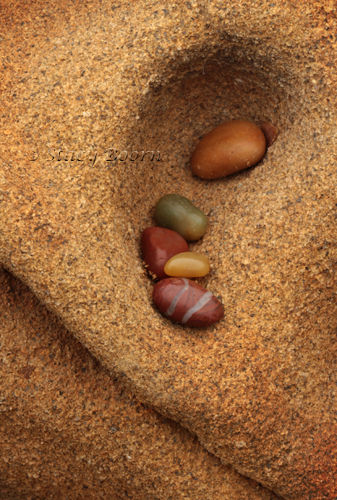
If they are a little beyond your telephoto range or have gone fishing you can turn your attention in this area to many other subjects.  One of my favorites is the small caverns in the rocks, called Tiffani, and the pebbles that the tide-waters toss into them.  Many of the pebbles are less than a quarter of an inch in diameter so you want to get in close.

With close up photography you have the option of controlling many elements in your images including the light.  If it is sunny the light will be too harsh and garish causing your colorful arrangement of pebbles to be watched out and the shadows in the caverns to be too dark.  Usually you have naturally diffused light, thanks to the fog.  Otherwise use a diffusion disc to soften the harsh lines and shadows caused by direct sunlight.

Photograph the pebbles where you found them or begin to move them around like the meditative arrangements of a Zen gardener.  Yellow with green and then green with burgundy, and striped with solids…. just keep an eye on the incoming tide because you can get lost (or found) among the pebbles for hours.

Posted in Weekly 2 | Comments Off on August week 3 – Pinnipeds and Pebbles

August Week 2 – SF Flower and Her Pride

The Dahlia Garden next to the Conservatory of Flowers in Golden Gate Park peaks in beauty from mid July to mid September.  This area was dedicated in 1920 to the dahlia, the official San Francisco Flower.  This weekend was the judging of the best of show in many categories held at the Hall of Flowers on 9th and Lincoln Way.

Although there are a variety of conditions in which to photograph these beautiful and diverse flowers, I prefer a calm foggy day.  The colors really pop! (The sunshine will bring out the butterflies but it often gives you garish light and very bright hot spots in your background).

Most mornings you can meet the overseers who donate all of the tubers for their particular area. They sure are proud of their award winning gardening.  The California Dahlia Society helps us all get acquainted with the garden and the growing process as well as provides a variety of programs, shows and plethora of information to the public. Volunteers help plant, disbud, de-leaf, water, deadhead, and dig out approximately 500 clumps of dahlias.

The Dahlia originated in Mexico and was used by the Aztecs for medicine, religious ornamentation, and food for the animals (the tubers).  The genetic make up of the Dahlia has an uncanny ability to cross breed into many varieties. Some dahlias are as small as a quarter and some as large as beach balls.  There is even a Dahlia that looks like my morning hairdo.

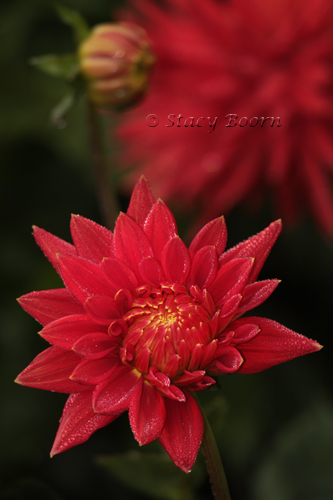
You can use every technique and piece of camera equipment available to you when capturing the essence and emotion of the Dahlias.  I love working with individual blooms.  Most often I choose to photograph with a 400 mm lens.  I add an extension tube between my lens and camera so I can focus at a closer distance.

I want to provide enough depth of field to give detail to the petals (f/5.6 – f/11) but allow for the background blooms and leaves to be quite out of focus.  I look specifically for a light colored dahlia with a dark colored one in the background.  You have to work at positioning your camera and tripod so that a specific colored back ground dahlia falls in the right place.

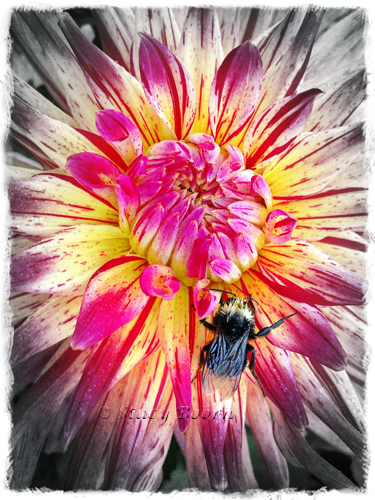
Using a close up lens you can isolate a detail or portion of a bloom that creates a creative composition. This is when you hope for no breeze so you can use small apertures (f/22 – f/32) to optimize depth of field. Most macro lenses will allow you to get life-sized images.  Using a 100, 180, 200mm close up lens keeps you from having to be right on top of your subject.  This is especially helpful if your subject is a bug or butterfly on your dahlia.

Although the growers don’t like the drizzly days because the water spots the dahlia petals (etc), we photographers appreciate the natural water drops.  The Dahlias are stunning right now.  But if you can’t get to the SF Golden Gate Dahlia Garden today, you have several weeks left…when there will still be many blooms.


Posted in Weekly 2 | Comments Off on August Week 2 – SF Flower and Her Pride

August week 1 – close and closer

Old familiar things are often transformed when placed next to their “upgraded” versions.  This was the case with an old cafeteria-styled glass pepper shaker when I saw it shelved with wooden pepper mills at a neighborhood cafe.

Subjects smack in the middle of your image like the bull’s eye of the dart board are supposed to be a “no-no” for good composition.  But sometimes I just love it that way. Know the rules and then break them, especially if it tells a good story or portrays memorable Americana items.

In the ordinary is the extra-ordinary  -  if we only take the time to look.

Paying attention to details can lead to some spectacular compositions.  But little unexpected finds can also be rewarding.  As a child I “caught” many walking sticks, grasshoppers  and praying mantis in the summer and kept them in a jar until my mother yelled “let them go … would you like to live in a jar?”  Only now do I more fully understand the underlying wisdom of what it means to be connected to all living things, even the insects (including the ones that bite).

Sometimes we don’t see the small things right in front of us.  Bugs and buds can easily be overlooked. That’s why I love working with close-up photography.  Photographing outside close-up is challenging because the slightest breeze will move your subject right out of your field of focus.  Since the closer you get the shallower your depth-of-field becomes, so you often need a small (f/16 – f/32) aperture to retain enough depth-of-field to cover the important parts of your subject.

Maybe close up shots remind me of looking into the jars of yester-years remembering those eye to eye experiences with my bug friends. Insects that are doing something, even as simple as an act of feeding, produce engaging images.  For me the eyes are the most important part of such images and if parts of the bug go out of focus that is fine with me.  I also prefer this if it means a nice soft background.  What kind of insect am I?

The praying mantis is named for its prominent front legs, which are bent and held together at an angle that resembles a prayer position.  Typically green or brown they are well camouflaged on the plants among which they live.  With two large compound eyes and three other simple eyes located between them the Mantids can turn their heads 180 degrees to scan their surroundings.

Now that’s a trick I would love to be able to do.  In the mean time I will simply slow down and smell the roses and be bitten by the insects and bugs around them!

Posted in Weekly 2 | Comments Off on August week 1 – close and closer

July week 4 – Lo, How a Rose is Blooming

Almost every city and town has a “rose garden.”  They seem to attract people of every age, culture. gender and philosophy who admire the beauty of the rose and in them find peace, serenity and joy while walking among them

It seems that most people never grow tired of photographing roses. The gardens also provide a wonderful location to create portraits, wedding images and family photos.  My father who was a portrait and wedding photographer would always take the bride and groom and their party to Central Park Rose Garden in Schenectady, New York.

An overcast day is the perfect time for portraits of people and the roses themselves because the colors are not washed out by the sun and their details are not lost in deep shadows.  Sunshine in the garden will make for very garish, contrasty and harsh images.

Dew Drops on Petals – Ring Light Flash

It is here among the rose’s petals and perfumes that you can practice and perfect practically every type of photography technique:  selective focus, macro, creative, maximum depth-of-field, abstract, portrait…. you name it!  You can even challenge yourself to go into the rose garden with every lens that you have and not return until you have used each one.  Or with a single lens capture multiple angles and vantage points!

I have the tendency of spending a lot of time looking through my lens at the same subject and repeatedly tweaking it by changing the angle slightly, the exposure or the depth-of-field.  Allow yourself the option of working with just one rose for an hour.  Or return to the same rose garden several days in a row before you head off to work or whatever routines fill your day.

Every morning Golden Gate Park was laden with fog and some mornings the fog was so thick that the drizzle and drip of it was making gorgeous water drops on the roses – the kind you cannot reproduce with a spritz bottle. For three mornings I worked exclusively (for an hour) with a 100-400 mm lens and an extension tube.  The tube allows you to move in a little closer than your minimum focusing distance.

Tweaked in Photoshop – Levels and Poster Edges

At 200-400mm your background is rather narrow as opposed to all the clutter you include with a wider angle lens.  Background can make or break your image.  I prefer soft splashes of color for a background.  Position yourself so that other flowers or greens are at certain distances from your subjects (looking especially for colors darker than your subject) and check your depth-of-field.  Too much focus creates too much busyness.

Getting in close to find compositions of just parts or petals of the rose is another way to capture their beauty. If you add flash be careful because the dew drops will reflect the flash,  although you might experiment and see how that can help create an image.

So I return to a beloved 15th century hymn song in my childhood:

  • Es, ist ein’ Ros entsprungen
  • aus einer Wurzel zart,
  • wie uns die Alten sungen:
  • von Jesse kam die Art
  • und hat ein Blümlein bracht
  • mitten im kalten Winter
  • wohl zu der halben Nacht.

Lo, how a rose is blooming – indeed!

Posted in Weekly 2 | Leave a comment

July Week 3 – Sunflowers

Sunflowers inimitably resemble their namesake.   It looks like a sun with all its fiery beams sprouting forth. The sunflower belongs to the genus Helianthus annus. “Helios” means “sun” in Greek and  “annus” means the flower is an annual.

“If I had a ladder…”  I would have a better vantage point for photographing the fields of Sunflowers that grow in the Sacramento Valley.  Some photographers actually drag around a ladder or have built platforms on the tops of their vehicles so that they can photograph certain subjects from above.

Each time I pulled over on the roads around Dixon, CA. I had great views of the initial rows of the sunflowers that were usually as tall as or taller than me, making it almost impossible to see the hundreds of others behind them.

Fortunately I found one group of sunflowers that had a slight incline on the other side of the dirt road that ran along the edge of the field.  In the morning hours, even in overcast light, the heads of the sunflowers all face the East.  It is as if the are all paying homage to the source of energy that gives them life.

Photographed from 3 feet above – 120 mm

Using a telephoto lens the sunflowers are “compressed” – giving the impression that they are extremely close to each other.  (Remember – grey skies are not worth including in your image).

About three thousand years ago, Native Americans started growing sunflowers for food. There are three main reasons for sunflower farms today: seeds, oil and for floral arrangements.

Shallow depth-of-field isolates one sunflower

Of all the crops harvested for seed, the sunflower is the only one that was domesticated in North America. This widely adapted crop is now grown in every temperate region of the world. Although the sunflowers themselves are generally not exported, the products derived from them are.

I didn’t realize that the crops are usually left to dry right in the fields because the heads remain too wet for harvest by machines until the brown color appears. The sight of rows upon rows of a sunflower in bloom is truly inspiring.  The sunflower resembles one huge flower, but a single sunflower head actually hosts hundreds of tiny flowers called florets.  The brown center of the sunflower is composed of  hundreds of flowers, all growing individually, and from these each sunflower seed will originate.

The sunflowers were rising above their roots, buzzed by bees, waiting for the harvest!

Posted in Weekly 2 | Comments Off on July Week 3 – Sunflowers

July Week 2 – Not in my back yard!

Often while walking and noticing beautiful things around me I find myself chanting:

“Ancient Mother, I hear your calling.  Ancient Mother, I hear your song.  Ancient Mother, I hear your laughter.  Ancient Mother, I taste your tears!”

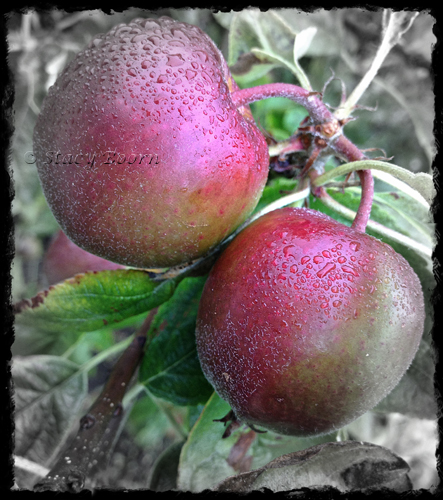
“Within walking distance” is one of my favorite photo challenges.  So this week vines and apples growing in neighbors’ yards caught my eye.

I used a fun and funky program called “Photo Toaster” with these images.  “Photo Toaster” is an iPhone app with a set of templates you apply to your image.

Desaturation of a portion of an image (as with the apples) or selective focus (as with the vines) can draw your attention to the “story” of an image.  Diagonal lines also make for dramatic presentations of even the most ordinary of subjects.

Enjoy!


Posted in Weekly 2 | Comments Off on July Week 2 – Not in my back yard!

July week 1 – Wolves and Waterfalls

When the gray wolf was eradicated from Yellowstone National Park in the 1920s, more was lost than this majestic predator. The park’s entire ecosystem changed. In the mid 1990 some wolves from Canada were introduced to the park and today there are approximately 100. Packs are now located in various parts of the park. Wolves prey on a variety of species, notably elk in the Yellowstone area, but will also pursue sheep, deer, moose, and other animals.

If  you don’t see any wolves or any close enough to fill your frame you might want to visit the Wolf and Bear Center in West Yellowstone.  Open from dawn to dusk the center is home for 8 wolves that live in two different packs. The wolves were born in captivity and are unable to live in the wild. Here, the wolves give visitors an up-close look at their daily activities.

“Wolfers” in Hayden Valley were following the movement of what some were saying was a white wolf.  But as the canine came into my camera view, still a spec, it looked like a huge coyote to me.  When it went out of view, like many other viewers, I jumped into my car to move toward the direction this wolf or coyote was traveling.  The Hayden Valley Pack is the most tolerant of humans so it was possible the wolfers had a sighting.

When I noticed it crossed the street I turned in to the Mud Volcano Trail parking lot and took up my ready stance for a possible sighting. From behind the bathrooms heading up the hill into the woods I was able to get a few frame filling shots at 400mm.  If she is a coyote she is a very big one.  After showing this particular image to a ranger she said, “I would need to see its behavior to say for certain….but probably a coyote.”

The first of July I swung through Yellowstone for one more visit to the park on my return from New York.  From white water rapids at the brink of water falls to white wolves I was blessed with beauty.

If you arrive at Artist Point to view the Grand Canyon of Yellowstone around 9:45 AM the sun will hit the spray of the Lower Falls providing a hint of rainbow colors.  At 400 mm you can isolate just the falls and some of the curvaceous cliffs on each side.  The Yellowstone River thunders more than 308 feet over the Lower Falls.

The multicolored canyon is the product the hydrothermal activity – orange, brown and green.  Also if you look carefully you are likely to see the Osprey soaring among these rugged pinnacles.  Timing and patience (and often a little luck) pay off.

Be sure to view “The Valley of the Wolves.”

Posted in Weekly 2 | Leave a comment

June Week 4 – Teton Sunrise, Sunset

Sunrise at the beginning of summer can be very early.  But if you are in Grand Teton National Park you must get up and out for the first light on the mountains, even if that means leaving your room/tent at 4:30 AM.  Summer isn’t the most likely time of the year to produce clouds needed to bounce the first light around.  Yet you have to go out just in case.  In my case there were only bald skies in the morning.  The reflection is still nice at Oxbow Bend and worth seeing but it won’t be a prize winner.

This site will make you want to return in fall when the aspen are golden at the water’s edge in front of Mt. Moran at Oxbow Bend along the Snake River.  Also the moose might roam in the water seeking vegetation there once they have stripped all the willows throughout the summer months.  In this image I preferred there to be no details in the tree line since that’s how they look before sunshine reaches them. (So I exposed for the Mountain.)

Bear Cub Plays

Both Grizzly and Black bears live all over the Tetons but usually it is the black bears that visitors observe along trails leading to the mountains.  They feed on berries, roots and grasses for most of the summer and fall.  In the spring they may prey on young elk and deer.

One evening sky in the Tetons did produce some color so I chose to focus on the clouds and silhouette the portion of Teton Range that is recognizable from its distinctive shapes.

One could take many different exposures and combine them with High Dynamic Range software and end up with details in the mountains.  But I chose to expose for the sky and let the mountain tips go dark!  This image was captured from the “Teton Point Turnout.”

Nothing rises as glorious as the Tetons
as thrust from the center of the earth heavenwards
its range from edge to edge amorphous
This garment hem of the Goddess is ragged
  as heaven meets the earth
She dances there between the sky and the ground
  each peak a fissiparous splitting of her very soul
the range that has come to be icon of grandeur.
Illuminated clouds above the earthen breasts
dream of each tomorrow waiting
to carry birth waters to lands’ ends.
Nothing rises as glorious as the Tetons 
 
Posted in Weekly 2 | Comments Off on June Week 4 – Teton Sunrise, Sunset